Artist: Bertel Thorvaldsen (1770–1844), after an antique original
Origin: Denmark
Date: first half of the 19th century
Material: marble
Dimensions: height 146 cm
Current Collection: The State Hermitage Museum
Inventory Number: N.sk-1169
Hermitage ID: 50965
Rudanovsky Connection: Entered the Hermitage in 1920 from the collection of A. K. Rudanovsky.
A marble statue of Ceres by Bertel Thorvaldsen, made in Denmark in the first half of the nineteenth century after an antique original.
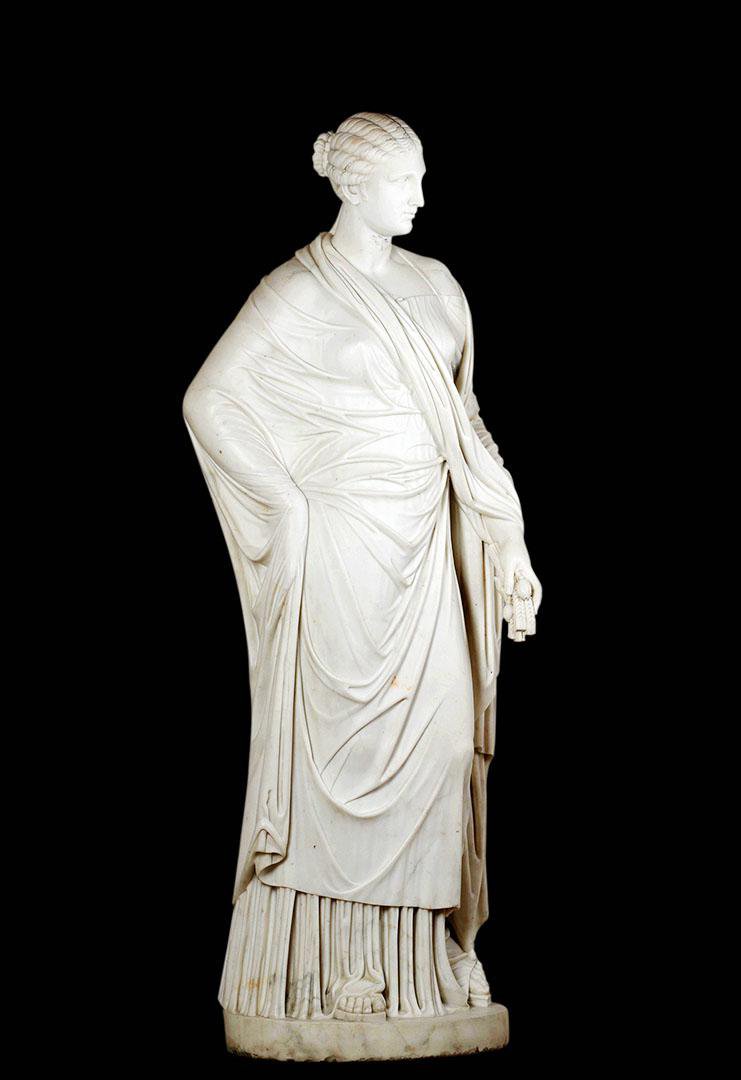
Ceres. The State Hermitage Museum.
The statue entered the Hermitage in 1920 from the collection of A. K. Rudanovsky, through the State Museum Fund. It is on display in the Winter Palace, in room 195.
It is a standing female figure, 146 centimetres high, wrapped in a long cloak, her head turned to the right.
The Object
The figure stands on a low, irregular base.
She wears a long tunic and a mantle, and the mantle is drawn across her body in heavy folds, covering one arm and falling to the ground. Her hair is bound in a knot, and her face is calm and classical.
Her right arm is hidden under the cloak, and her left hand, at her side, holds a small object — perhaps a sheaf or a torch, the attributes of Ceres.
Ceres
Ceres is the Roman goddess of agriculture and grain.
She was the mother of Proserpina, and her myth tells of the loss of her daughter and the search that brought winter to the world. She was worshipped as the protector of the harvest, and she was shown with a sheaf of wheat, a torch or a basket of fruit.
The statue presents her as a calm, matronly figure, wrapped in her mantle: a goddess of the earth, not of the sky.
The Drapery
The drapery is the statue’s great subject.
The cloak is drawn across the body in long, flowing folds, and it covers the figure from the shoulder to the feet. The folds are deep and heavy, and they catch the light.
Drapery was the test of a neoclassical sculptor: it had to be classical in its forms, natural in its fall and expressive in its rhythm. Thorvaldsen was a master of it, and this statue shows his skill.
Thorvaldsen
Bertel Thorvaldsen (1770–1844) was a Danish sculptor.
He worked in Rome for most of his career, and he became the leading sculptor of the neoclassical movement, alongside Canova. His work is characterised by clarity, restraint and a close study of antique sculpture.
He made statues of gods, heroes, saints and princes, and his workshop produced a large number of replicas after his models.
The Antique Model
The statue is after an antique original.
Thorvaldsen often worked from antique models, and he restored and copied classical statues for his patrons. The Ceres type was known from Roman statues, and it was adapted and repeated in the neoclassical period.
The inscription on the base or the record identifies the model, and the statue is a homage to antiquity as much as an original work.
Neoclassicism
The statue belongs to neoclassicism.
Neoclassicism was the dominant style of European art from the mid-eighteenth to the early nineteenth century. It valued clarity, order, simplicity and the imitation of antiquity, and it rejected the excesses of the Baroque.
Thorvaldsen’s Ceres is a perfect example: a calm, balanced figure, with no dramatic gesture and no unnecessary detail.
The Marble
The statue is carved in white marble.
Marble was the material of classical sculpture, and it was used for the finest neoclassical works. It is hard, translucent and capable of a high polish, and it allows the sculptor to model flesh and cloth with great subtlety.
The surface of this statue is smooth and cool, and its whiteness gives the figure a serene, distant quality.
The Display
The statue is displayed in the Winter Palace, in room 195.
It stands among other sculptures, and it is seen in the round, from several angles. Its calm, vertical presence makes it a natural centrepiece for a gallery.
The room and the statue belong together: the neoclassical interior and the neoclassical figure, in a single space.
The Base
The statue stands on a low, irregular base.
It is carved as a piece of ground, with a rough surface, and it supports the figure without a pedestal. The base is part of the statue, and it gives the figure a place to stand.
Bases of this kind are common in neoclassical sculpture: they suggest the earth, and they connect the figure to the ground from which she rises.
The Attributes
Ceres is identified by her attributes.
In her left hand, at her side, she holds a small object — a sheaf of wheat or a torch, the signs of the harvest and of the search for Proserpina. The object is small, and it is partly hidden by the drapery.
Attributes are the language of classical sculpture: they tell the viewer who the figure is, and they connect the statue to its myth.
Thorvaldsen’s Workshop
Thorvaldsen’s workshop was one of the largest in Rome.
It produced statues, busts, reliefs and copies, and it employed a team of assistants who carved the marble from the master’s models. The workshop made replicas of Thorvaldsen’s works for collectors across Europe.
This statue may have been produced in that workshop, after a model by Thorvaldsen, and it belongs to the wide circulation of his art.
The Classical Body
The body is classical.
It is tall, full and calm, with broad shoulders and a long neck, and it follows the proportions of antique sculpture. The face is a classical oval, with a straight nose and a small mouth.
The body is not a portrait: it is an ideal, and it is meant to be seen as such.
The Head
The head is turned to the right.
The face is a classical oval, and the hair is parted and gathered in a knot at the back. The features are regular and calm, and the expression is distant.
The head is the statue’s centre of gravity, and its slight turn gives the figure a direction: she is looking at something beyond the viewer, and her body follows her gaze.
The Room
The statue stands in a room of the Winter Palace.
The room is a neoclassical interior, with columns, mouldings and a light that falls from high windows. The white marble of the statue and the pale walls of the room belong to the same world.
The statue and the room are a single image: the neoclassical figure in the neoclassical interior, in the palace of the emperors.
Provenance
The statue carries the inventory number N.sk-1169 and entered the Hermitage in 1920 from the collection of A. K. Rudanovsky, through the State Museum Fund.
In the Hermitage
The statue is on display in the Winter Palace, in room 195.
It is a fine example of Thorvaldsen’s neoclassicism, and it preserves the image of Ceres — a goddess of the harvest, calm and draped, in white marble.
She has stood in this palace for a century, and she still looks as if she had just stepped out of antiquity, quietly, with a sheaf she no longer quite holds, in a palace built for other gods.