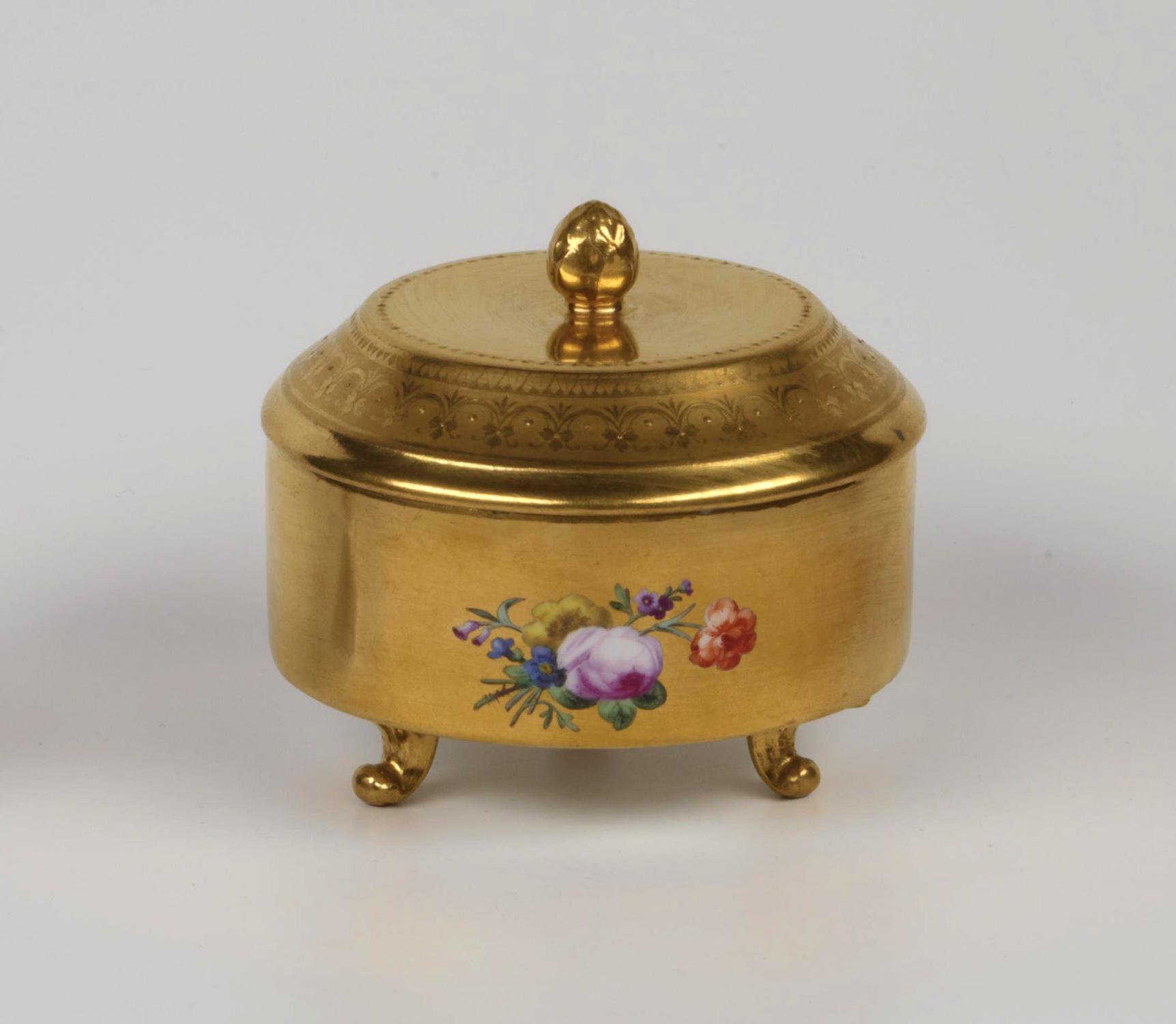
Organization: Imperial Porcelain Manufactory, Vienna
Origin: Austria, Vienna
Date: late 18th – early 19th century
Complex: Breakfast Service (Déjeuner)
Material: porcelain
Technique: gilding, polychrome painting
Dimensions: height with lid 11.7 cm; jug 10.2 cm with handle; body diameter 6.8 cm
Current Collection: The State Hermitage Museum
Inventory Number: ZF-17057
Hermitage ID: 352440
Rudanovsky Connection: Entered the Hermitage in 1919 from the collection of A. K. Rudanovsky.
A gold-ground Viennese porcelain cream jug of the late eighteenth or early nineteenth century, from a breakfast service.
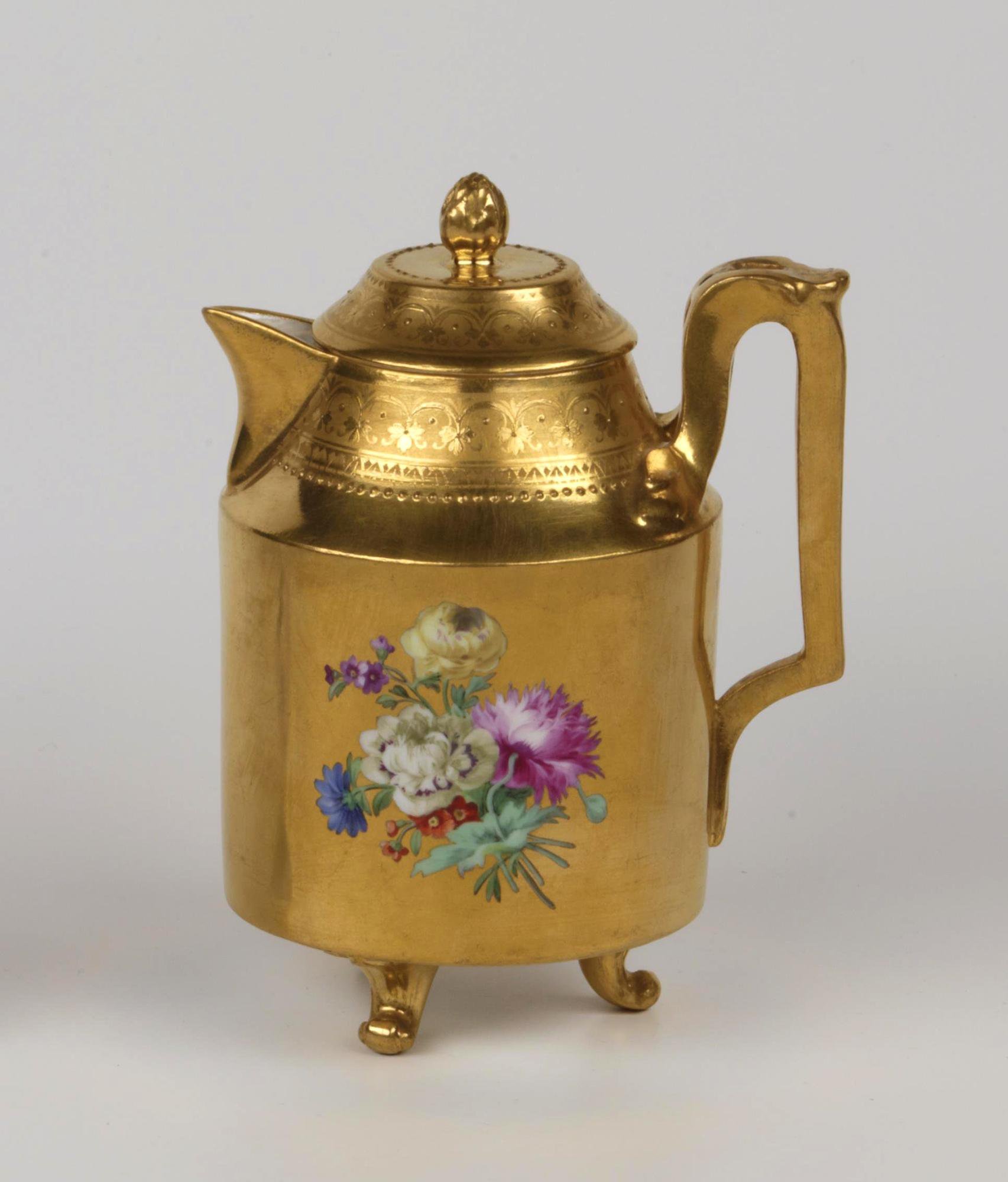
Cream Jug with a Lid. The State Hermitage Museum.
The jug entered the Hermitage in 1919, transferred through the Branch for the Protection of Monuments of Art and Antiquities from the collection of A. K. Rudanovsky. It is not currently on permanent display.
It is a small jug — about twelve centimetres high with its lid — completely gilded, with a bouquet of flowers on the body.
The Object
The jug is cylindrical, with a slightly recessed neck and a spout.
It has a lid with a pointed knop, a large loop handle, and four small feet. The body is gold, with a painted bouquet of flowers — a rose, a white flower, a purple aster and smaller blossoms.
The gold covers the whole surface, and the flowers are painted directly on the gold.
Cream
The jug is a cream jug.
Cream was served with coffee and tea, and the jug was part of the table service: it stood beside the coffee pot, the sugar bowl and the cups. The cream was poured into the cup, and the jug was passed around.
Cream was a luxury in the eighteenth century, and its jug was decorated to match the rest of the service.
The Spout
The spout is the jug’s functional feature.
It is a short, flared lip, set opposite the handle, and it allows the cream to be poured in a thin stream. The spout is gilded, like the rest of the jug.
A jug without a spout would be a pot; with it, it becomes a vessel for pouring.
The Lid
The jug has a lid.
It is a small domed cover, with a pointed knop, and it keeps the cream fresh. The lid is gilded and decorated with a stamped pattern of leaves and dots.
The lid turns the jug into a closed vessel, and it adds a note of ceremony to the object.
The Handle
The handle is a large loop.
It is gilded, with a curved profile, and it is attached to the body with a small scroll. The handle is practical — it allows the jug to be lifted and poured — and decorative.
Its size contrasts with the small body of the jug, and it gives the object its character.
The Feet
The jug stands on four small feet.
They are gilded, like the rest, and they raise the body from the table. The feet give the jug stability and lift, and they are one of the signs of the service’s quality.
Feet of this kind are a feature of Viennese porcelain of the period.
The Gold
The gold is the set’s colour.
It covers the jug, the lid, the handle and the feet, and it gives the object a rich, warm surface. The gold was applied over the glaze, fired and burnished, and it is the most expensive part of the decoration.
A fully gilded service was a display of wealth.
The Bouquet
The bouquet is the jug’s ornament.
It is painted on the body, in soft colours, and it includes a rose, a white flower, a purple aster and smaller blossoms. The flowers stand out against the gold.
The painting is delicate, and it turns a gold surface into a garden.
Vienna
The jug was made in Vienna.
The Imperial Porcelain Manufactory of Vienna was one of the earliest in Europe, and it produced services, figures and decorative objects. In the late eighteenth and early nineteenth centuries, it was known for its rich grounds, its flower painting and its gilding.
The jug belongs to that production.
The Déjeuner
The jug is part of a breakfast service.
The service included a tray, a coffee pot, a sugar bowl and cups and saucers, all decorated with the same gold ground and flower bouquets. The jug is one of its smaller pieces.
A déjeuner was a private service, used for a small meal in a private room.
The Neck
The jug has a recessed neck.
It narrows below the rim, and it is decorated with a band of stamped ornament: leaves, dots and arches. The neck gives the jug its elegant profile, and it separates the body from the lid.
Neck bands of this kind are common in Viennese porcelain, and their stamped patterns were applied with a small tool.
The Pattern
The pattern is stamped, not painted.
It consists of bands of leaves, dots and arches, pressed into the porcelain with a tool while it was still soft. The pattern runs around the neck, the lid and the feet.
Stamped ornament is a technique of the potter: it is quicker than painting, and it gives a crisp, regular decoration.
The Painting
The painting is the jug’s ornament.
The bouquet is painted on the body, in soft colours, and it includes a rose, a white flower, a purple aster and smaller blossoms. The flowers stand out against the gold.
The painting is the work of a specialist, and it is the jug’s chief ornament.
The Collector
The jug came to the Hermitage with the Rudanovsky collection.
Rudanovsky collected European porcelain alongside paintings, drawings, glass and miniatures, and his collection included Viennese services and decorative objects.
The jug is therefore a double document: of Vienna in the late eighteenth century and of a Russian collector’s taste.
The Burning
The gilding was fired in a kiln.
The gold was applied in a liquid medium, then fired at a low temperature, then burnished. The firing fused the gold to the glaze, and the burnishing gave it its shine.
The process was slow and risky: a mistake in the firing could ruin the whole surface.
The Breakfast
The jug belongs to a breakfast.
A déjeuner was served in the morning, in a private room, and it was a small, intimate meal: coffee, cream, sugar, bread and fruit. The jug was part of the ritual.
The object is therefore not only a vessel but a piece of a morning: a small ceremony, repeated every day.
The Knop
The knop is the lid’s handle.
It is a small, pointed cone, gilded like the rest, and it is the point where the lid is lifted. Its shape is simple and elegant, and it gives the lid its finish.
Knops of this kind were modelled separately and applied before firing.
Provenance
The jug carries the inventory number ZF-17057. It entered the Hermitage in 1919, transferred through the Branch for the Protection of Monuments of Art and Antiquities from the collection of A. K. Rudanovsky.
In the Hermitage
The jug is preserved in the State Hermitage Museum in Saint Petersburg and is not on permanent display.
It is a small, rich object, and it preserves a moment of the Viennese table: a gold jug, a bouquet of flowers and a spoonful of cream.