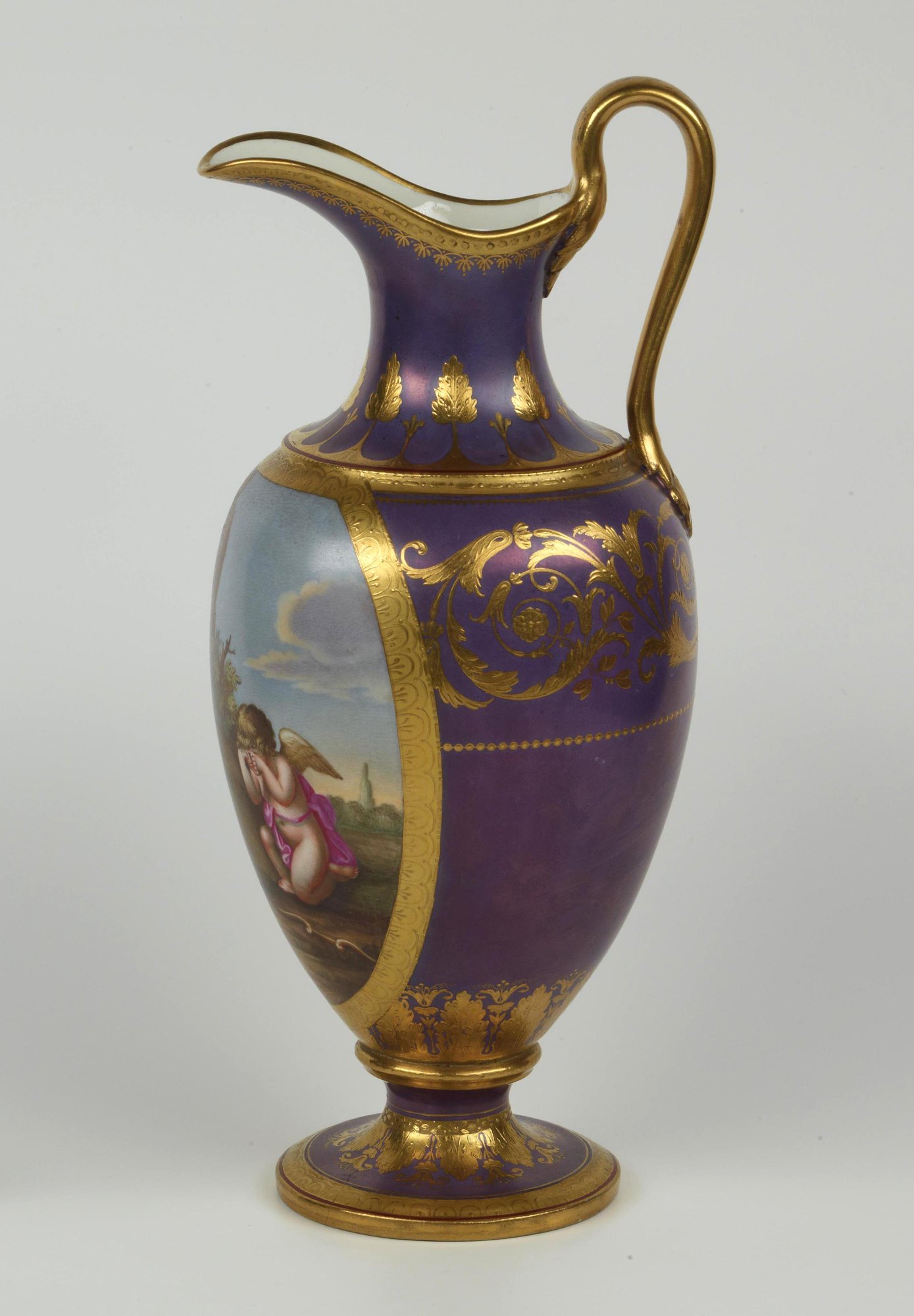
Organization: Imperial Porcelain Manufactory, Vienna
Origin: Austria, Vienna
Date: mid-19th century
Material: porcelain
Technique: polychrome painting, gilding
Dimensions: cup 6 cm high, 8 cm diameter; saucer 13.5 cm diameter
Current Collection: The State Hermitage Museum
Inventory Number: ZF-17080
Hermitage ID: 352443
Rudanovsky Connection: Entered the Hermitage in 1919 from the collection of A. K. Rudanovsky.
A Viennese porcelain cup and saucer of the mid-nineteenth century, green and gold, with an inscription on the saucer.
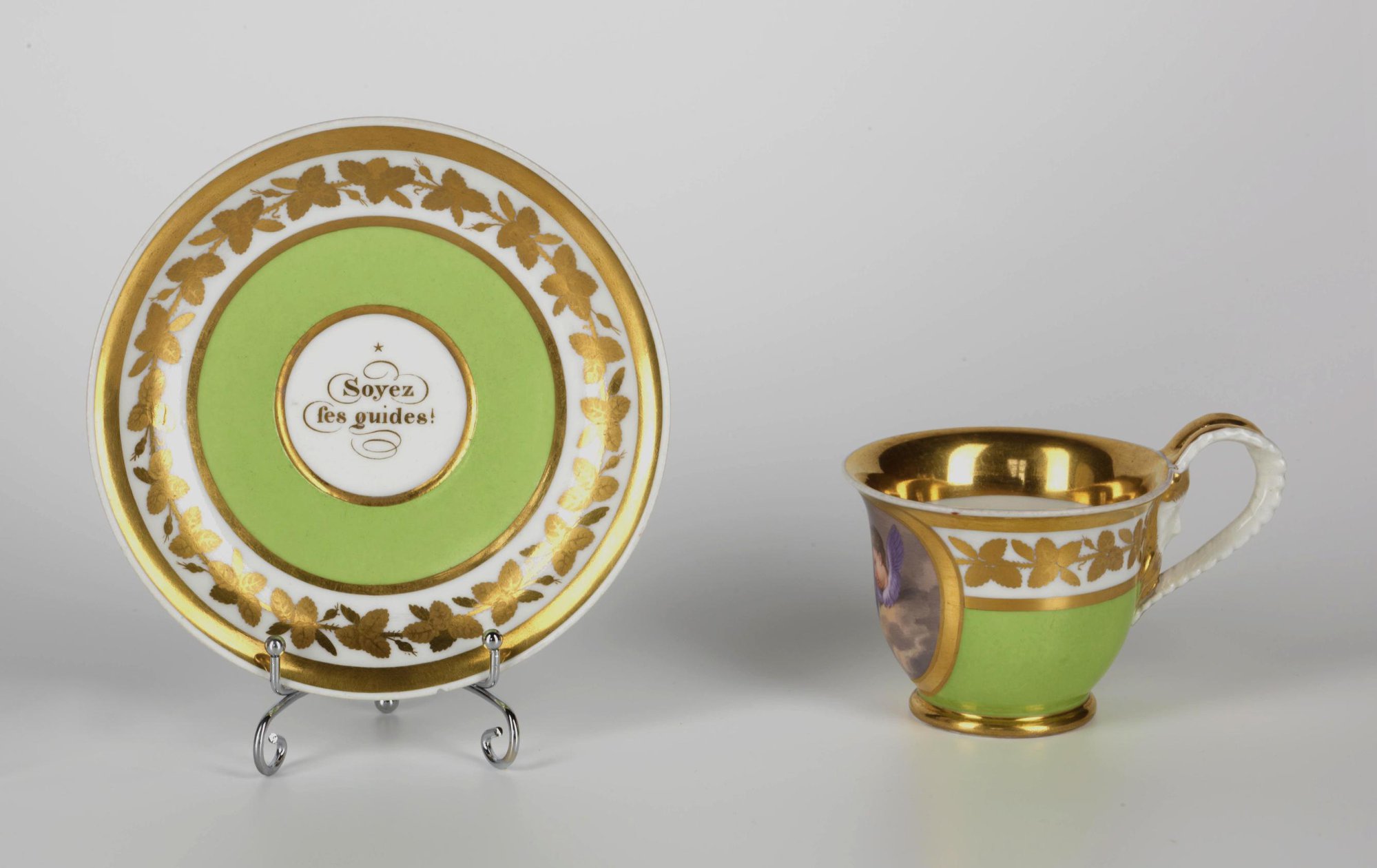
Cup and Saucer (ZF-17080). The State Hermitage Museum.
The cup entered the Hermitage in 1919, transferred through the Branch for the Protection of Monuments of Art and Antiquities from the collection of A. K. Rudanovsky. It is not currently on permanent display.
It is a cup and saucer with a green ground, a border of gold ivy and an inscription in the centre of the saucer.
The Object
The cup has a rounded body, a gilt interior and a loop handle.
Its ground is a soft apple green, and it is framed by bands of gold ivy leaves and a white border. On the side, a small medallion contains a painted portrait.
The saucer is green, with the same gold ivy border, and in its centre a white medallion carries an inscription: Soyez les guides!
The Green
The green is the set’s colour.
It is a soft, slightly yellow green, and it covers the cup and the saucer. The green is painted over the glaze and fired, and it gives the porcelain a fresh, spring-like quality.
Green was a fashionable colour in the nineteenth century, and it was used for services that were meant to look light and cheerful.
The Gold Ivy
The border is a wreath of gold ivy.
The leaves are painted in gold, and they run around the rim of the cup and the saucer in a continuous band. The ivy is a classical motif, and it symbolises fidelity and eternal life.
The gold ivy frames the green ground and gives the set its richness.
The Inscription
The inscription is the saucer’s most unusual feature.
Soyez les guides! — «Be the guides!» — is painted in gold letters in the centre of the saucer, with a star above it and a ribbon below. It is a motto, a dedication or a message.
The phrase suggests a gift: a cup and saucer given to someone with a wish that they might lead or guide. It turns the object into a personal token.
The Portrait
A small medallion on the cup contains a portrait.
It is painted in soft colours, and it shows a face or a figure, framed by a gold ring. The medallion is small, and it is the cup’s only figurative element.
Portraits on cups were common in the nineteenth century: they turned a service into a personal or commemorative object.
The Cup
The cup is small and rounded.
It holds six centimetres of liquid, and it is designed for coffee or tea. Its interior is gilded, which is unusual: the gold gives the cup a luxurious look, and it hides the colour of the drink.
The gilt interior is a sign of the cup’s quality, and it marks it as an object for a special occasion.
Vienna
The set was made in Vienna.
The Imperial Porcelain Manufactory of Vienna was one of the earliest in Europe, and it produced services, figures and decorative objects. In the nineteenth century, it continued to make high-quality porcelain for the court and the nobility.
The set belongs to that production, and it shows the Viennese taste for colour and gilding.
The Gift
The set was probably a gift.
The inscription, the portrait and the luxury of the gold suggest that it was made for a specific person and a specific occasion. It may have been a present for a wedding, a birthday or a farewell.
Objects of this kind are personal documents: they record a relationship as well as a style.
The Saucer
The saucer is round and wide.
It is 13.5 centimetres across, and it carries the cup and the inscription. Its green ground and gold ivy border repeat the cup’s decoration, so that the two objects read as a set.
The saucer is the cup’s stage: it frames the cup and holds the message.
The Gilding
The gilding is generous.
It covers the interior of the cup, the ivy border, the rim of the saucer and the inscription. It was applied over the glaze, fired and burnished, and it is the most expensive part of the decoration.
A gilt interior is unusual, and it marks the cup as a luxury object.
The Star
A small star is painted above the inscription.
It is a gold star with five points, and it sits in the white medallion of the saucer. The star is a symbol of guidance, and it echoes the words Soyez les guides!
The image and the text belong together: the star leads, and the words ask the recipient to lead.
The Table
The set was made for a table.
It stood among other cups and saucers, and it was used for coffee or tea. Its green and gold would have caught the candlelight, and its inscription would have been read by the guests.
That table is gone, but the set still carries its message.
The Collector
The set came to the Hermitage with the Rudanovsky collection.
Rudanovsky collected European porcelain alongside paintings, drawings, glass and miniatures, and his collection included Viennese services and decorative objects.
The set is therefore a double document: of Vienna in the nineteenth century and of a Russian collector’s taste.
The Ivy’s Meaning
Ivy is not a neutral ornament.
In classical and Christian symbolism, ivy stands for fidelity, friendship and eternal life, because it is evergreen and clings to what it grows on. A wreath of ivy was a gift of loyalty and affection.
The border on this cup is therefore more than decoration: it reinforces the message of the inscription, and it turns the set into a token of constancy.
The French
The inscription is in French.
French was the language of the European aristocracy in the nineteenth century, and a motto in French was a mark of education and elegance. The Viennese factory used it for objects meant for a courtly or diplomatic public.
The set speaks, therefore, in two languages: the German of its makers and the French of its owners.
Provenance
The set carries the inventory number ZF-17080. It entered the Hermitage in 1919, transferred through the Branch for the Protection of Monuments of Art and Antiquities from the collection of A. K. Rudanovsky.
In the Hermitage
The set is preserved in the State Hermitage Museum in Saint Petersburg and is not on permanent display.
It is a small, personal object, and it preserves a message: a green cup, a gold ivy and four words in French, painted on a saucer a century and a half ago.
It is a small object with a large message, and it has carried that message, in gold on green, for more than a century and a half.
A cup, a saucer, a wish: it is enough.
And it is still asking, in French, politely, from a shelf. It has not had an answer yet.