Organization: Imperial Porcelain Manufactory, Vienna
Origin: Austria, Vienna
Date: first quarter of the 19th century
Material: porcelain
Technique: polychrome painting, gilding
Dimensions: height 27.3 cm; diameter 11.9 cm
Current Collection: The State Hermitage Museum
Inventory Number: ZF-17098
Hermitage ID: 352451
Rudanovsky Connection: Entered the Hermitage in 1919 from the collection of A. K. Rudanovsky.
A tall Viennese porcelain jug of the first quarter of the nineteenth century, the pair to another jug in the same collection.
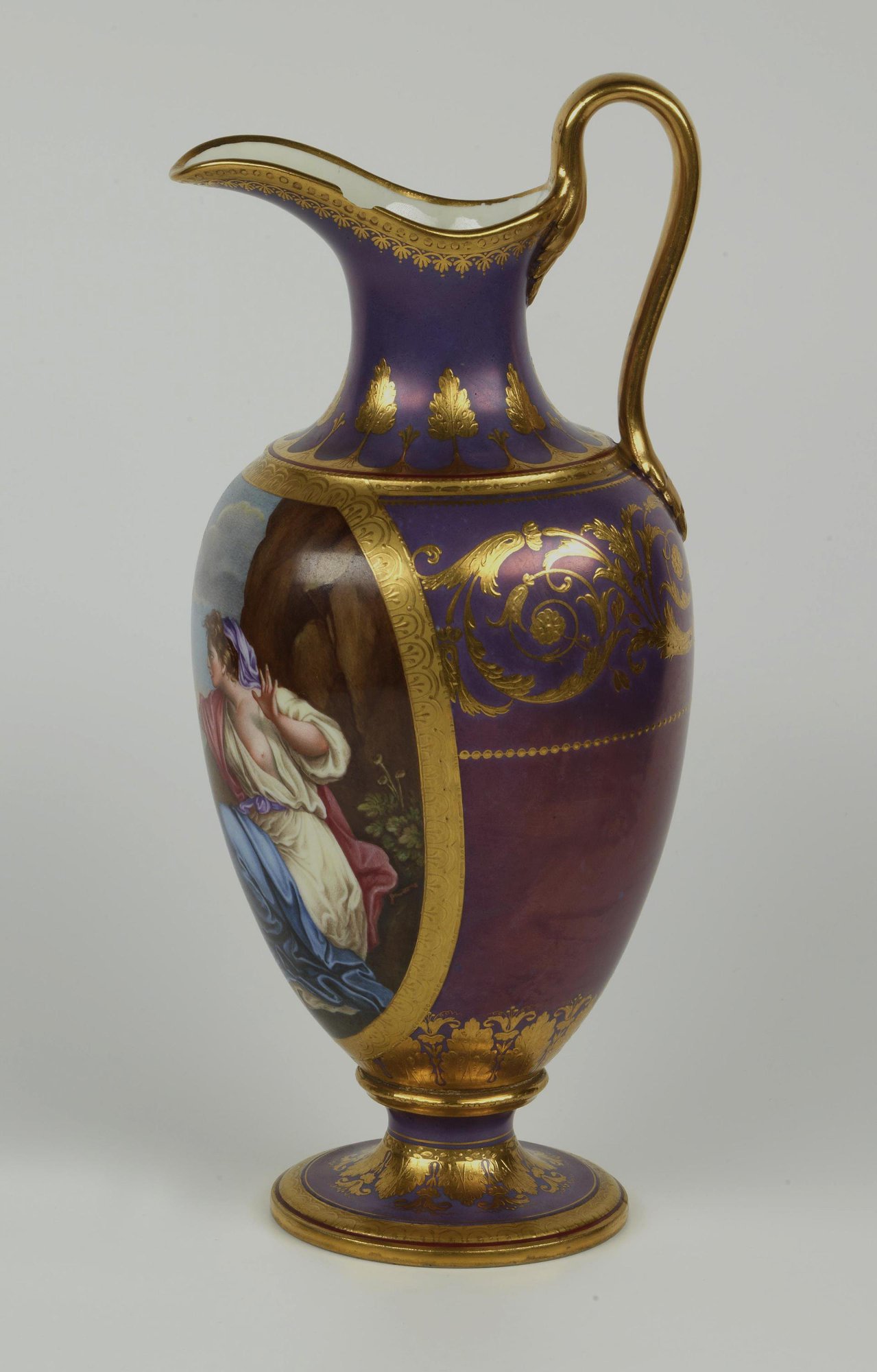
Jug (ZF-17098). The State Hermitage Museum.
The jug entered the Hermitage in 1919, transferred through the Branch for the Protection of Monuments of Art and Antiquities from the collection of A. K. Rudanovsky. It is not currently on permanent display.
It is a tall jug — 27.3 centimetres high — with a purple ground, gold ornament and a painted scene of a woman in a landscape.
The Object
The jug has an ovoid body, a narrow neck and a flared lip.
Its ground is a deep violet-purple, and it is covered with gold ornament: leaves at the neck, scrolls on the body, a band of flowers at the foot. On the front, a gold-framed cartouche contains a painted scene.
The handle is a high gilt loop, and the jug stands on a moulded foot.
The Pair
The jug is the pair of another in the collection, ZF-17097.
The two are the same size and shape, with the same purple ground and gold ornament. They differ in their cartouches: one shows a kneeling putto, the other a standing woman.
Together, they form a pair of vases or jugs, made to be displayed together, and their subjects are complementary.
The Cartouche
The cartouche is a gold-framed panel.
It is shaped like a shield or a scroll, and it contains the painted scene. The frame is wide, decorated with a scroll pattern, and it separates the picture from the purple ground.
Cartouches are a common device in Empire porcelain: they frame a scene and turn a vessel into a painting.
The Woman
The scene shows a woman.
She stands in a landscape, her body turned, her head lifted, and she wears a white dress with a red cloak and a blue skirt. Her hair is bound with a purple ribbon.
Her pose is classical, and her gesture — one hand raised to her head — suggests surprise, fear or revelation.
The Purple
The purple is the jug’s colour.
It is a deep, slightly blue violet, applied over the glaze and polished. The colour is rich and dark, and it makes the gold ornament stand out.
Purple was a fashionable colour in the Empire period, and it was used for the most luxurious objects.
The Gold
The gold covers the jug’s ornament.
It is painted in leaves, scrolls and bands, and it is fired and burnished. The gold gives the purple ground its richness and its texture.
Gold of this kind is the most expensive part of the decoration, and it is the first to wear.
The Handle
The handle is a high loop.
It rises from the shoulder and curves down to the body, and it is gilded. Its shape is elegant and functional, and it allows the jug to be lifted and poured.
Handles of this kind are a feature of Empire jugs, and they give the object its vertical movement.
Vienna
The jug was made in Vienna.
The Imperial Porcelain Manufactory of Vienna was one of the earliest in Europe, and it produced services, figures and decorative objects. In the early nineteenth century, it was known for its rich grounds, its gilding and its painted cartouches.
The jug belongs to that production, and it shows the Viennese taste for colour and ornament.
The Empire
The jug belongs to the Empire style.
The Empire style was the official style of the Napoleonic period, and it was characterised by classical forms, strong colours, gold and military motifs. It was a style of power and display.
The jug is a good example: a classical form, a purple ground, gold ornament and a painted scene.
The Scene
The scene is a small painting.
A woman stands in a rocky landscape, with a dark cliff behind her and a pale sky above. Her gesture and her pose suggest a story, but the jug gives no attribute to identify it.
Scenes of this kind are a favourite of Empire porcelain: a single figure, a landscape and a moment of drama, painted on a vase.
The Gold Frame
The cartouche is framed in gold.
The frame is wide, with a scroll pattern, and it has a raised edge. It separates the painted scene from the purple ground, and it turns the jug into a framed picture.
Frames of this kind are a feature of Empire porcelain: they are painted, but they look as if they were carved.
The Wear
The jug is worn.
The gold is rubbed on the handle and the rim, and there are small scratches on the purple ground. The painting is still legible, but the object shows its age.
The wear is a sign of use and of time, and it is part of the jug’s history.
The Collector
The jug came to the Hermitage with the Rudanovsky collection.
Rudanovsky collected European porcelain alongside paintings, drawings, glass and miniatures, and his collection included Viennese services and decorative objects.
The jug is therefore a double document: of Vienna in the early nineteenth century and of a Russian collector’s taste.
The Neck
The neck of the jug is slender.
It rises from the shoulder and flares into a wide lip, and it is decorated with a band of gold leaves. The neck gives the jug its elegance, and it makes the object look taller.
A slender neck is a classical proportion: it balances the broad body and gives the jug its grace.
The Foot
The jug stands on a moulded foot.
It is gilded, with a band of gold leaves, and it raises the body from the table. The foot gives the jug stability and lift, and it is one of the signs of the object’s quality.
Feet of this kind are common in Viennese porcelain of the period.
The Two Jugs
The two jugs are a pair.
They share a shape, a size and a ground, and they were probably made to stand together, on a sideboard or a console. Their cartouches show different figures, one male and one female, and their scenes complement each other.
A pair of objects is more than two single ones: it is a composition, and it was designed as such.
Provenance
The jug carries the inventory number ZF-17098. It entered the Hermitage in 1919, transferred through the Branch for the Protection of Monuments of Art and Antiquities from the collection of A. K. Rudanovsky.
In the Hermitage
The jug is preserved in the State Hermitage Museum in Saint Petersburg and is not on permanent display.
It is a fine example of Viennese porcelain, and it preserves a small scene: a purple jug, a gold frame and a woman who stands in a landscape, looking at something we cannot see.
It is a jug, and it has a twin, and together they make a room look as if someone had just left it.