Artist: Circle of Pieter Mulier II (Cavalier Pietro Tempesta, 1637–1701)
School: Genoese
Origin: Italy
Date: 17th century
Material: canvas
Technique: oil
Dimensions: 73 × 125 cm
Current Collection: The State Hermitage Museum
Inventory Number: GE-7247
Hermitage ID: 31610
Rudanovsky Connection: Entered the Hermitage in 1933 from the collection of A. K. Rudanovsky.
A moonlit landscape from the circle of Pieter Mulier II, known as Cavalier Pietro Tempesta, painted in Italy.
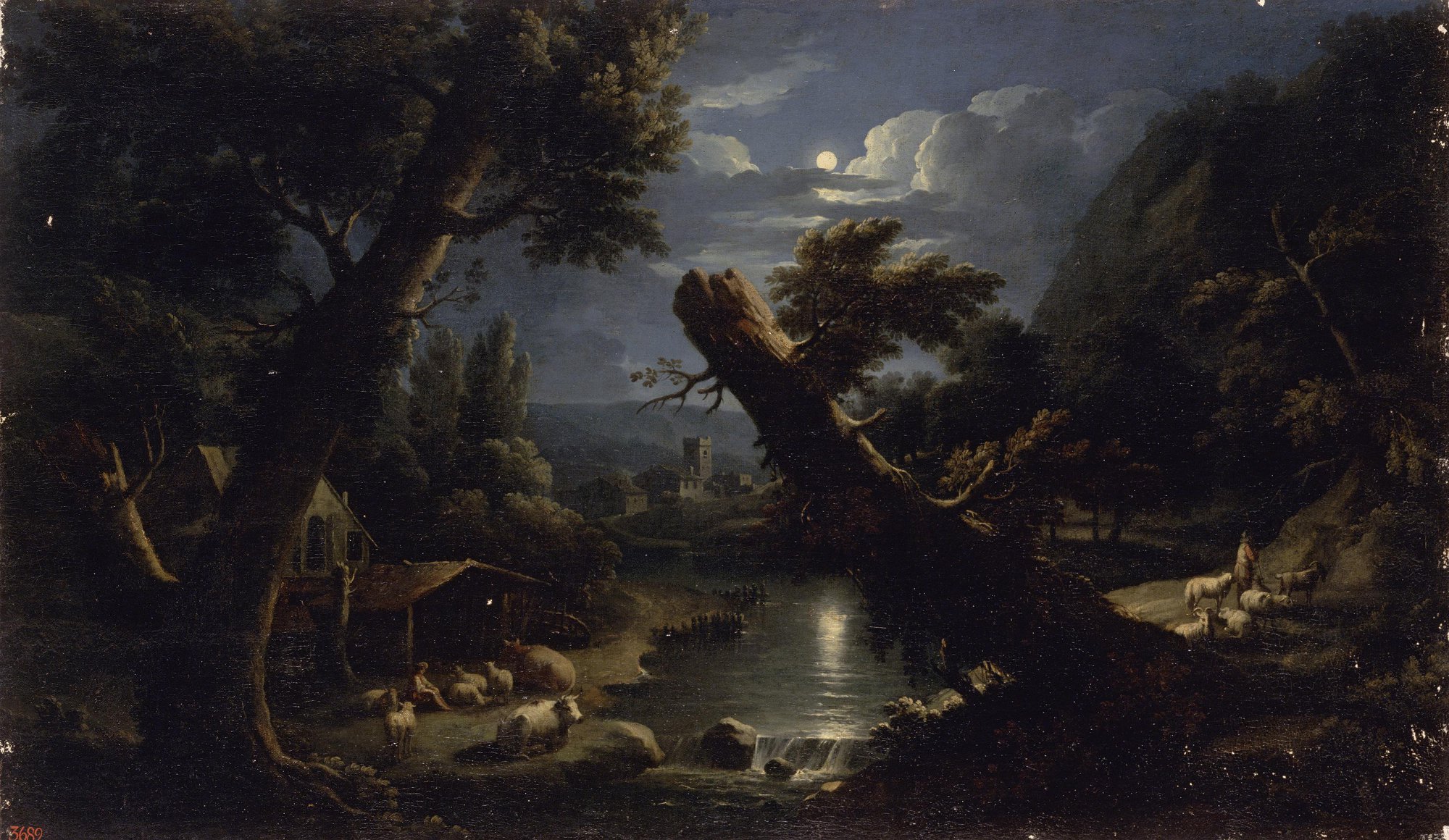
Moon Landscape (GE-7247). The State Hermitage Museum.
The painting entered the Hermitage in 1933, handed over by the Antikvariat All-Union Association, and it was originally in the collection of A. K. Rudanovsky. At a later date it was in the Constantine Palace at Strelna, near St Petersburg. It is not currently on permanent display.
It is a large moonlit landscape — 73 by 125 centimetres — with a river, a broken tree, cattle and a distant castle.
The Object
The painting shows a valley at night.
The moon hangs in a bank of clouds, and its light falls on the water. A river runs through the centre, with a small waterfall at the bottom, and a broken tree leans over it.
At the left, a house and a shed, with cattle and shepherds resting. At the right, a flock of sheep on a slope. In the distance, a castle or a tower.
The Moon
The moon is the painting’s source of light.
It is a pale disc, partly covered by clouds, and its light spreads across the sky and the water. The reflection on the river is a long, broken column of light.
The moon is also the painting’s subject: a night landscape is a study of light, and the moon is its lamp.
The Broken Tree
A broken tree dominates the centre.
Its trunk is split, and its branches are bare, and it leans across the river like an arch. It is painted in dark browns, and its silhouette stands out against the moonlit water.
Broken trees are a favourite motif of seventeenth-century landscape: they suggest the passage of time, and they give the scene its drama.
The Cattle
Cattle and shepherds rest at the left.
A cow lies on the ground, and a shepherd sits beside a shed. Sheep stand around them.
The animals give the landscape its life, and they turn a night scene into a pastoral: a quiet world, at rest.
The Castle
A castle or a tower stands in the distance.
It is pale and small, and it rises above the trees. Its shape is simple, and it gives the scene a focus.
Castles and towers are a common element in landscapes of the period: they suggest history, and they give the view a destination.
The Water
The river runs through the painting.
It is painted in dark greys and silvers, and it catches the moonlight. A small waterfall falls at the bottom, and its white foam catches the light.
Water is the painting’s mirror: it reflects the moon, and it gives the scene its depth.
Mulier
Pieter Mulier II (1637–1701) was a Dutch painter known as Cavalier Pietro Tempesta.
He worked in Italy, in Genoa and Rome, and he specialised in landscapes with storms, mountains and moonlight. His work is characterised by dramatic light and wild nature.
The painting is from his circle: it follows his manner, but it may be by a follower or a pupil.
The Genoese School
The painting belongs to the Genoese school.
Genoa was a centre of landscape painting in the seventeenth century, and its painters specialised in rugged landscapes, harbours and storms. Mulier was one of its most important figures.
The painting is a good example of that school: a wild landscape, a dramatic light and a mood of melancholy.
The House
A house stands at the left.
It is small and dark, with a shed beside it, and it is half hidden by trees. Its roof and its windows are painted with a few strokes.
The house gives the landscape its human centre, and it suggests a life of work and rest.
The Sheep
A flock of sheep stands at the right.
They are pale against the dark slope, and a shepherd stands among them. Their stillness is part of the painting’s peace.
Sheep are a pastoral motif, and their presence turns the night scene into a quiet, inhabited world.
The Clouds
The clouds are heavy and pale.
They roll across the sky and partly cover the moon, and their edges catch its light. They give the sky its depth and its movement.
Clouds of this kind are a test of a landscape painter’s skill: they must be soft and solid at once.
The Light
The light is the painting’s subject.
It comes from the moon, and it falls on the water, the broken tree and the road. The shadows are deep, and the highlights are small and precise.
A night landscape is a study of light, and this one is a good example: the darkness is varied and legible.
The Palette
The palette is restricted.
Blues, greys, silvers, browns and dark greens: the colours of night, applied in thin layers. There is almost no red, and the warm tones are limited to the earth and the animals.
This restriction is what makes the moonlight convincing.
The Road
A road runs along the right side.
It is pale, and it leads from the foreground to the distance, past the sheep and the castle. It gives the landscape its movement, and it invites the eye to travel.
Roads of this kind are a device of landscape painting: they lead the viewer into the scene.
The Silhouette
The painting is built on silhouettes.
The trees, the house, the broken trunk and the castle are all dark shapes against the lighter sky and water, and they give the scene its structure.
Silhouettes of this kind are a feature of night landscapes: at night, form is more legible than colour.
The Frame
The painting was probably framed when new.
It is a large canvas, and it would have hung in a gallery or a drawing room. Its dark tones were designed for a candlelit interior.
The frame is lost or replaced, but the painting still carries the scale of the room for which it was made.
The Mood
The painting is melancholy.
The moon, the broken tree, the sleeping cattle and the distant castle all speak of quiet and of time passing. There is no drama in the scene: only light and silence.
That mood is the painting’s purpose, and it is what makes it a work of art rather than a record of a place.
Provenance
The painting carries the inventory number GE-7247. It entered the Hermitage in 1933, handed over by the Antikvariat All-Union Association, and it was originally in the collection of A. K. Rudanovsky. At a later date it was in the Constantine Palace at Strelna.
In the Hermitage
The painting is preserved in the State Hermitage Museum in Saint Petersburg and is not on permanent display.
It is a quiet, atmospheric image, and it closes this collection as it began: with a room, a light and a story — a moon, a river and a world at rest.
It is a night piece, and it has outlasted the night it describes.