Artist: Jean-Jacques Pierre le jeune (painter)
Organization: Sèvres Porcelain Manufactory
Origin: France
Date: 1788
Complex: Blue Service
Material: soft-paste porcelain
Dimensions: diameter 24.2 cm
Current Collection: The State Hermitage Museum
Inventory Number: ZF-16276
Hermitage ID: 352376
Rudanovsky Connection: Entered the Hermitage in 1919 from the collection of A. K. Rudanovsky.
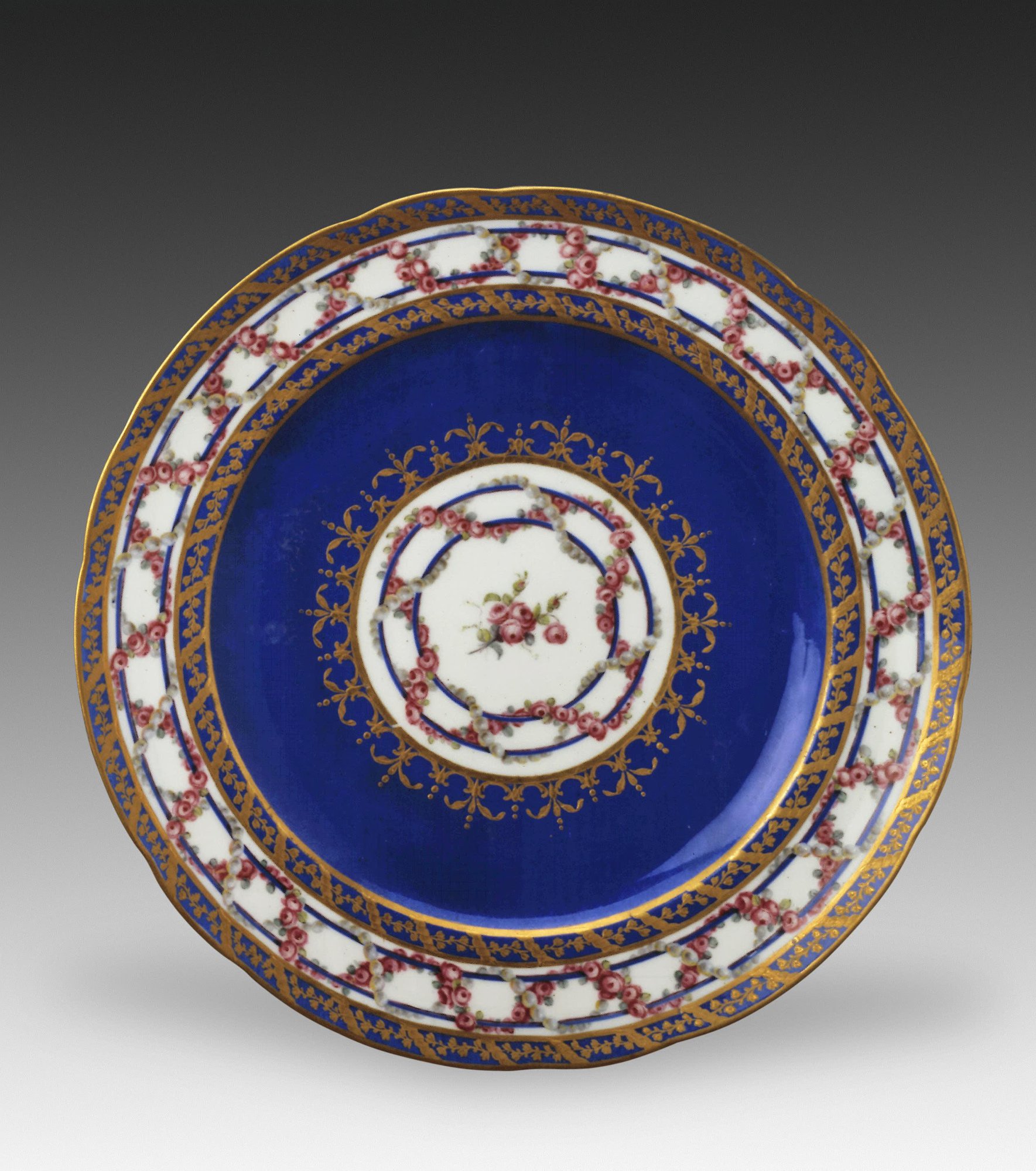
A Sèvres plate of 1788 from the «Blue Service», its rim ringed with roses and its centre a blue field around a white medallion.
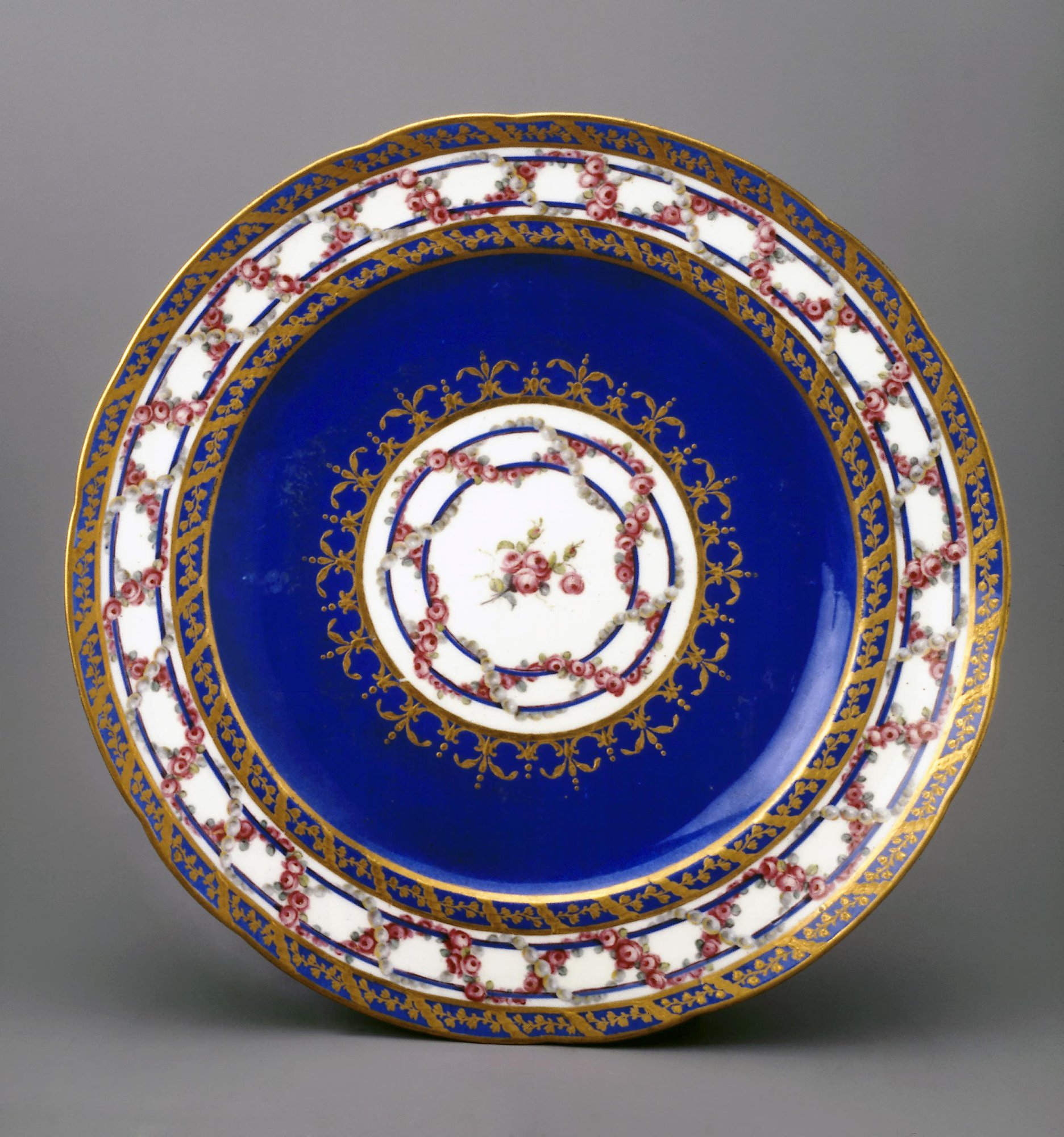
Plate, Blue Service (ZF-16276). The State Hermitage Museum.
The plate entered the Hermitage in 1919 from the collection of A. K. Rudanovsky. It is not currently on permanent display.
It is a round plate, 24.2 centimetres across, with a shaped rim, a deep blue field and a central medallion of roses.
The Object
The plate is circular, with a scalloped edge and a shallow well.
The rim is white, with a continuous garland of roses framed by blue lines and gold bands. The well is deep cobalt blue, with a gold ring of scrolls around the central medallion, and the medallion is white, with a circle of roses and a single rose at the centre.
The edge is gilded, and the underside is white.
The Plate
A plate is the most ordinary object of the table.
It is also the most demanding: it must be flat, even, and strong enough to survive use. A large plate like this one — 24.2 centimetres — is a dinner plate, and it was made for the main course or the dessert.
Its size and its decoration place it among the grandest plates of the service.
The Rim
The rim is the plate’s frame.
It is white, with a garland of roses, and it is framed by blue lines and gold. The garland runs continuously around the edge, and it is interrupted only by the scallops of the rim.
The rim is also where the plate is handled, and the gold is worn in places — a trace of use.
The Centre
The centre of the plate is a white medallion.
It is framed by a gold ring of scrolls, and it contains a circle of roses with a single rose at the middle. The roses are painted in pinks and greens, and they form a delicate, symmetrical composition.
The medallion is the plate’s focal point, and it is where the painter’s hand is most visible.
The Gold
The gold on the plate is applied in several ways.
It forms the edge of the rim, the lines that frame the garland, and the ring of scrolls around the medallion. It is fired and burnished, and it shines against the blue and white.
Gold is the most fragile part of the decoration, and it wears first where the object is touched.
Pierre
The plate is attributed to Jean-Jacques Pierre le jeune, a painter at Sèvres.
Pierre was active at the factory in the 1770s and 1780s, and his work is characterised by fine flower painting and careful composition. His mark on the underside identified the piece.
The attribution connects the object to a named hand, and it allows the decoration to be placed within the production of the service.
Sèvres in 1788
The plate was made in 1788, at the height of the Sèvres production.
The factory was a royal manufactory, and it supplied the court and the aristocracy with services of extraordinary quality. Its painters, gilders and modellers worked together to produce objects in which every detail was coordinated.
The plate belongs to that production: a large, precise object, painted with care and designed for a grand table.
The Blue Service
The plate belongs to the Blue Service of 1788.
The service included cups, plates, trays, bowls and compotiers, all decorated with the same blue ground, white borders and rose garlands. Plates of this size were the backbone of the service: they were made in dozens, and they were used at every course.
The service was a luxury commission, and it would have been used for dessert and dinner.
The Table
The plate was made for a table.
It stood beside other plates of the same service, and it carried the food of a formal dinner. Its blue and gold would have caught the candlelight, and its roses would have repeated across the table like a pattern.
That table is gone, but the plate still carries its logic: a surface for food, framed by a garden of roses.
The Pair
The plate has a companion in the collection, ZF-16277, painted by another hand.
The two are the same size, the same shape and the same decoration, and they were made in the same year. Taken together, they show how the service worked: a fixed model, a shared pattern and individual hands.
Repetition was the principle of the service, and variation was its life.
The Blue Field
The blue field is the plate’s depth.
It is a broad band of cobalt between the rim and the gold ring, and it gives the plate its richness. The colour is applied as a ground, fired and polished, and it is slightly uneven, as hand-applied grounds always are.
The blue makes the white rim and the central medallion appear to float.
The Scallops
The rim of the plate is scalloped.
The scallops follow the circle of the plate and give it a slightly wavy outline, which catches the light and softens the geometry. Each scallop is edged with gold.
Scalloped rims were common in Sèvres plates of the period, and they were one of the ways in which a flat object could be given a sculptural edge.
The Foot
The plate stands on a small foot ring.
It is white and unglazed on the underside, and it raises the plate slightly from the table. The foot ring is a technical necessity — it prevents the plate from rocking — and it is also a sign of careful manufacture.
On the underside, the factory’s marks would have been painted: the interlaced Ls, the date letter and the painter’s mark.
The Collector
The plate came to the Hermitage with the Rudanovsky collection.
Rudanovsky collected Sèvres porcelain alongside paintings, drawings, glass and miniatures, and the Blue Service is one of the most important groups in his collection.
The plate is therefore a double document: of the Sèvres factory in 1788 and of a nineteenth-century Russian collector’s taste.
The Underside
The underside of the plate is white and unglazed at the foot ring.
It carries the factory’s marks: the interlaced Ls of Sèvres, the date letter and the painter’s mark. These small signs are the plate’s identity card, and they allow it to be dated and attributed.
Without them, the plate would be a beautiful object; with them, it is a document of the factory’s production.
Provenance
The plate carries the inventory number ZF-16276 and entered the Hermitage in 1919 from the collection of A. K. Rudanovsky.
In the Hermitage
The plate is preserved in the State Hermitage Museum in Saint Petersburg and is not on permanent display.
It is a fine example of the Blue Service, and it shows how a plate could be turned into a small painting — blue, white, gold and roses, arranged around a single flower, and made to be used at a grand table.