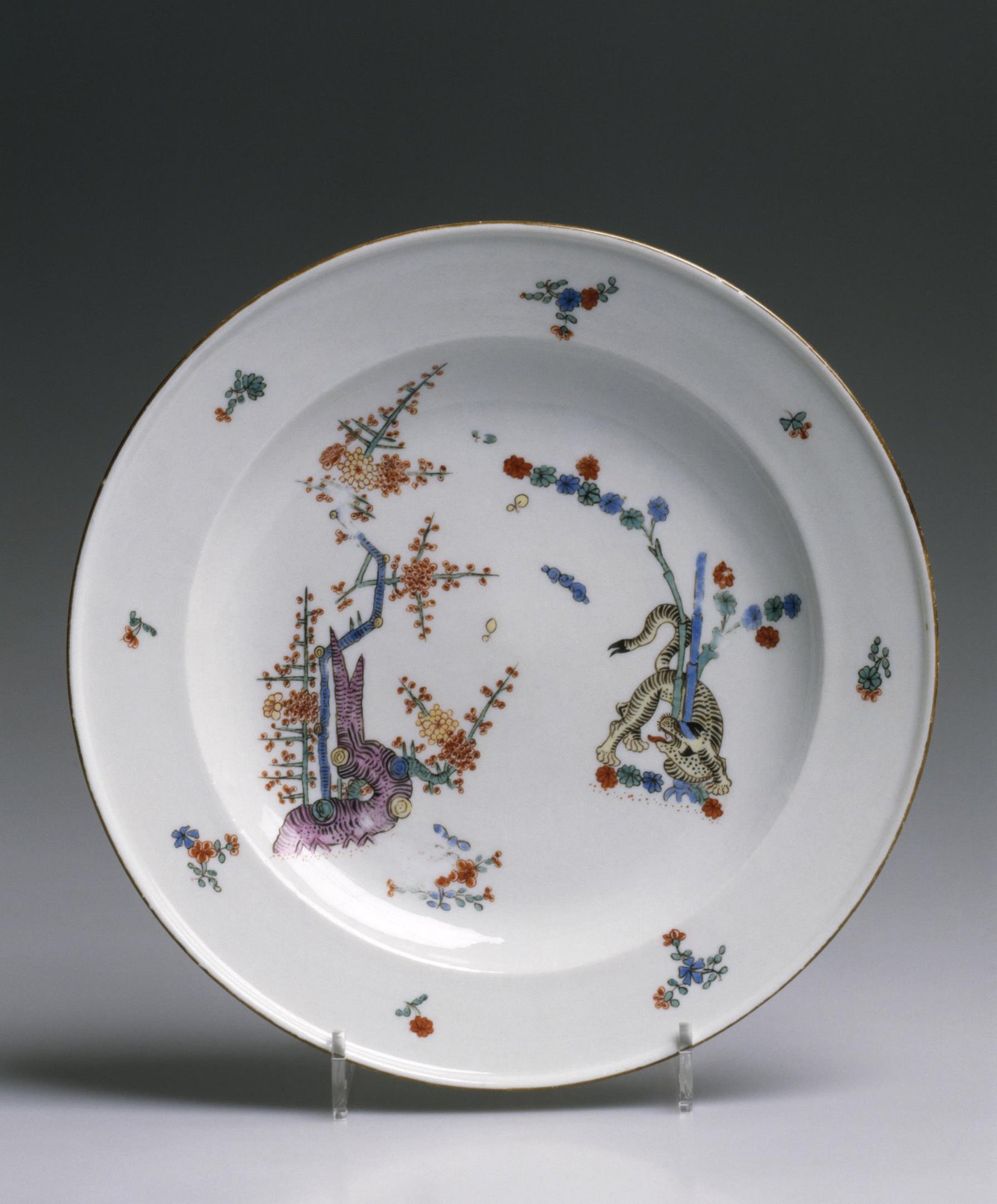
Organization: Meissen Porcelain Manufactory
School: Meissen
Origin: Germany
Date: circa 1730
Complex: Service with a Yellow Lion
Material: porcelain
Technique: overglaze painting with gilding
Dimensions: diameter 21.7 cm
Current Collection: The State Hermitage Museum
Inventory Number: ZF-16753
Hermitage ID: 354342
Rudanovsky Connection: Entered the Hermitage in 1919 from the collection of A. K. Rudanovsky.
A Meissen plate of about 1730 from the «Yellow Lion» service, painted with a tiger and a dragon.
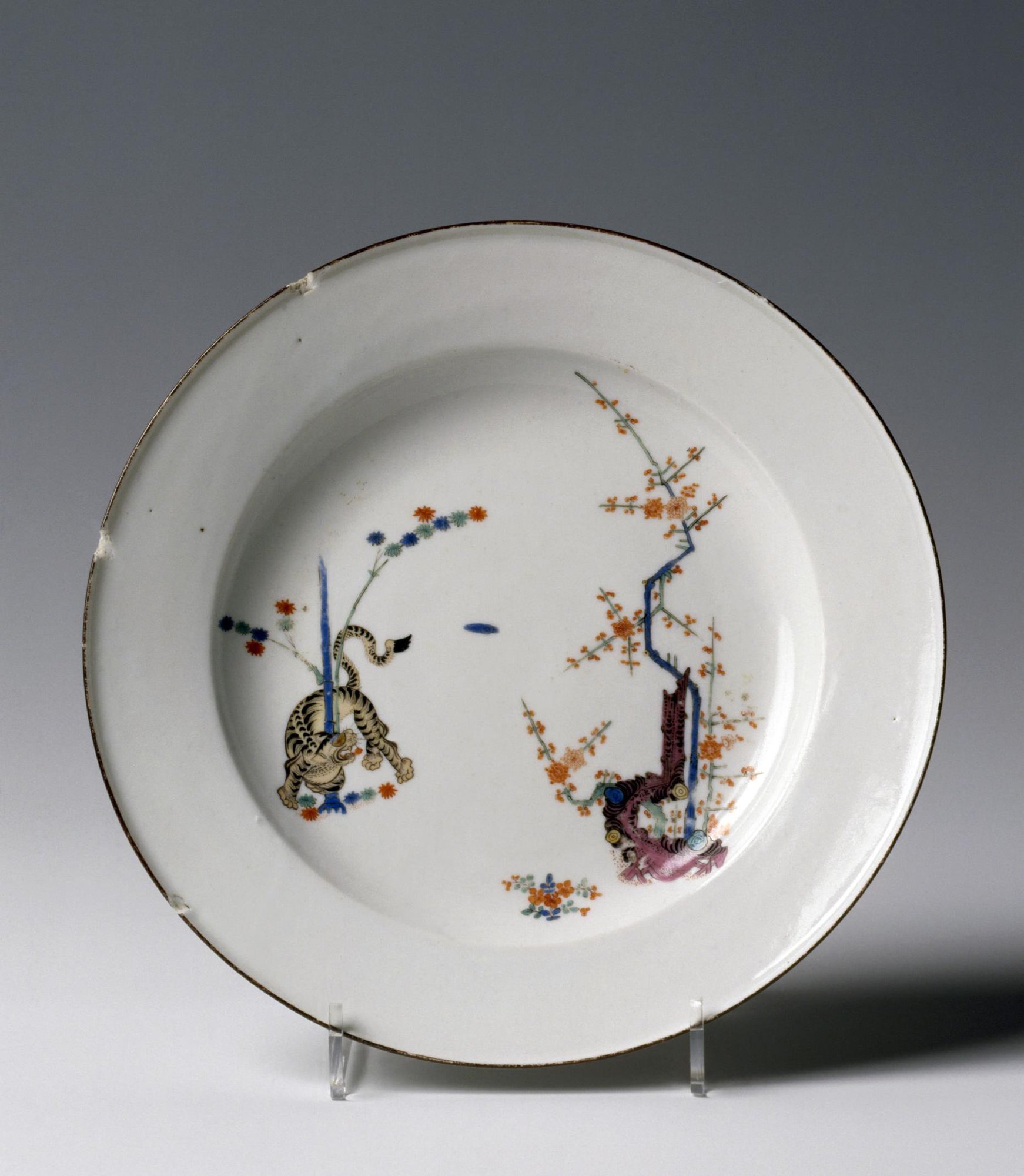
Plate (ZF-16753). The State Hermitage Museum.
The plate entered the Hermitage from the collections of Prince Dolgorukov, Fersen, A. K. Rudanovsky, Oliv, Gorchakov, Shuvalova and Baron Alexander Stieglitz, and from the Leningrad Art Treasures Department. It is on display in the Winter Palace, in room 305.
It is a round plate — 21.7 centimetres in diameter — with a white ground, a brown rim and a painted scene of animals and flowers.
The Object
The plate is white, with a slightly wavy rim edged in brown.
In the centre, a tiger and a dragon are painted on opposite sides, facing each other across an empty middle. Between them, a small blue dot floats.
Flowering branches rise from the animals, and small flowers are scattered around the rim.
The Kakiemon Style
The plate is painted in the Kakiemon style.
Kakiemon is a Japanese porcelain style of the seventeenth century, characterised by a white ground, asymmetrical compositions and a few colours: red, blue, green, yellow and black. It was imitated by Meissen from the 1720s.
The plate’s white ground, its sparse composition and its animals are all Kakiemon features, translated into European porcelain.
The Lion
The animal at the left is a tiger or a lion.
It is painted in yellow and black, with stripes, and it crouches with its head turned. In the Meissen pattern it is called a «yellow lion», though its stripes suggest a tiger.
The animal is the plate’s subject and its title, and it gives the service its name.
The Dragon
The dragon at the right is painted in red and blue.
It has a long, sinuous body, a horned head and clawed feet, and it is coiled around a flowering branch. The dragon is a Chinese and Japanese motif, and it was popular in European chinoiserie.
The dragon and the tiger are a classical pair in Asian art, and they face each other across the plate.
The Flowers
The flowers are painted in orange, blue and green.
They grow from the animals’ backs, and they are scattered around the rim. They are stylised, with simple petals and leaves.
Flowers of this kind are a Kakiemon convention: they fill the empty spaces and give the composition its balance.
The Yellow Lion Service
The plate belongs to a service known as the «Yellow Lion» service.
The service was produced at Meissen in the 1730s, and it was decorated with the tiger and dragon pattern. It was one of the most successful of the factory’s Kakiemon-style services, and it was copied and imitated across Europe.
The plate is one of its pieces, and it carries the service’s name.
Meissen around 1730
The plate was made around 1730.
It was the golden age of Meissen, when the factory was producing its finest wares and its painters were perfecting the art of porcelain decoration. The Kakiemon style was at its height.
The plate belongs to that moment, and it shows the Meissen mastery of colour and composition.
The Condition
The plate is damaged.
Its rim is chipped in several places, and the brown edge is worn. The painting is still legible, but the object shows its age.
The damage is part of the plate’s history: it was used, and it has survived almost three hundred years.
The Plate
The plate is a dinner or dessert plate.
It is 21.7 centimetres across, with a shallow well and a wide rim. Its white ground gives the painting its space, and its brown edge frames it.
The plate was part of a service, and it was used at table: a painted surface for food, and a picture at the same time.
The Blue Dot
A small blue dot floats between the animals.
It is a single mark, painted in blue, and it is the plate’s most enigmatic detail. In Kakiemon porcelain, such dots often stand for a jewel, a fruit or a distant object.
The dot is a small, deliberate mystery, and it gives the composition its centre.
The Rim
The rim is white, with a brown edge.
It is wide and plain, and it frames the scene like a picture frame. The brown edge is worn and chipped, and it records the plate’s use.
A plain rim is characteristic of Kakiemon-style plates: it gives the painting room and keeps the composition sparse.
The Collector
The plate came to the Hermitage through several collections.
Its record lists Prince Dolgorukov, Fersen, A. K. Rudanovsky, Oliv, Gorchakov, Shuvalova and Baron Alexander Stieglitz, and the Leningrad Art Treasures Department. The plate therefore has a long and complicated history.
The list is a document of Russian collecting: it shows how objects moved between families, dealers and museums.
The Asymmetry
The composition is asymmetrical.
The tiger sits low at the left, the dragon rises at the right, and the space between them is almost empty. This imbalance is deliberate: it gives the plate its movement, and it is a hallmark of the Kakiemon style.
European painters often filled every space; the Kakiemon masters left it empty, and Meissen followed them.
The Service
The plate belongs to a service.
The «Yellow Lion» service included plates, dishes, tureens and cups, all decorated with the tiger and dragon pattern. It was one of the most popular services of the 1730s, and it was copied by other factories.
The plate is one piece of a large set, and it carries the service’s name.
The Hall
The plate is displayed in the Winter Palace, in room 305.
It stands in a case among other porcelain, and it is seen in a controlled light. Its white ground and its animals make it a striking object in the display.
The room and the plate belong together: a nineteenth-century interior and an eighteenth-century plate.
The White Ground
The white ground is the plate’s space.
It is the colour of the porcelain, glazed and smooth, and it gives the painting its emptiness. In the Kakiemon style, white is not a background but a material: it is the sea, the sky and the paper of the picture.
The white of this plate is warm, slightly cream, and it makes the reds, blues and yellows of the animals stand out.
Provenance
The plate carries the inventory number ZF-16753. It entered the Hermitage from the collections of Prince Dolgorukov, Fersen, A. K. Rudanovsky, Oliv, Gorchakov, Shuvalova and Baron Alexander Stieglitz, and from the Leningrad Art Treasures Department.
The long list of owners is unusual: it records the plate’s passage through several of the great collections of imperial Russia.
In the Hermitage
The plate is on display in the Winter Palace, in room 305.
It is a fine example of Meissen’s Kakiemon style, and it preserves a small scene: a tiger, a dragon and a flowering branch, painted on a white plate.
It is a plate, and it has outlasted seven collections, which is a kind of journey.