Artist: Robert Lefèvre (1755–1830)
School: French
Origin: France
Date: 1814
Material: canvas
Technique: oil
Dimensions: 73 × 60 cm
Current Collection: The State Hermitage Museum
Inventory Number: GE-5750
Hermitage ID: 37720
Rudanovsky Connection: Entered the Hermitage in 1919 from the collection of A. K. Rudanovsky.
A portrait of General Pyotr Chicherin by Robert Lefèvre, painted in Paris in 1814.
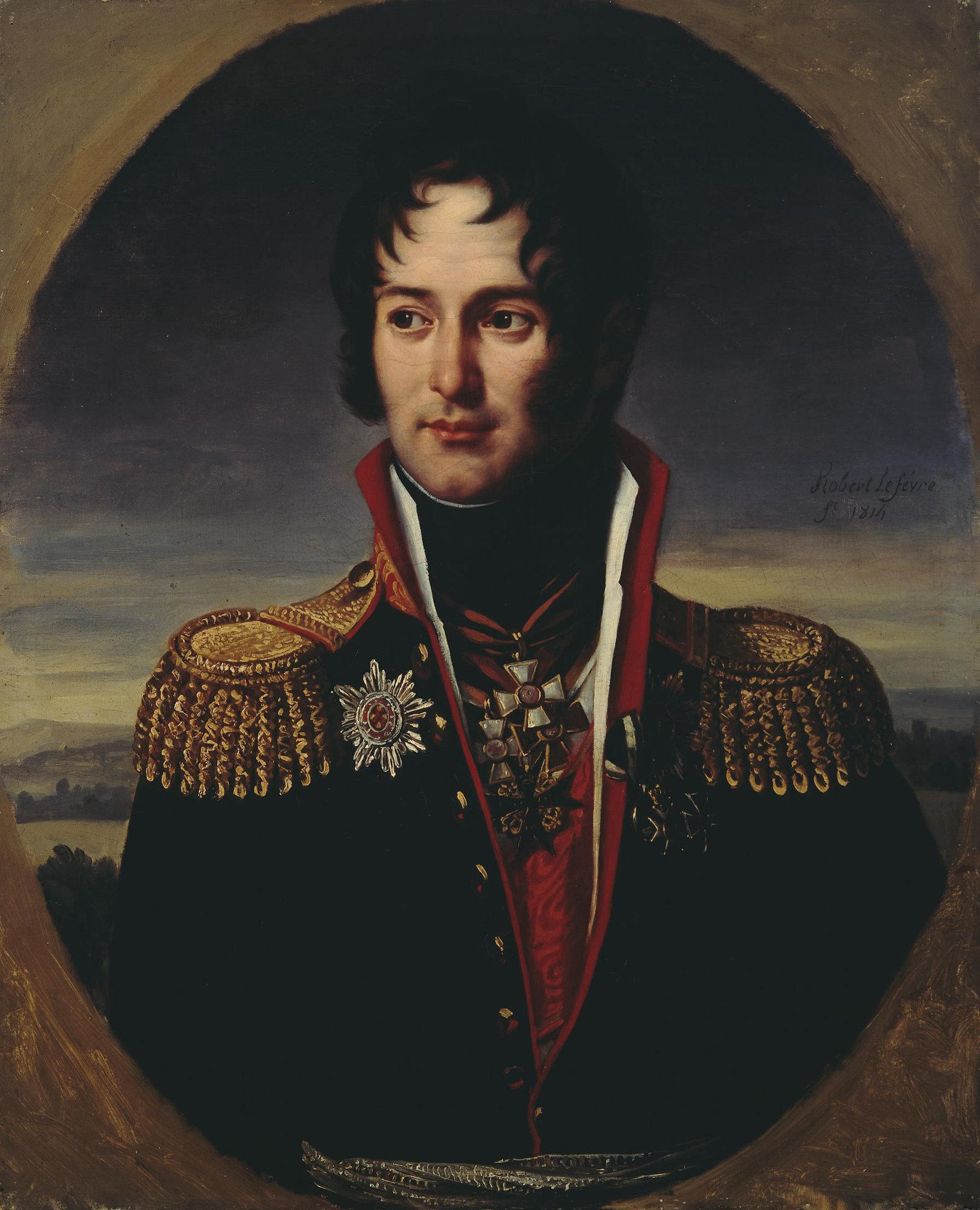
Portrait of General Piotr Chicherin. The State Hermitage Museum.
The portrait entered the Hermitage in 1919, handed over from the State Museum Fund and originally in the collection of A. K. Rudanovsky in Petrograd. It is on display in the General Staff Building, in room 309.
It is a half-length portrait in an oval — 73 by 60 centimetres — of a young officer in a dark green uniform with red collar and gold epaulettes.
The Object
The general is shown from the chest up, turned slightly to the left, his face toward the viewer.
He has dark, wavy hair, a pale complexion and large dark eyes. He wears a dark green uniform with a red collar, a white waistcoat and heavy gold epaulettes, with a cluster of orders on his chest.
The portrait is set in an oval, painted within the rectangular canvas, and it is signed «Robert Lefèvre 1814» at the right.
Chicherin
The sitter is General Pyotr Alexandrovich Chicherin (1778–1848).
He was a Russian officer who fought in the campaigns of 1805–1807 and in the Patriotic War of 1812, and he took part in the Allied occupation of Paris in 1814. He later became a general and a senator.
The portrait shows him at thirty-six, at the height of his military career, in the year of the fall of Napoleon.
The Uniform
The uniform is the portrait’s colour.
It is dark green, with a red collar and gold epaulettes, and it is painted with attention to the cloth, the gold and the buttons. The white waistcoat and the black stock complete the dress.
The uniform is a statement of rank and service, and its colours are the portrait’s strongest notes.
The Orders
The orders on the chest are a record of the sitter’s career.
There is a large silver star — the Order of St Anna or St Alexander — and several crosses, including the cross of the Order of St George and a foreign order.
Each order was awarded for a battle or a campaign, and together they form a small biography of the sitter.
The Oval
The portrait is set in a painted oval.
The oval is brown and gold, and it frames the figure like a medallion. It is painted, not carved, and it gives the portrait a formal, monumental character.
Ovals were common in portraiture of the period: they concentrated attention on the face and gave the image a jewel-like completeness.
Lefèvre
Robert Lefèvre (1755–1830) was a French portraitist.
He worked in Paris, and he painted portraits of the imperial family, the marshals and the nobility. His work is characterised by smooth modelling, clear colours and a precise likeness.
Lefèvre painted many Russian officers during the occupation of Paris in 1814–1815, when the city was full of Allied officers commissioning portraits.
1814
The portrait is dated 1814.
It was painted in Paris in the year of the Allied occupation, when Russian officers were among the victors of Europe. Chicherin sat for Lefèvre, and the portrait was probably sent home to Russia.
The date gives the portrait its historical context: it is an image of a victor, painted in the capital he had entered.
The Background
The background is a soft landscape.
It is painted in pale greens and browns, with a low horizon, and it suggests a sky and a distant field. The landscape is vague, and it serves mainly to set off the figure.
Backgrounds of this kind are a convention of military portraiture: they suggest a campaign without describing one.
The Hair
The sitter’s hair is dark and wavy.
It is brushed forward in soft locks, with a slight curl at the temples, and it frames the face. The hair is painted with care, and its darkness contrasts with the pale skin.
Hair of this kind is a test of a portraitist’s skill: it must be soft and detailed at once, and it must catch the light.
The Face
The face is the portrait’s centre.
It is young, with a high forehead, a straight nose and large dark eyes. The skin is pale, with a faint flush on the cheeks, and the expression is calm and slightly melancholy.
The likeness is precise, and it gives the sitter a quiet, dignified presence.
The Epaulettes
The epaulettes are the uniform’s most striking feature.
They are heavy and golden, with long fringes, and they sit on the shoulders like small sculptures. The gold is painted with care, and it catches the light.
Epaulettes of this kind marked the rank of a general, and they were a sign of status as well as of service.
The Frame
The oval frame is painted on the canvas.
It is brown and gold, with a shadowed edge, and it turns the portrait into a medallion. The frame is part of the picture, not a separate object.
Painted frames of this kind were common in the nineteenth century, and they gave portraits a formal, monumental character.
The Collector
The portrait came to the Hermitage with the Rudanovsky collection.
Rudanovsky collected European paintings alongside porcelain, drawings, glass and miniatures, and his collection included portraits of Russian nobles and officers.
The portrait is therefore a double document: of Lefèvre’s art and of a Russian collector’s taste.
The Collar
The collar is red.
It is a high, stiff collar, painted with a clear edge, and it frames the face like a frame. The red contrasts with the dark green coat and the white waistcoat.
A red collar was part of the Russian general’s uniform, and it is one of the portrait’s strongest colour notes.
The Signature
The portrait is signed «Robert Lefèvre 1814» at the right.
The signature is painted on the background, and it is partly hidden by the oval frame. It identifies the artist and the year, and it is a mark of the portrait’s authenticity.
Signatures of this kind were standard in French portraiture of the period, and they allow the painting to be dated precisely.
The Waistcoat
A white waistcoat is visible under the coat.
It is painted in pale grey and white, with a row of buttons, and it gives the dark uniform a note of lightness. The waistcoat was part of the general’s dress, and it is one of the details that make the uniform legible.
Details of this kind are what make a portrait convincing, and Lefèvre does not neglect them.
Provenance
The portrait carries the inventory number GE-5750. It entered the Hermitage in 1919, handed over from the State Museum Fund and originally in the collection of A. K. Rudanovsky in Petrograd.
In the Hermitage
The portrait is on display in the General Staff Building, in room 309.
It is a fine example of French military portraiture, and it preserves the image of a Russian general in 1814 — a face, a uniform and a list of honours, painted in Paris.