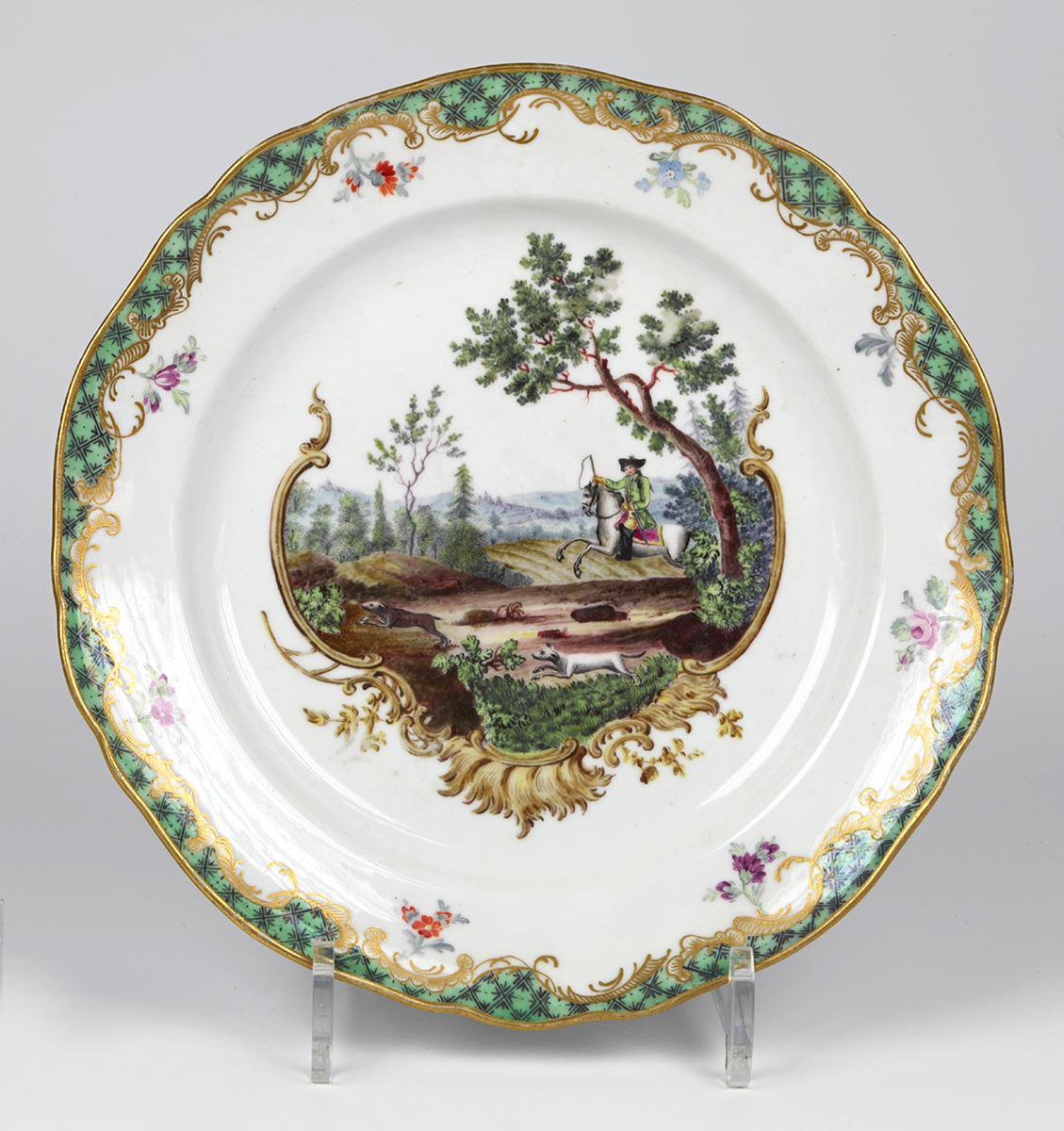
Organization: Imperial Porcelain Factory, St Petersburg
Origin: Russia, St Petersburg
Date: late 18th century
Complex: Hunting Service; addition to the main set (Meissen Porcelain Manufactory, 1765–1768)
Material: porcelain
Technique: polychrome overglaze painting, gilding
Dimensions: 5.5 × 30.6 cm
Current Collection: The State Hermitage Museum
Inventory Number: ERF-8939
Hermitage ID: 931434
Rudanovsky Connection: Entered the Hermitage in 1919 from the collection of A. K. Rudanovsky.
A large round dish of the late eighteenth century, made at the Imperial Porcelain Factory as an addition to the Meissen «Hunting Service».
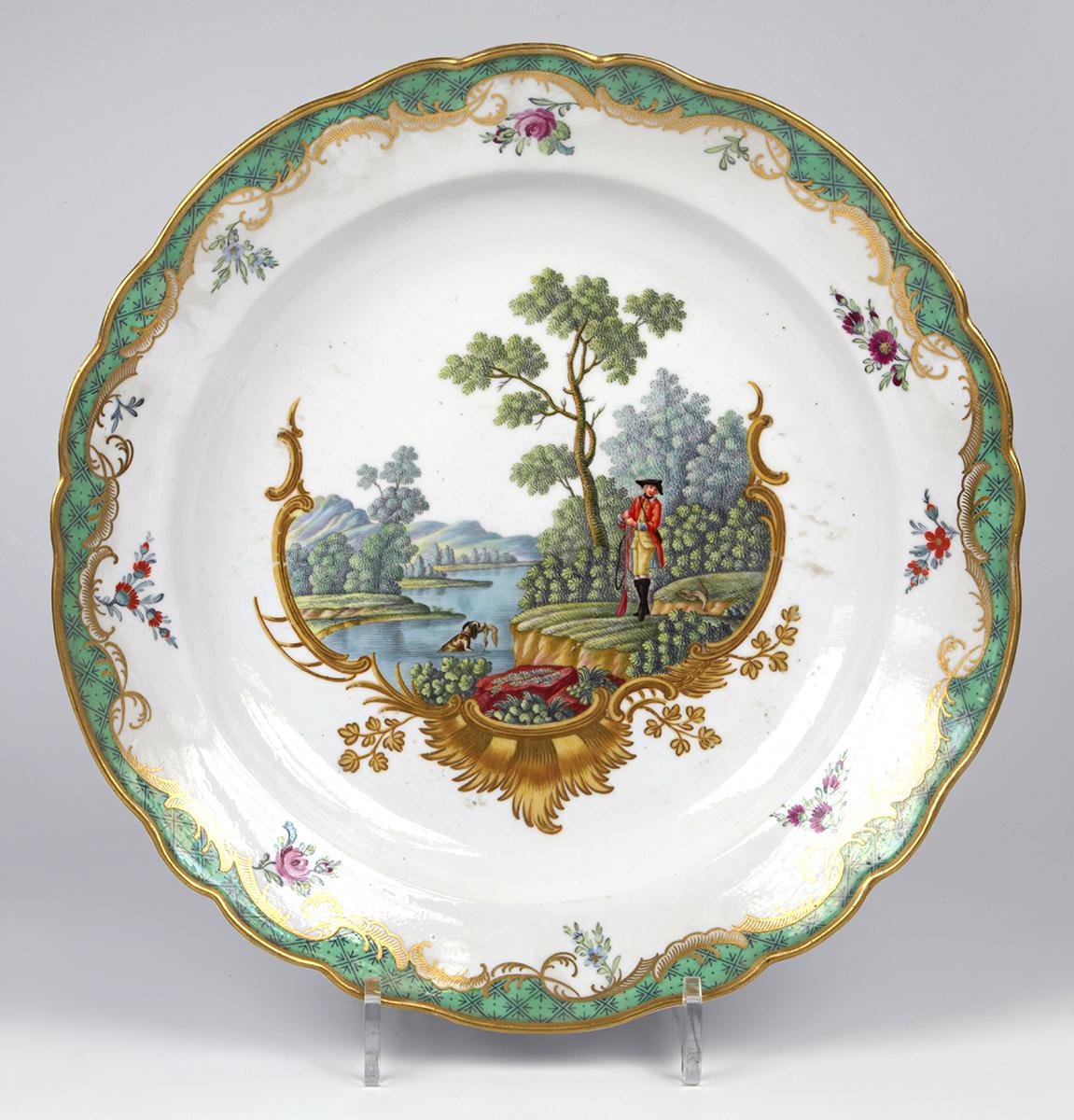
Round Dish. The State Hermitage Museum.
The dish entered the Hermitage in 1919, transferred through the Branch for the Protection of Monuments of Art and Antiquities and previously in the collection of A. K. Rudanovsky. It is not currently on permanent display.
It is a large round dish — 30.6 centimetres across — with a green border and a painted huntsman in the centre.
The Object
The dish is round, with a scalloped rim and a deep well.
Its border is green, painted with a diaper pattern and framed by gold scrolls and small flowers. In the centre, a gold cartouche frames a scene: a huntsman, a dog, a landscape and a basket of game.
The palette is soft: greens, browns, reds and gold.
The Hunter
The hunter stands at the right.
He wears a red coat, a white waistcoat and a black hat, and he leans on his gun. His pose is relaxed, and he looks across the landscape.
He is a gentleman of leisure, not a working hunter: his dress and his pose belong to the world of the eighteenth-century nobility.
The Game
A basket of game lies in the foreground.
It is filled with grapes and fruit, and a red cloth covers part of it. Beside it, a dog drinks from the water.
The game and the basket turn the scene into a hunting still life: the spoils of the chase, laid out for the viewer.
The Cartouche
The cartouche is a gold frame.
It is painted with scrolls and leaves, and it surrounds the hunter like a window. Its shape is irregular, and it follows the landscape.
Cartouches of this kind are a feature of the service: they frame each scene and separate it from the white ground.
The Border
The border is green.
It is painted with a diaper pattern of small stars, and it is edged with gold scrolls and flower sprays. Its colour contrasts with the white ground and the red coat.
The border is one of the signs of the service, and it unites its many pieces.
The Imperial Addition
The dish is an addition to the service, not an original piece.
It was made at the Imperial Porcelain Factory in St Petersburg in the late eighteenth century, and it was designed to match the Meissen pieces made in 1765–1768. Its border and its scenes copy the German model.
The dish shows how a great service could grow: new pieces were added as the set was used, and the decoration was continued across factories.
The Meissen Service
The «Hunting Service» was originally made at Meissen.
The service was one of the most ambitious of the eighteenth century, and it was decorated with hunting scenes after paintings and prints. It was made for the Russian court.
The Russian additions continued the service, and they show the prestige of the Meissen model.
The Landscape
The landscape is soft and pale.
A river runs across the middle, with trees on its banks, and a range of hills closes the horizon. The sky is pale, with a few clouds.
Landscapes of this kind are a convention of hunting scenes: they provide a setting without distracting from the action.
The Dog
A dog stands at the water.
It is brown and white, and it drinks or sniffs the water, its head lowered. It is the hunter’s companion, and it gives the scene its life.
Dogs are a common element in hunting scenes, and they add a note of loyalty and movement.
The Basket
A basket of game lies in the foreground.
It is filled with grapes and fruit, and a red cloth covers part of it. The basket turns the scene into a still life, and it shows the spoils of the chase.
Baskets of this kind are a feature of hunting scenes: they hold the game, and they give the painter a chance to show texture and colour.
The Gold
The gold is applied in scrolls and lines.
It edges the border, frames the cartouche and covers the small rococo ornaments. It was applied over the glaze, fired and burnished.
The gold gives the dish its richness, and it frames the hunter.
The Table
The dish was made for a table.
It was a serving dish, and it stood at the centre of a grand dinner. Its hunting scene would have been admired between courses.
That table is gone, but the dish still carries its function: a surface for food, and a picture for the interval.
The Red Coat
The red coat is the dish’s colour accent.
It is a warm, saturated red, and it stands out against the green landscape and the white ground. It marks the hunter as a man of fashion, and it draws the eye to him.
In a scene of greens and browns, a single red coat is a deliberate device: it gives the composition its focus.
The Water
A river runs across the scene.
It is painted in pale blues and greys, and it reflects the sky. On its bank, the hunter stands, and the dog drinks.
The water gives the landscape its depth, and it connects the figures to the distance.
The Rim
The rim of the dish is scalloped.
It is cut into a series of small waves, and it is edged with gold. The scallops follow the border, and they give the dish its elegant outline.
Scalloped rims are a feature of eighteenth-century services, and they frame the decoration.
The Piece’s Number
The dish carries an inventory number, ERF-8939.
Numbers of this kind were given by the museum, and they identify the object in the collection. They are the modern equivalent of the old owners’ marks.
The number is a small trace of the object’s life after the table: it is a museum object now.
Provenance
The dish carries the inventory number ERF-8939. It entered the Hermitage in 1919, transferred through the Branch for the Protection of Monuments of Art and Antiquities and previously in the collection of A. K. Rudanovsky.
In the Hermitage
The dish is preserved in the State Hermitage Museum in Saint Petersburg and is not on permanent display.
It is a fine example of Russian porcelain, and it preserves a hunting scene: a red coat, a basket of game and a green border, painted two centuries ago.
It is a dish, and it is also a small afternoon in a forest, and it has kept its red coat and its basket of game for two centuries.
And it is still a dish, and it is still a picture.
It is a small object, and it has carried a whole afternoon of the eighteenth century on its surface. And it is still holding it.