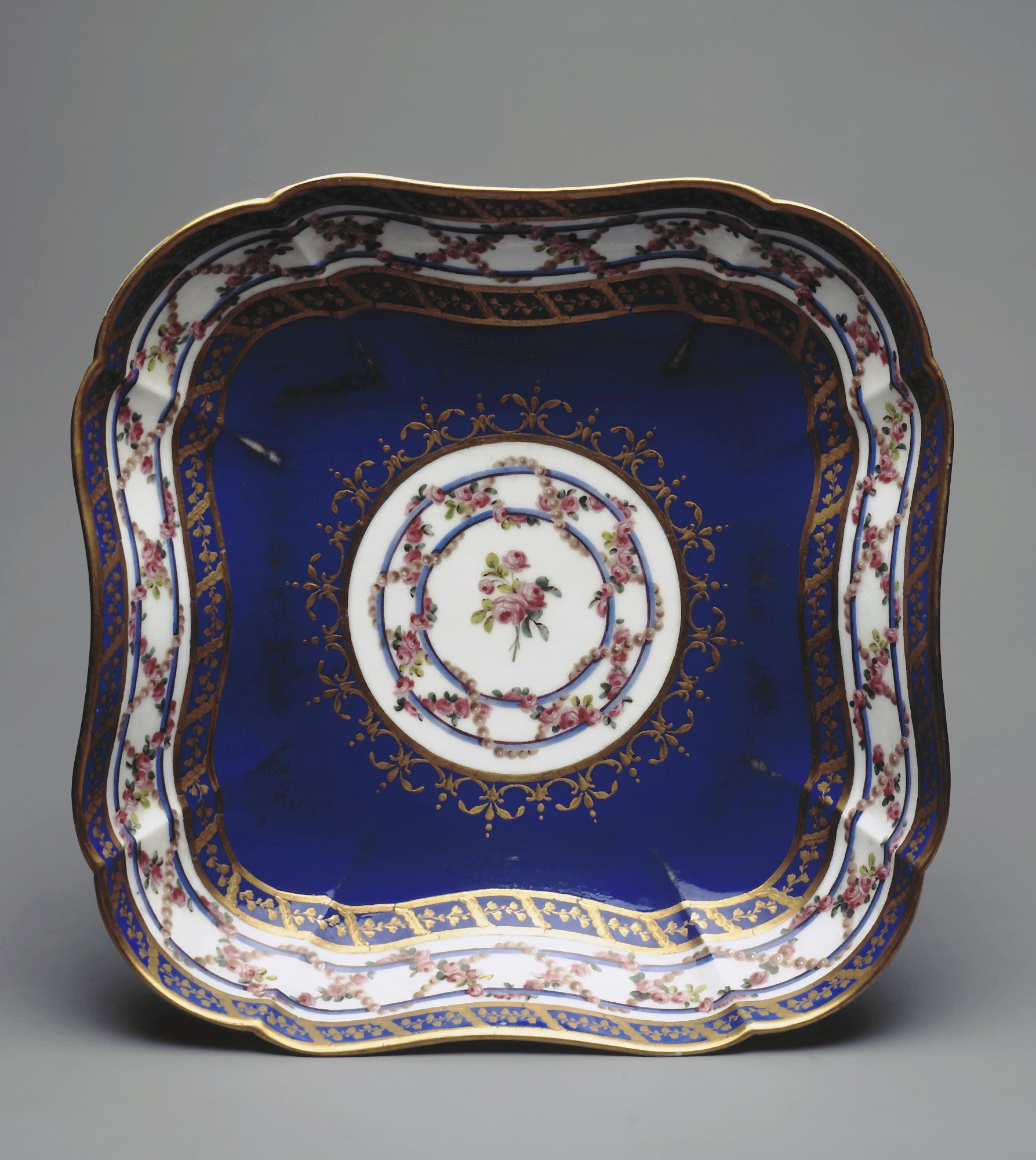
Artist: Hirel de Choisy (painter)
Organization: Sèvres Porcelain Manufactory
Origin: France
Date: 1788
Complex: Blue Service
Material: soft-paste porcelain
Dimensions: length 22 cm; width 21.6 cm
Current Collection: The State Hermitage Museum
Inventory Number: ZF-16264
Hermitage ID: 352364
Rudanovsky Connection: Entered the Hermitage in 1919 from the collection of A. K. Rudanovsky.
A shell-shaped Sèvres compotier of 1788, its blue body edged with gold and its centre painted with a garland of roses.
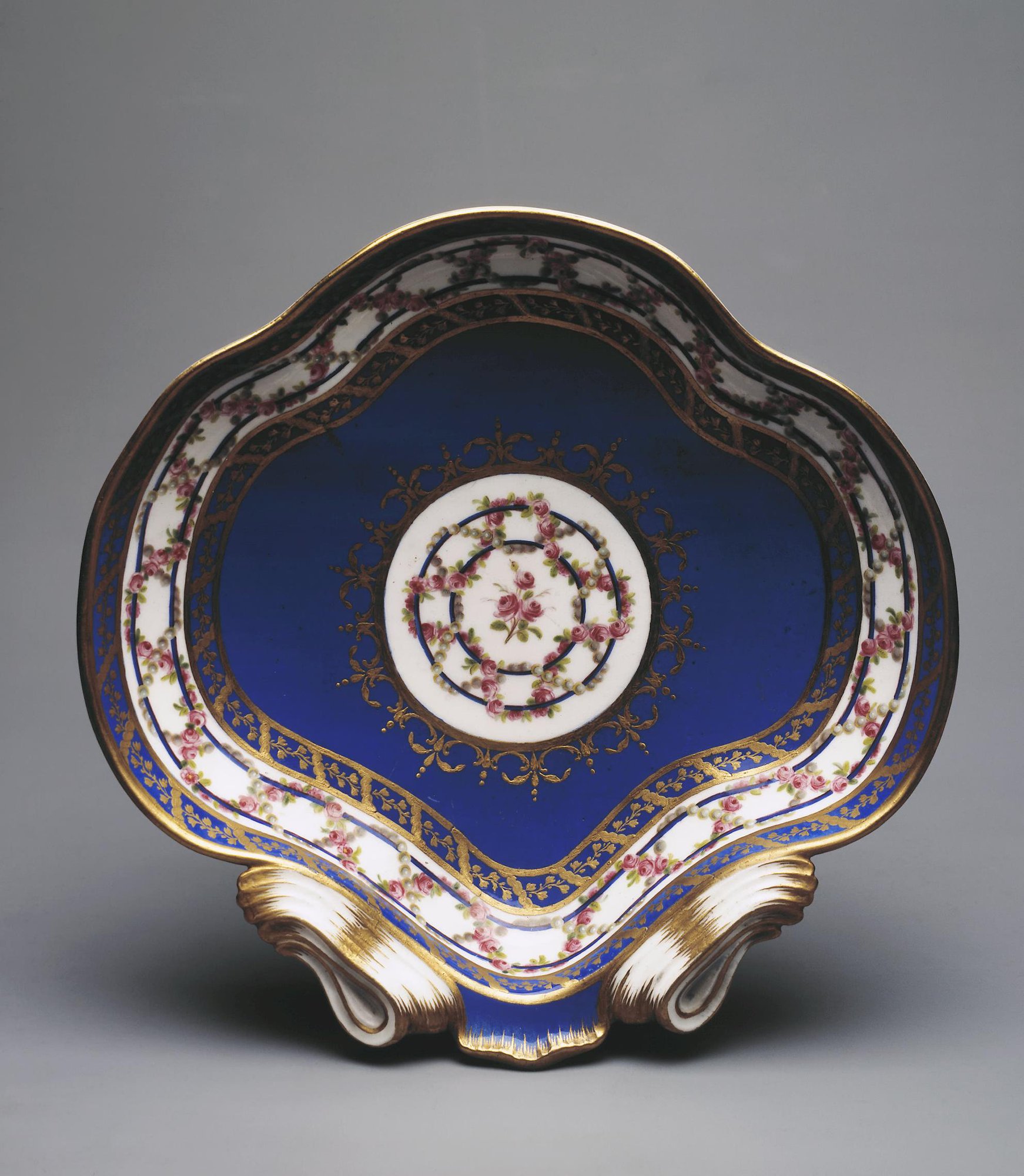
Shell-Shaped Compotier. The State Hermitage Museum.
The dish entered the Hermitage in 1919 from the collection of A. K. Rudanovsky. It is not currently on permanent display.
It is a shallow dish in the shape of a shell, with a scalloped edge and a small foot, painted with a deep blue ground and a white reserve at the centre.
The Object
The dish is shaped like a shell: a rounded body with a scalloped rim and a small, curled foot.
The rim is blue, with gold bands and a garland of roses on a white band. The centre is a white medallion, framed by gold scrollwork, with a ring of roses and a single rose at the middle.
The foot is scrolled and gilded, and the whole object rests on it like a shell on a rock.
The Shell
The shell shape is a Rococo invention.
Shells were one of the basic motifs of Rococo ornament, and they were used for dishes, basins, fountains and furniture. A shell-shaped dish suggests the sea, nature and abundance, and it turns a serving vessel into a small sculpture.
The shape also has a practical side: the scalloped rim and the curved body make the dish easy to hold and to serve from.
The Compotier
A compotier is a dish for fruit or compote.
It is usually shallow, with a wide rim and a small foot, and it is designed to display fruit at the dessert table. Compotiers were made in sets, in several sizes, and they were among the most decorative pieces of a service.
This one is a small compotier, suitable for a single portion of fruit or sweets.
The Centre
The centre of the dish is a white medallion.
It is framed by a ring of gold scrollwork, and it contains a circle of roses with a single rose at the centre. The roses are painted in pinks and greens, and they form a delicate, symmetrical composition.
The medallion is the dish’s focal point, and it is where the painter’s hand is most visible.
The Rim
The rim is blue, with a white band and a garland.
The white band carries a continuous garland of roses, framed by blue lines and gold bands, and the blue ground of the rim is decorated with gold scrolls and leaves.
The contrast between the blue rim and the white centre is the dish’s main visual structure.
The Blue Service
The compotier belongs to the Blue Service of 1788.
The service included cups, plates, trays, bowls and compotiers, all decorated with the same blue ground, white bands and rose garlands. The compotier is one of its smaller and more delicate pieces.
The service was a luxury commission, and it would have been used for dessert and wine.
Hirel de Choisy
The compotier is attributed to Hirel de Choisy, a painter at Sèvres.
His mark on the underside identified the piece, and the roses on the dish are consistent with his style. Like other painters of the service, he worked within a shared vocabulary of flowers and garlands.
The attribution connects the object to a named hand, and it allows the decoration to be placed within the production of the service.
The Foot
The foot of the compotier is scrolled and gilded.
It is modelled as a small rock or shell, with curls and ridges, and it raises the dish above the table. The foot gives the object a sculptural base and echoes the shell shape of the body.
Feet of this kind are a feature of Sèvres in the 1780s, and they turn a flat dish into a small monument.
The Gold Scrolls
The gold scrolls frame the central medallion.
They are painted in fine lines, with leaves and volutes, and they separate the white centre from the blue ground. The scrolls are delicate and airy, and they give the dish a sense of movement.
Gold of this kind is applied last and fired at a low temperature, and it is the most fragile part of the decoration.
Fruit
A compotier is a dish for fruit.
It would have held grapes, peaches, plums or a compote of stewed fruit, and it would have stood at the centre of the dessert table. The shell shape and the blue ground made it a decorative object as well as a useful one.
The fruit is gone, but the dish still carries its purpose: to display, to offer and to delight.
The Table
The compotier was made for a table.
It stood among cups, plates and bowls of the same service, and it was filled at the moment of dessert. Its blue and gold would have caught the candlelight, and its shell shape would have made it a conversation piece.
That table is gone, but the dish still carries its logic: a small stage for fruit and conversation.
The Collector
The compotier came to the Hermitage with the Rudanovsky collection.
Rudanovsky collected Sèvres porcelain alongside paintings, drawings, glass and miniatures, and the Blue Service is one of the most important groups in his collection.
The dish is therefore a double document: of the Sèvres factory in 1788 and of a nineteenth-century Russian collector’s taste.
The Shell’s Rim
The rim of the dish is cut into scallops.
The scallops follow the curve of the shell and give the object its organic outline. Each scallop is edged with gold, and the notches between them echo the ridges of a real shell.
The rim is the dish’s most sculptural element, and it is what makes the object read as a shell rather than a plate.
The Blue Ground
The blue ground is the dish’s dominant colour.
It is applied as a wash over the glaze, fired and polished, and it covers the rim and the body. The colour is deep and even, with a slight variation that comes from hand application.
Blue was the most expensive colour in the Sèvres palette, and its use here signals the quality of the service.
The Medallion Ring
The medallion is surrounded by a ring of gold scrollwork.
The ring is painted in fine lines — leaves, volutes and small flowers — and it separates the white centre from the blue ground. Its openness allows the blue to show through, so that the ring seems to float.
Rings of this kind are a Sèvres speciality: a small piece of goldsmith’s work, painted with a brush.
Provenance
The compotier carries the inventory number ZF-16264 and entered the Hermitage in 1919 from the collection of A. K. Rudanovsky.
In the Hermitage
The compotier is preserved in the State Hermitage Museum in Saint Petersburg and is not on permanent display.
It is a small, elegant object, and it shows how a dish could be turned into a shell, a garden and a piece of sculpture — blue, white, gold and roses, all in the space of a hand.