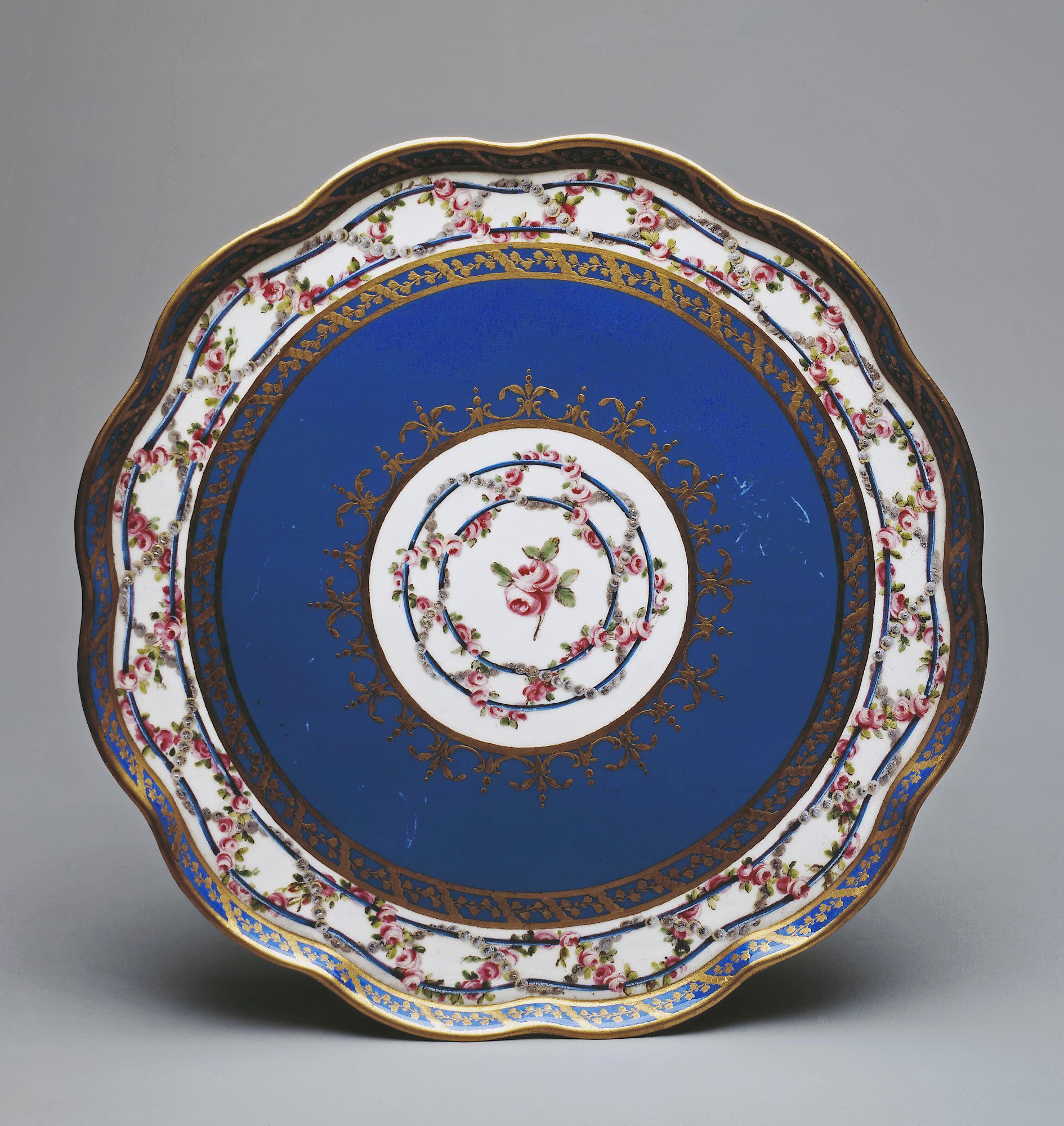
Organization: Sèvres Porcelain Manufactory
Origin: France
Date: 1788
Complex: Blue Service
Material: soft-paste porcelain
Dimensions: height 10.8 cm; tray 18.6 × 14.9 cm
Current Collection: The State Hermitage Museum
Inventory Number: ZF-16267
Hermitage ID: 352367
Rudanovsky Connection: Entered the Hermitage in 1919 from the collection of A. K. Rudanovsky.
A Sèvres sugar bowl of 1788 with its lid and tray, painted with blue bands and garlands of roses.
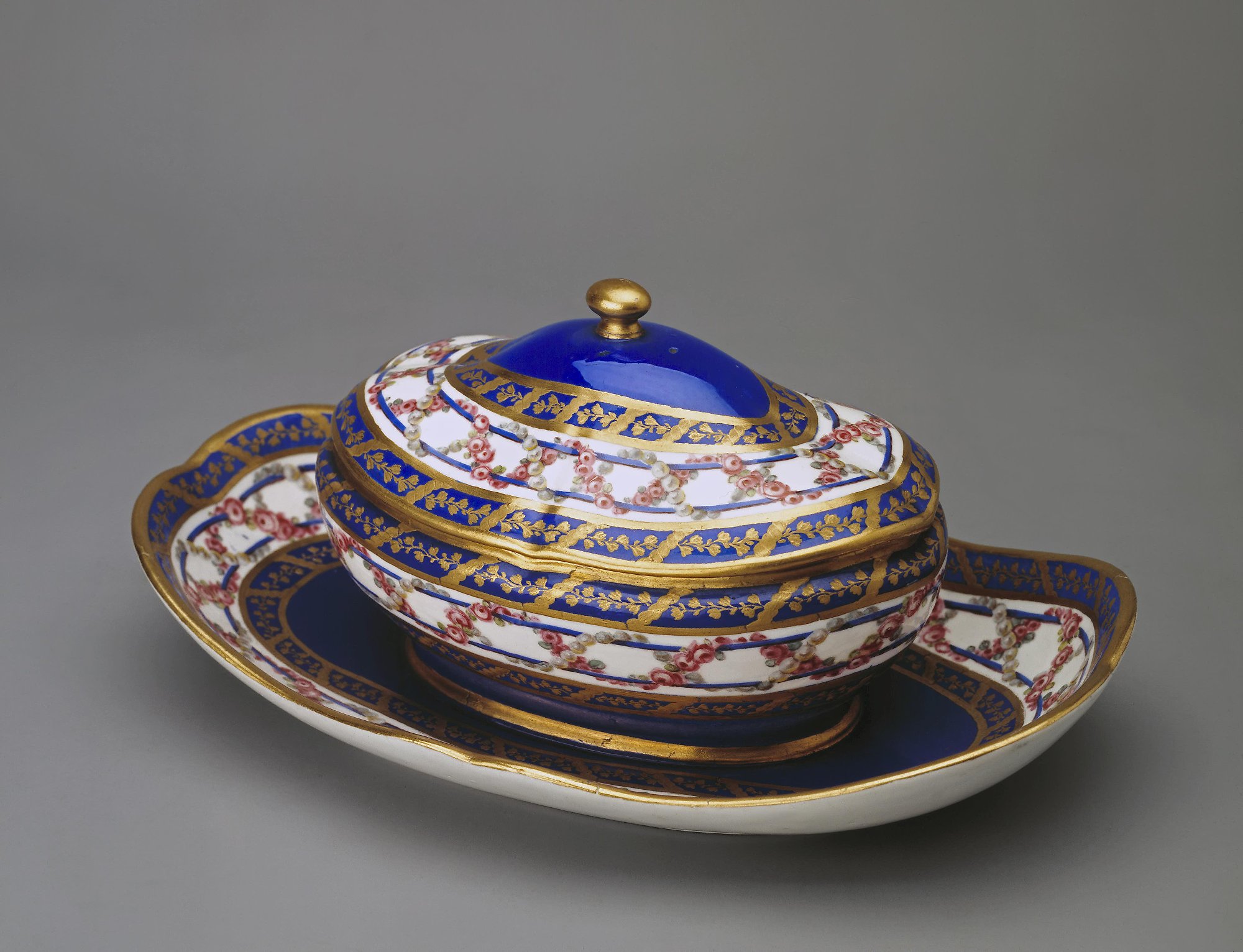
Sugar-Bowl with a Lid on a Tray. The State Hermitage Museum.
The bowl entered the Hermitage in 1919 from the collection of A. K. Rudanovsky. It is not currently on permanent display.
It is a small covered bowl on an oval tray, with a gilded knob on the lid and a blue band around the body.
The Object
The bowl is round, with a domed lid and a gilded knob.
Its body is banded with blue and white: a blue band with gold foliage, a white band with a garland of roses, another blue band, and a blue base with a gold edge. The lid repeats the pattern, and the tray carries the same decoration around its rim.
The tray is oval, with a shaped edge and a blue band around the border.
Sugar
Sugar was a luxury in the eighteenth century.
It was sold in cones and broken into pieces, and it was served at the table in a covered bowl — a sucrier — with a spoon. The bowl protected the sugar from moisture and dust, and it was part of the dessert and tea service.
A sugar bowl was therefore a small but essential piece of the table, and it was decorated to match the rest of the service.
The Lid
The lid is domed, with a gilded knob.
It fits into the rim of the bowl and keeps the sugar dry. Its blue bands and garland match the body, so that the closed object reads as a single form.
The knob is a small sculpture in itself: a gilded sphere on a short stem, easy to grasp and pleasant to look at.
The Tray
The tray is oval, with a shaped edge.
It is painted with the same blue bands and rose garlands, and its size — 18.6 by 14.9 centimetres — is just large enough to hold the bowl and a spoon.
The tray protects the table, frames the bowl and completes the object. Without it, the sugar bowl would be a vessel; with it, it becomes an ensemble.
The Ensemble
The bowl, lid and tray form an ensemble.
They were made together, painted with the same pattern, and designed to be used together. In the eighteenth century, such ensembles were common: tureens on stands, bowls on trays, cups on saucers.
The ensemble is the unit of the service: not a single object, but a group of objects that belong together.
Sèvres in 1788
The sugar bowl was made in 1788, at the height of the Sèvres production.
The factory was a royal manufactory, and it supplied the court and the aristocracy with services of extraordinary quality. Its painters, gilders and modellers worked together to produce objects in which every detail was coordinated.
The sugar bowl belongs to that production: a small, precise object, painted with care and designed for a grand table.
The Blue Service
The sugar bowl belongs to the Blue Service of 1788.
The service included cups, plates, trays, bowls and compotiers, all decorated with the same blue ground, white bands and rose garlands. The sugar bowl is one of its smaller and more intimate pieces.
The service was a luxury commission, and it would have been used for dessert and tea.
The Blue Band
The blue bands are the object’s structure.
They run around the body, the lid and the tray, separating the white garlands and giving the eye a rhythm. The blue is deep and even, and it contrasts with the white porcelain and the gold.
Bands of this kind are a feature of Sèvres in the 1780s: they frame the decoration and give the object a clear architecture.
The Gilded Knob
The knob on the lid is a small sculpture.
It is a gilded sphere on a short stem, easy to grasp and pleasant to look at. Its gold catches the light and draws the eye to the top of the object.
Knobs of this kind were modelled and gilded separately, and they are one of the details that distinguish a fine service from a plain one.
The Spoon
A sugar bowl needed a spoon.
The spoon was usually silver, and it rested in the bowl or on the tray. It was not part of the porcelain service, but it was essential to the object’s use.
The tray, with its shallow depression, may have been designed to hold both the bowl and the spoon, keeping the table clean.
Tea and Sugar
Sugar was served with tea and coffee.
In the eighteenth century, tea was drunk sweet, and the sugar bowl stood beside the teapot and the cups. It was part of the ritual of the tea table, which was one of the most important social ceremonies of the period.
The sugar bowl, with its lid and tray, is therefore a small monument to the tea table.
The Collector
The sugar bowl came to the Hermitage with the Rudanovsky collection.
Rudanovsky collected Sèvres porcelain alongside paintings, drawings, glass and miniatures, and the Blue Service is one of the most important groups in his collection.
The bowl is therefore a double document: of the Sèvres factory in 1788 and of a nineteenth-century Russian collector’s taste.
The Bowl
The bowl is round, with a slight taper and a small foot.
It is shallow enough to allow a spoon to reach the sugar, and deep enough to hold a supply for a tea party. Its shape is simple and functional, and its decoration follows the curve of the body.
A sugar bowl is a small object, but it has to work: it must open easily, close firmly and keep its contents dry.
The Pattern
The pattern is the same on every piece.
Blue bands, white garlands, gold lines, roses: the decoration of the bowl, the lid and the tray is identical, only the scale changes. This consistency is what makes the ensemble read as a single object.
The pattern is also the service’s signature, and it allows the pieces to be matched even when they are separated.
Provenance
The sugar bowl carries the inventory number ZF-16267 and entered the Hermitage in 1919 from the collection of A. K. Rudanovsky.
In the Hermitage
The sugar bowl is preserved in the State Hermitage Museum in Saint Petersburg and is not on permanent display.
It is a small, elegant object, and it shows how the service worked as a system: bowl, lid and tray, all painted with the same blue and roses, all designed to be used together.
It is also a small monument to the tea table, where sugar, porcelain and conversation went together — and where a bowl with a lid was a small piece of architecture for daily life.
It is, in the end, a small essay in company: bowl, lid and tray, each incomplete without the others, and each very much better with them.