
Artist: Charles-Louis Mereaud le Jeune (painter)
Organization: Sèvres Porcelain Manufactory
Origin: France
Date: 1764
Material: soft-paste porcelain
Dimensions: length 45.1 cm; width 37.9 cm
Current Collection: The State Hermitage Museum
Inventory Number: ZF-16292
Hermitage ID: 352387
Rudanovsky Connection: Entered the Hermitage in 1919 from the collection of A. K. Rudanovsky.
A large Sèvres stand of 1764, painted with blue scrolls and flowers, made to carry a covered tureen at the centre of a table.
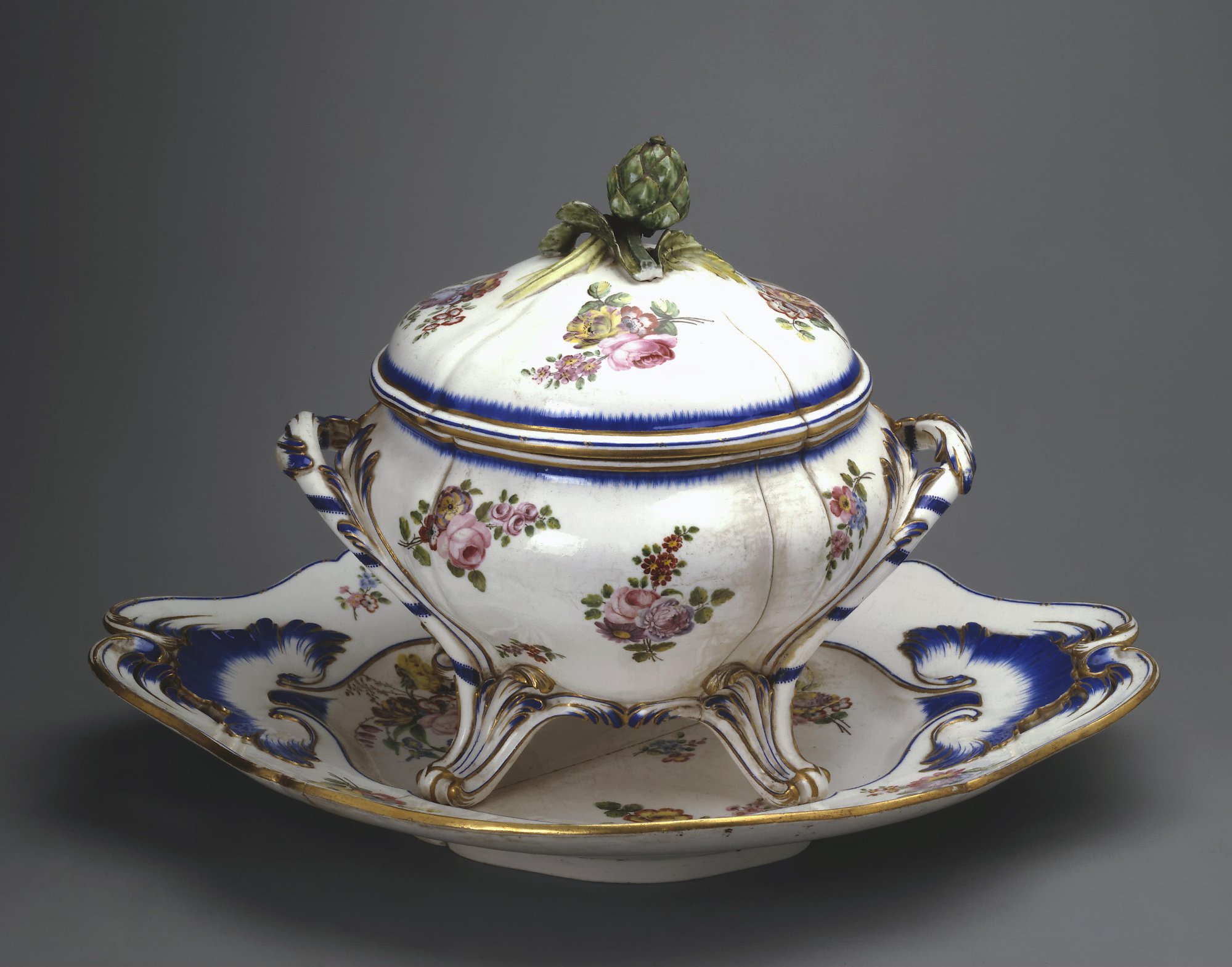
Tray (ZF-16292). The State Hermitage Museum.
The tray entered the Hermitage in 1919 from the collection of A. K. Rudanovsky. It is not currently on permanent display.
It is the stand beneath the tureen: a large oval dish with a shaped, scalloped edge, painted with blue scrolls and scattered flowers.
The Object
The tray is oval, 45 centimetres long, with a broad rim and a shallow depression in the centre.
The rim is white, decorated with bold blue scrolls that curl across the surface and with small bouquets of flowers. The centre is painted with a light bouquet, and the edge is gilded.
The blue of the scrolls is deep and slightly feathered, like the blue band on the tureen, and the flowers are painted in the same palette as the rest of the service.
The Stand
A stand is not a tray in the modern sense.
It is the base on which a tureen or a bowl is placed at table: it catches drips, protects the cloth and frames the object. It is made to match the vessel it carries, and the two are designed together.
This stand belongs to the tureen recorded as ZF-16291, and the two objects are photographed together: the tureen standing on the stand, the artichoke on top.
The Blue Scrolls
The blue scrolls are the stand’s most striking decoration.
They are painted with a broad brush, in a deep blue that contrasts with the white ground, and they curl across the rim like waves or foliage. Their edges are soft, as if the colour had bled slightly into the glaze.
This kind of free, painterly scrollwork is characteristic of Sèvres in the 1760s, and it gives the stand a vigorous, almost abstract character.
Mereaud
The stand is attributed to Charles-Louis Mereaud le Jeune, a painter at Sèvres.
Mereaud is recorded among the painters of the factory, and his name appears on a number of pieces of the period. His work is less documented than that of the great flower painters, but the stand shows a confident hand.
The attribution is based on the mark on the underside, which the factory used to identify the painter.
The Pair
The stand and the tureen form a pair.
They were made in the same year, with the same palette, and they were designed to be used together. The stand’s shape follows the tureen’s foot, and its blue scrolls echo the tureen’s blue band.
Separated in the museum record, they are united in the photograph: the tureen standing on the stand, a single object made of two parts.
Sèvres in 1764
The stand was made at Sèvres in 1764, at the height of the factory’s production.
Sèvres was a royal manufactory, and its wares were prized across Europe. The factory’s painters, gilders and modellers worked together to produce services of great complexity, in which every piece was decorated to match.
The stand is one of those pieces: a large, ambitious object, painted with care, designed for a grand table.
Soft Paste
The stand is made of soft-paste porcelain.
Soft paste is difficult to fire in large flat pieces: the clay tends to warp, and the glaze can crack. A stand of 45 centimetres is therefore a technical achievement, and its survival is a testament to the skill of the factory.
The soft paste gives the stand its warm white and its fine, glassy surface.
The Table
The stand belongs to the ceremonial of the table.
It was placed at the centre of the dinner table, with the tureen on it, and it was surrounded by plates, dishes and glasses. Its size made it a focal point, and its decoration matched the rest of the service.
The table for which it was made is gone, but the stand still carries its logic: a frame for a vessel, a setting for a meal.
The Edge
The edge of the stand is shaped and gilded.
It rises and falls in a series of curves, following the oval of the tray, and a thin gold line runs along the rim. The shaped edge softens the outline and gives the object a decorative, almost organic quality.
The edge is also the part that was most handled, and the gilding is worn in places.
The Centre
The centre of the stand is a shallow depression.
It is painted with a light bouquet of flowers, and it is surrounded by the blue scrolls of the rim. The depression holds the tureen in place and catches any drips.
The design of the centre is deliberately quieter than the rim: it is the setting, not the subject, and it must not compete with the tureen.
The Size
At 45 by 38 centimetres, the stand is large.
It is one of the biggest pieces of a dinner service, and it was made to hold a tureen large enough for a substantial table. Its size is a measure of the importance of the object it carried.
A stand of this size is also a technical challenge: flat, thin and large, it is prone to warping in the kiln.
The Gilding
The gilding on the stand is applied in lines and bands.
It frames the rim, outlines the scrolls and adds small touches to the flowers. The gold is fired and burnished, and it shines against the white and blue.
Gilding is the last stage of decoration, and it is the most fragile: on this stand, it is worn along the edge, where the object was handled.
The Shape
The stand is oval, with a shaped edge and a shallow well.
The oval follows the shape of the tureen’s foot, and the shaped edge gives the object a decorative silhouette. The well is a shallow depression that holds the tureen in place.
Oval stands were standard in eighteenth-century services, and they were made in several sizes for different vessels. This one is among the largest.
Provenance
The stand carries the inventory number ZF-16292 and entered the Hermitage in 1919 from the collection of A. K. Rudanovsky.
In the Hermitage
The stand is preserved in the State Hermitage Museum in Saint Petersburg and is not on permanent display.
It is a large, generous object, painted with blue scrolls and flowers, and it completes the tureen it was made for — a pair of porcelain objects designed to hold the centre of a table.
Without the stand, the tureen would be an orphan; with it, the object is whole again.
Together they are a small lesson in how services work: each piece is made for another, and the meaning of the whole depends on the relation between the parts.
It is a stand, and it is also a stage: the tureen stands on it, and the table is arranged around it, like a small theatre.
