Artist: Anonymous artist, early 19th century
Origin: Germany
Date: late 18th – early 19th century
Material: canvas
Technique: oil
Dimensions: 111 × 146 cm
Current Collection: The State Hermitage Museum
Inventory Number: GE-5479
Hermitage ID: 38538
Rudanovsky Connection: Entered the Hermitage in 1919 from the collection of A. K. Rudanovsky.
A large landscape of the waterfall at Tivoli, painted by an anonymous German artist at the end of the eighteenth or the beginning of the nineteenth century.
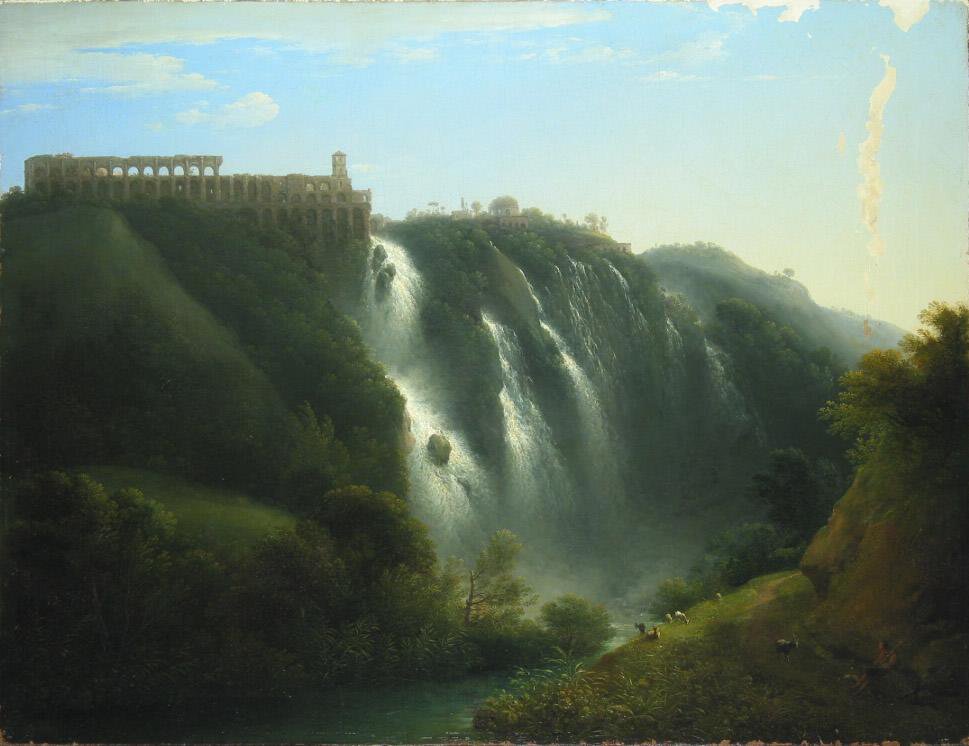
Waterfall in Italy (Tivoli, Lazio). The State Hermitage Museum.
The painting entered the Hermitage in 1919 from the collection of A. K. Rudanovsky. It is not currently on permanent display.
It is a wide landscape — 111 by 146 centimetres — showing the falls of the Aniene at Tivoli, with a ruined Roman temple on the cliff above and a green gorge below.
The Object
The painting is horizontal, and it is built around the waterfall.
At the left, a long ruined arcade and a round temple stand on the edge of a cliff; from the cliff, several streams of water fall into a deep green gorge. In the foreground, trees, rocks and a slope of grass; at the lower right, a few tiny figures.
The sky is pale blue, with soft clouds, and the light is that of a clear Italian day.
Tivoli
Tivoli is a town in the hills east of Rome.
It was famous for its waterfalls, its ancient villas and its views, and it was one of the essential stops of the Grand Tour. Travellers came to see the falls, the Temple of Vesta and the Villa d’Este, and artists came to paint them.
The falls of the Aniene were among the most painted landscapes in Europe, and every landscape painter who visited Rome tried his hand at them.
The Temple
The round temple on the cliff is the Temple of Vesta, or the Temple of the Sibyl.
It is a small circular building with columns, and it stands at the edge of the gorge, above the falls. In the painting, it is a pale silhouette against the sky, and the long arcade beside it extends to the left.
The temple is the painting’s classical note: antiquity, ruins, and the Italian landscape, all in one view.
The Falls
The falls are the painting’s centre.
The water drops in several streams from the cliff, and it is painted in white and pale grey, with a mist rising from the bottom. The streams are not a single mass but a series of veils, each with its own edge.
The falls give the painting its movement and its sound: even in paint, they seem to roar.
The Gorge
The gorge is the painting’s depth.
It is a deep green hollow, filled with trees and bushes, and it opens toward the foreground. The water collects at the bottom, and a river runs out of the picture at the lower left.
The green of the gorge is the painting’s dominant colour, and it sets off the white of the falls and the blue of the sky.
The Figures
A few tiny figures stand at the lower right.
They are shepherds or travellers, painted in a few strokes, and they give the landscape its scale. Their smallness emphasises the size of the falls and the height of the cliff.
Figures of this kind are a convention of landscape painting: they make the scene legible by giving it a human measure.
The German Artist
The painting is attributed to an anonymous German artist.
German painters were among the most enthusiastic travellers to Italy in the eighteenth century, and many of them settled in Rome, where they formed a colony of artists. They painted views of the city and its surroundings for the market of Grand Tour travellers.
This painting belongs to that tradition: a German view of an Italian landscape, painted for a Northern collector.
The Date
The date is given as the late eighteenth or early nineteenth century.
It was a period of transition in landscape painting: the classical view was giving way to the romantic landscape, and painters were beginning to value wildness and atmosphere over clarity.
This painting stands between the two: it is a classical view, but its mist and its scale already suggest the romantic taste.
The Sky
The sky is pale blue, with soft white clouds.
It fills the upper part of the canvas, and it gives the scene its light. The blue is clear and slightly cool, and it contrasts with the green of the gorge and the white of the water.
A sky of this kind is a classical convention: it is serene, luminous and unchanging, and it frames the landscape below.
The Light
The light falls from the left.
It catches the temple, the falls and the tops of the trees, and it leaves the gorge in shadow. The contrast between the lit cliff and the dark hollow is the painting’s main visual structure.
The light is clear and even, without the dramatic contrasts of romantic painting: it is the light of a classical view.
The Grand Tour
The painting belongs to the culture of the Grand Tour.
Young aristocrats travelled to Italy to complete their education, and they bought paintings, prints and souvenirs to bring home. Views of Tivoli, Rome and Venice were among the most popular purchases.
The painting was made for that market: a large, impressive view, suitable for a gallery or a drawing room in the North.
The Foreground
The foreground is green and soft.
Trees, bushes and a slope of grass fill the lower part of the canvas, and they frame the falls. The foreground is painted loosely, with broad strokes, and it leads the eye into the scene.
A dark, textured foreground is a device of landscape painting: it pushes the view back and makes it appear deeper.
The Ruin
The arcade is a ruin.
It is a long, broken wall with arches, and it runs along the edge of the cliff to the left of the temple. Its stones are pale, and its arches are open to the sky.
The ruin gives the landscape its historical depth: it is a reminder that the Roman past is still present in the Italian landscape, and that time has passed over it.
The Composition
The composition is built on a diagonal.
The cliff runs from the left to the centre, the falls drop in the middle, and the gorge opens to the right. The eye follows the cliff, then the water, then the valley.
This arrangement gives the painting its movement, and it balances the solid mass of the cliff with the openness of the sky and the gorge.
Provenance
The painting carries the inventory number GE-5479 and entered the Hermitage in 1919 from the collection of A. K. Rudanovsky.
In the Hermitage
The painting is preserved in the State Hermitage Museum in Saint Petersburg and is not on permanent display.
It is a fine example of the Italian landscape tradition, and it preserves a view that has been painted a thousand times: the falls of Tivoli, the temple, the gorge and the light.
It is also a record of a journey: a German painter, an Italian view, and a memory carried north.