A. K. Rudanovsky’s Antique Boutique on Nevsky Avenue
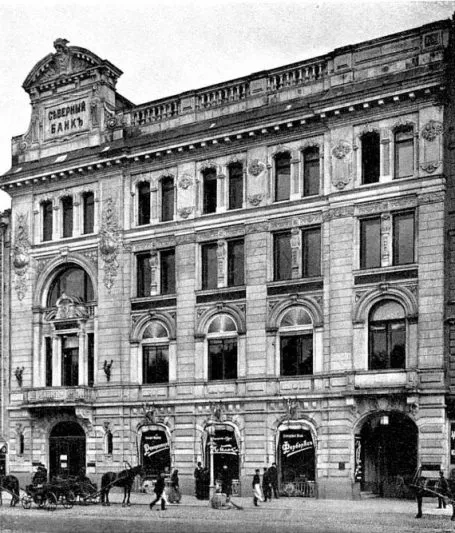
At 62 Nevsky Avenue in St. Petersburg, an address preserved in the historical Rudanovsky records, stood a place associated with the antique business of A. K. Rudanovsky.
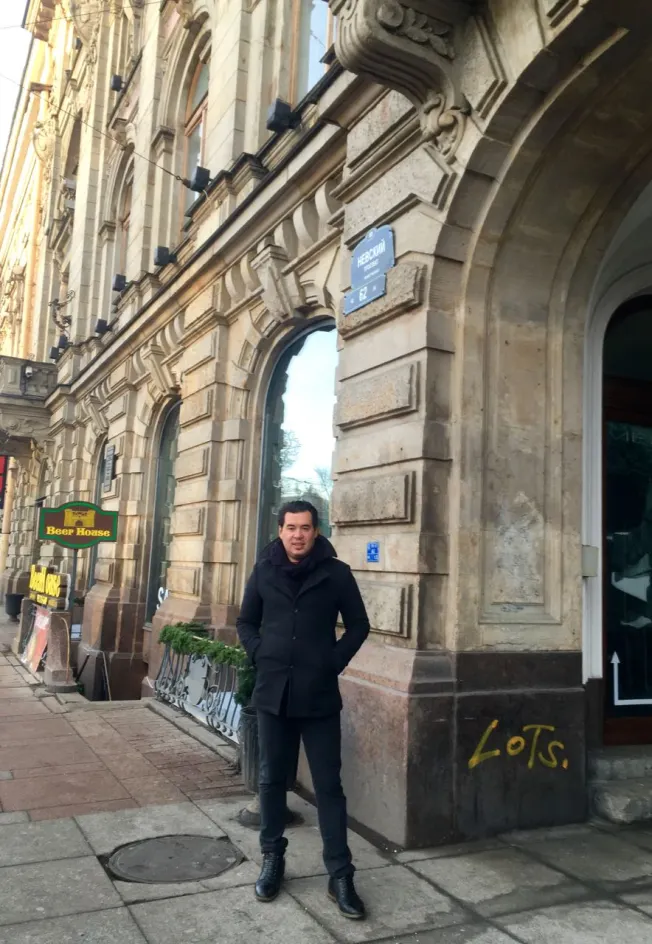
A surviving historical photograph records the location in 1910, while a second photograph taken in 2017 returns to the same address more than a century later.
Placed together, the two images create a simple but powerful connection between the history of the Rudanovsky family and the modern city.
Nevsky Avenue, 62
Nevsky Avenue has long been one of the principal streets of St. Petersburg.
Running through the historical centre of the city, it became a major commercial and cultural artery, lined with shops, hotels, restaurants, publishing houses and other businesses.
For an antique dealer and collector, such an address placed the business within the commercial life of Imperial St. Petersburg.
The Rudanovsky record identifies Nevsky Avenue 62 with the antique boutique of A. K. Rudanovsky and dates the historical image to 1910.
St. Petersburg in 1910
The photograph belongs to the final years of Imperial Russia.
In 1910, the city was still officially known as St. Petersburg. It would be renamed Petrograd only in 1914, following the outbreak of the First World War.
This distinction is worth preserving when looking at the historical record: although the original Rudanovsky caption described the image as “Petrograd 1910,” the historically accurate name of the city at that date was St. Petersburg.
The photograph therefore captures Nevsky Avenue during the last decade of the Russian Empire, before war, revolution and the enormous political and social changes that transformed the city.
A. K. Rudanovsky and the World of Collecting
The address forms part of the wider history surrounding A. K. Rudanovsky and the collection of European art associated with his name.
The surviving Rudanovsky records document works connected with Italian Renaissance art, French painting, Flemish and German masters, portraiture, sculpture and decorative art.
Many of these works would later become associated with the collection of the State Hermitage Museum.
Against that wider history, the antique business on Nevsky Avenue provides something different from an individual painting or sculpture.
It gives the collection a physical location.
Instead of looking only at the objects that survived, we can also look at the urban environment in which the activities of a collector and antique dealer took place.
The Antique Trade in Imperial St. Petersburg
At the beginning of the twentieth century, St. Petersburg was one of the great cultural capitals of Europe.
Private collecting played an important role in its artistic life. Works of art moved between aristocratic collections, dealers, auctions and private buyers, while objects from different periods and European schools circulated through an international art market.
Antique dealers occupied an important position within this world.
They connected objects with collectors and helped move paintings, sculpture, furniture, jewellery and decorative art between private collections.
The historical reference to the Rudanovsky boutique places A. K. Rudanovsky within this broader culture of collecting and dealing that existed in the Russian capital before the Revolution.
One Address, Two Photographs
More than a century separates the two photographs preserved with the original article.
The first records Nevsky Avenue 62 in 1910.
The second shows the location again in 2017.
Buildings survive differently from the people and businesses that once occupied them. Their façades can be altered, interiors reconstructed and functions completely changed, yet the physical address remains fixed within the city.
That is what makes the comparison particularly valuable.
The modern photograph is not simply an illustration of St. Petersburg. It returns to a specific place connected with the Rudanovsky family history.
1910 → 2017
The two images span 107 years.
Between them came the First World War, the Russian Revolution, the renaming of St. Petersburg as Petrograd and later Leningrad, the Soviet period, the Second World War and the Siege of Leningrad, the dissolution of the Soviet Union and the restoration of the city’s historical name.
Yet the address remains:
62 Nevsky Avenue, St. Petersburg.
The comparison between 1910 and 2017 therefore transforms an ordinary street address into a physical point connecting two very different periods of the city’s history.
A Physical Trace of the Rudanovsky Story
Much of the history of a collection survives through objects.
A painting retains an inventory number. A sculpture appears in a museum catalogue. A document preserves a name or date.
Places provide another kind of evidence.
They allow family history to be connected with the physical geography of a city.
For the history of the Rudanovsky family, Nevsky Avenue 62 is one such place — an address preserved alongside the story of A. K. Rudanovsky and his activities as an antique dealer and collector.
The photographs of 1910 and 2017 bring those two worlds together.
One belongs to the city in which the Rudanovsky collection was being formed.
The other belongs to the city more than a century later.
The address stands between them.