Artist: French sculptor, 18th century
Origin: France
Date: 18th century
Material: marble
Dimensions: 68 × 43 cm
Current Collection: The State Hermitage Museum
Inventory Number: N.sk-1176
Hermitage ID: 40455
Rudanovsky Connection: Entered the Hermitage in 1920 from the collection of A. K. Rudanovsky.
A French marble bust of the eighteenth century, described in the museum record as a Nubian boy.
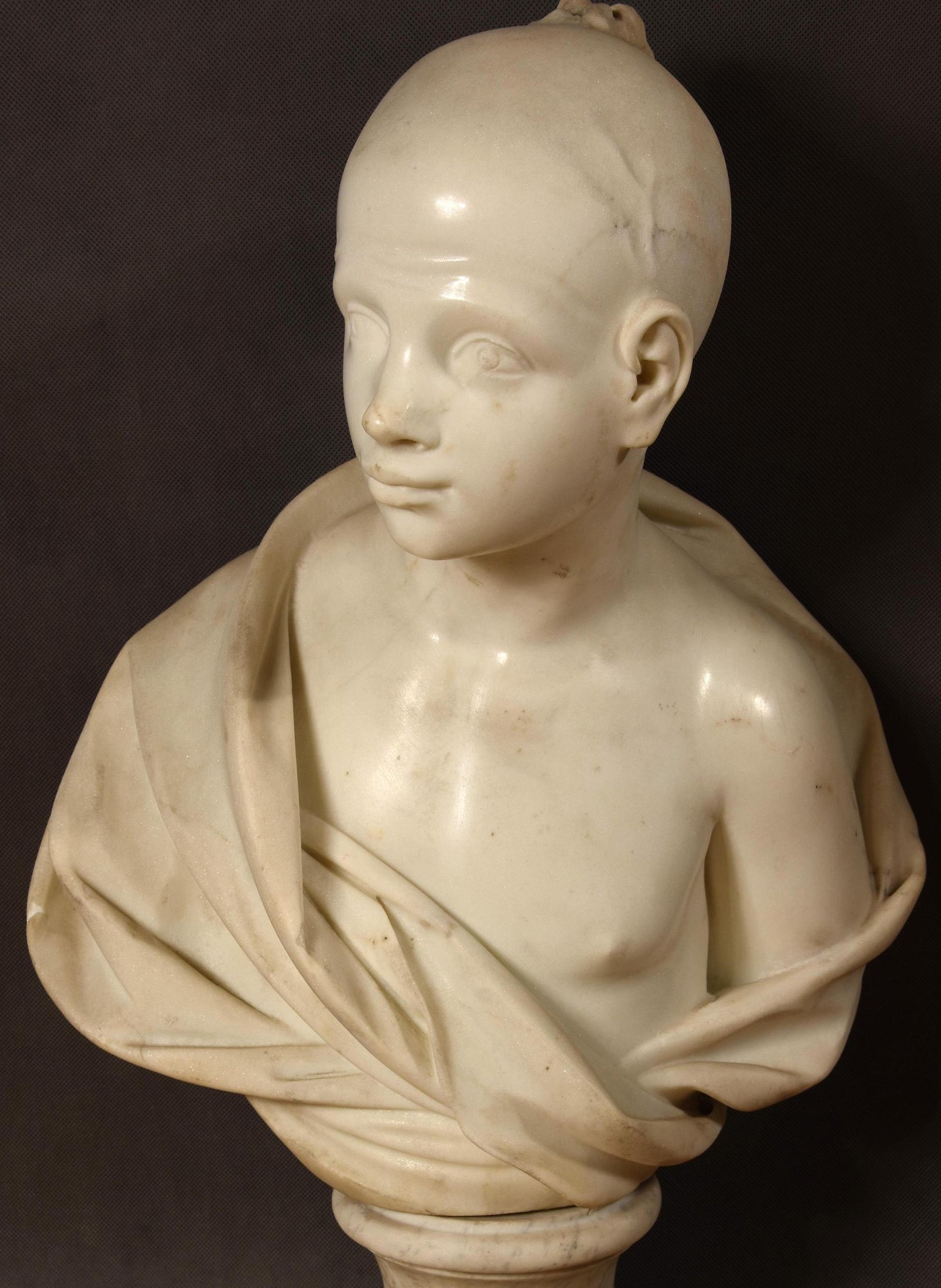
A Nubian Boy. The State Hermitage Museum.
The bust entered the Hermitage in 1920 from the collection of A. K. Rudanovsky, through the State Museum Fund. It is not currently on permanent display.
It is a white marble bust of a boy, his head tilted up and to the left, a length of drapery over one shoulder.
The Object
The bust shows a boy from the chest up.
His head is turned and raised, and his face is young, with full lips, a broad nose and large eyes. His hair is short, and a small knot or tuft is visible at the top of the head.
A drapery crosses his shoulders and falls over the chest, leaving the shoulders bare.
The Boy
The boy’s identity is unknown.
Like the companion bust of a young woman in the same collection, he is described by a term that reflects the European vocabulary of the eighteenth century rather than a documented origin. He may be a portrait of a real person, or a study of a type.
His face is observed with care: the sculptor has given him an individual expression, and his upward gaze gives him a quality of attention or wonder.
The Pose
The pose is the bust’s most striking feature.
The head is tilted back and turned to the side, and the eyes look upward. It is a pose of listening or of looking at something above, and it gives the boy an air of life.
In eighteenth-century sculpture, the turned head was a way of animating a portrait: it suggested movement, curiosity and a world beyond the bust.
The Drapery
The drapery is classical.
It crosses the shoulders and falls over the chest in soft folds, and it is carved with attention to the cloth’s weight. The drapery is a European convention, and it connects the boy to the tradition of antique sculpture.
At the same time, it leaves the shoulders and chest bare, and the contrast between cloth and skin is one of the bust’s pleasures.
French Sculpture
The bust belongs to French sculpture of the eighteenth century.
French sculptors of the period produced portraits, allegories, garden figures and studies of heads, and there was a fashion for expressive heads — the têtes d’expression — and for figures of foreign or exotic types.
This bust belongs to that fashion, and it is also a portrait: a specific face, modelled with care.
The Pair
The boy has a companion in the collection: the bust of a young woman, also described as Nubian, also French and eighteenth-century, and of similar size.
The two are not documented as a pair, but they are related in style and subject, and they were both in the Rudanovsky collection. Seen together, they form a small group of portraits of Black sitters.
The Label
The term «Nubian» is part of the object’s record.
In the eighteenth century, European artists and writers used «Nubian», «Ethiopian» and «Moor» loosely, to describe people of African descent. The terms were not neutral: they marked difference, and they were part of a culture that was built on slavery and colonial trade.
The bust should be seen in that context: a fine object, made in a society that was also a society of exploitation.
The Marble
The bust is carved in white marble.
Marble was the material of the finest sculpture, and it was used for portraits, allegories and garden figures. It is hard and translucent, and it takes a high polish.
The marble here is warm white, with a few veins, and its surface is smooth and slightly polished.
The Hair
The boy’s hair is short.
It is carved close to the skull, with a small knot or tuft at the top, and it is described with fine lines. The hairline is high, and the forehead is broad.
Hair is a test of a sculptor’s skill, and here it is treated simply: a few lines, a knot, and the shape of the skull.
The Gaze
The gaze is the bust’s centre.
The boy looks up and away, and his eyes are wide, with carved lids. He seems to be looking at something beyond the viewer, and his expression is one of attention rather than of fear or sadness.
That upward gaze is what gives the bust its life, and it is what makes it a portrait rather than a type.
The Base
The bust rests on a small circular base.
It is a plain marble disc, and it supports the figure and turns the bust into a self-contained object. The base is slightly darker than the bust, and it has a few chips.
Bases of this kind were standard for busts of the period: they allowed the sculpture to stand on a pedestal or a shelf.
The Collector
The bust came to the Hermitage with the Rudanovsky collection.
Rudanovsky collected European art of many kinds, and his collection included sculpture as well as paintings, porcelain, glass and miniatures. Small busts like this one were part of his cabinet.
The bust is therefore a double document: of eighteenth-century French sculpture and of a Russian collector’s taste.
The Shoulders
The shoulders are bare.
The drapery crosses the chest and leaves the shoulders exposed, and the marble is polished to suggest the skin. The shoulders are narrow and round, and they belong to a child’s body.
The contrast between the bare chest and the heavy drapery is one of the bust’s visual pleasures, and it gives the figure its softness.
The Ear
The ear is carved with care.
It is large and well defined, with a lobe and a helix, and it is one of the details that make the head feel real. In sculpture, ears are difficult: they are small, complex and easy to get wrong.
Here the ear is correct, and it is one of the signs of a skilled hand.
Provenance
The bust carries the inventory number N.sk-1176 and entered the Hermitage in 1920 from the collection of A. K. Rudanovsky, through the State Museum Fund.
In the Hermitage
The bust is preserved in the State Hermitage Museum in Saint Petersburg and is not on permanent display.
It is a fine example of eighteenth-century French sculpture, and it is also a document: a face, a drapery and a gaze, carved in marble, and a record that tells us less about him than we would like.
He looks up at something we cannot see, and the gesture is still legible after two centuries, in a museum store in Saint Petersburg, on a shelf, beside a bust of a young woman who may have been his companion, and who looks up at something of her own, in the same dark store, in the same city, on the same day, and neither of them knows it, and both of them are still here, in marble, in a store, outlasting everything.