Artist: French sculptor, 18th century
Origin: France
Date: 18th century
Material: bronze
Technique: cast, gilding
Dimensions: height 20 cm
Current Collection: The State Hermitage Museum
Inventory Number: N.sk-1180
Hermitage ID: 40456
Rudanovsky Connection: Entered the Hermitage in 1920 from the collection of A. K. Rudanovsky.
A small French bronze statuette of the eighteenth century showing a young woman with a cupid on her shoulders.
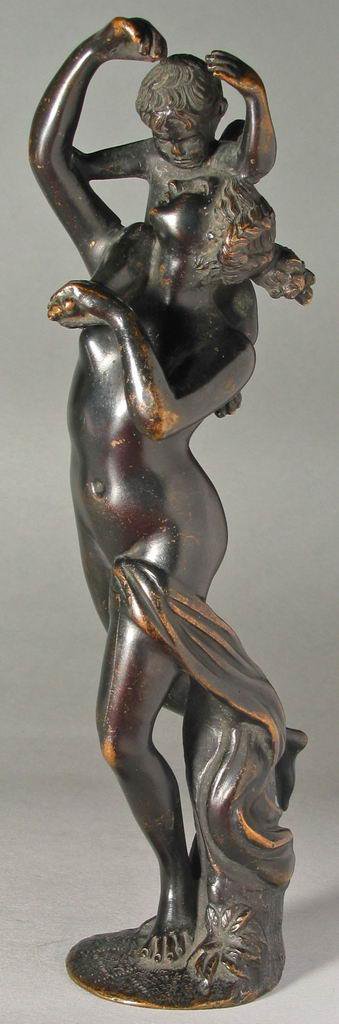
Young Woman and Cupid. The State Hermitage Museum.
The statuette entered the Hermitage in 1920 from the collection of A. K. Rudanovsky, through the State Museum Fund. It is not currently on permanent display.
It is a small bronze — 20 centimetres high — of a standing nude woman, with a winged child climbing on her back.
The Object
The group is cast in bronze, and it is dark brown, with traces of gilding in the recesses.
The woman stands on a small base, her body turned slightly, her left arm raised to her head. A cupid, small and winged, climbs on her shoulders behind her, his arms around her head, his legs on her back.
A tree stump supports the group at the base, and a cloth falls over it.
The Group
The group is a composition of two bodies.
The woman is tall and slender, and her pose is relaxed, almost languid. The cupid is small and energetic, and his position on her shoulders makes him a second head, a small figure above the large one.
The composition is playful: the cupid seems to be teasing her, or whispering to her, and the woman’s raised arm suggests that she is responding.
The Woman
The woman is nude.
Her body is modelled with care: the breasts, the waist, the hips and the legs are all described, and her skin is smooth and polished. Her hair is gathered at the back of her head.
Her pose is elegant and slightly unstable: she stands on one leg, with the other slightly bent, and her raised arm gives her body a spiral movement.
Cupid
Cupid is the group’s second figure.
He is a winged child, and he is climbing on the woman’s shoulders, his arms around her head. His body is small and plump, and his face is turned toward hers.
Cupid was a favourite figure of eighteenth-century sculpture, and his presence turns the group into a scene of love: the god of desire, playing with a mortal woman.
The Bronze
The group is cast in bronze.
Bronze was the material of small sculpture: it is durable, it takes fine detail and it can be gilded or patinated. It was used for statuettes, medals, mounts and decorative objects.
The bronze here is dark, with a warm brown patina, and traces of gilding remain in the recesses.
The Patina
The patina is part of the object.
It is the dark, slightly green-brown surface that bronze develops with age, and it protects the metal and gives it its colour. The patina here is uneven: the high points are worn and lighter, and the recesses are darker.
Patina is one of the signs of age in a bronze, and collectors value it as much as the form.
The French Sculptor
The sculptor is unknown.
The statuette is attributed to a French sculptor of the eighteenth century, and it belongs to the tradition of small bronzes after models by the great sculptors of the period. Such statuettes were made in series, and they were collected by amateurs.
The subject — a woman and a cupid — is typical of the French Rococo, with its taste for love, playfulness and the nude.
The Scale
At 20 centimetres, the statuette is small.
It was made for a table, a shelf or a cabinet, and it was meant to be held and examined. Its small size invites close looking, and it makes the group an intimate object.
Small bronzes were a collector’s genre: they allowed amateurs to own a version of a large sculpture, and they were arranged in cabinets and on desks.
The Base
The statuette stands on a small base.
It is cast with the group, and it is modelled as a piece of ground, with a tree stump and a cloth. The stump supports the woman’s leg and gives the group stability.
Bases of this kind are common in small bronzes: they are part of the composition, and they solve the problem of standing a figure upright.
The Arm
The woman’s raised arm is the group’s most expressive gesture.
Her left arm is lifted to her head, and her hand is hidden in her hair or behind her head. The gesture is ambiguous: it could be a response to the cupid, a movement of the hair, or a pose of modesty.
That ambiguity is part of the group’s charm, and it gives the figure a moment of life.
The Nude
The woman is nude, and the group is a study of the female body.
The nude was a central subject of eighteenth-century sculpture, and it was used for goddesses, nymphs, bathers and allegories. The body was modelled with attention to anatomy and to the play of light.
The nude here is graceful rather than sensual, and its small scale makes it an object of contemplation rather than of display.
The Cabinet
The statuette was made for a cabinet.
It is a small, precious object, designed to stand on a table or a shelf among other bronzes, marbles and curiosities. It was collected by amateurs, and it was admired for its finish and its subject.
Small bronzes were a way of owning sculpture: they brought the art of the great studios into the private house.
The Wings
The cupid’s wings are small and folded.
They rise from his shoulders, and they are modelled with a few feathers, and they identify him as a winged god rather than a human child. The wings are dark bronze, like the rest, and they catch a little light on their edges.
Wings are the attribute of Cupid, and their small size keeps the figure childlike.
The Cloth
A cloth falls over the tree stump.
It is modelled in soft folds, and it serves as a support for the composition and as a contrast to the nude bodies. The cloth is dark bronze, and it is one of the few areas of texture in the group.
Drapery in a small bronze is a test of the casting: it must be thin and detailed, and it must survive the pour.
Provenance
The statuette carries the inventory number N.sk-1180 and entered the Hermitage in 1920 from the collection of A. K. Rudanovsky, through the State Museum Fund.
In the Hermitage
The statuette is preserved in the State Hermitage Museum in Saint Petersburg and is not on permanent display.
It is a small, lively object, and it preserves a scene of playfulness: a woman, a cupid and a dark bronze base, in the space of a hand.
It is a private object, made for a cabinet and a quiet hour, and it has kept its small drama intact, in bronze, for more than two hundred years, in a cabinet, in the dark, waiting to be picked up and looked at again, by someone who has not yet been born.