Artist: French sculptor, 18th century
Origin: France
Date: early 18th century
Material: marble
Dimensions: 49 × 37 cm
Current Collection: The State Hermitage Museum
Inventory Number: N.sk-1191
Hermitage ID: 40458
Rudanovsky Connection: Entered the Hermitage in 1920 from the collection of A. K. Rudanovsky.
A French marble bust of the early eighteenth century representing Winter as an old man wrapped in a cloak.
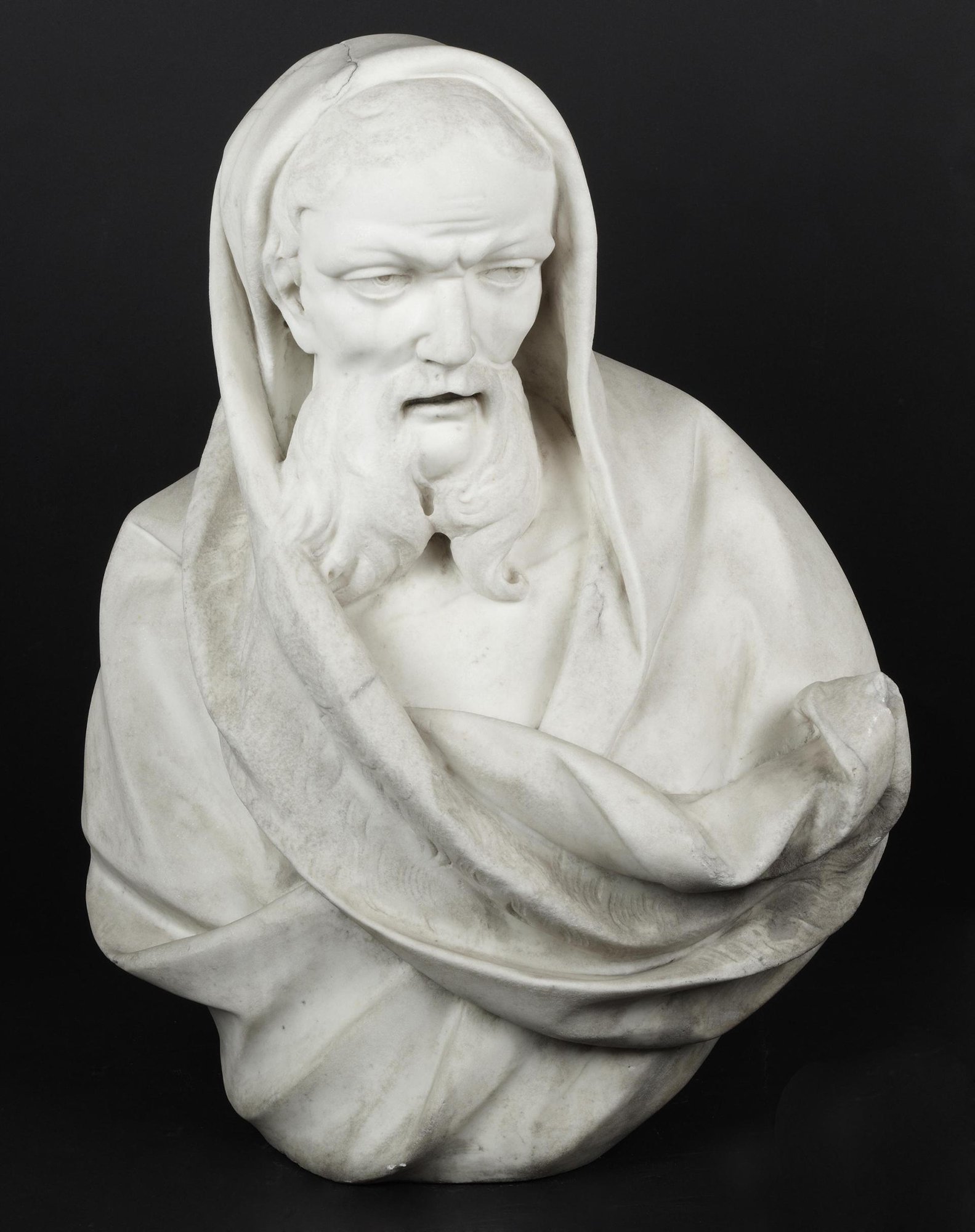
Allegory of Winter. An Old Man. The State Hermitage Museum.
The bust entered the Hermitage in 1920, transferred from the State Museum Fund and previously in the collection of A. K. Rudanovsky. It is not currently on permanent display.
It is a white marble bust of a bearded old man, his head covered by a heavy hood, his body wrapped in a cloak.
The Object
The bust is carved in white marble, and it is almost life-size.
The man’s head is covered by a hood that falls over his shoulders, and his body is wrapped in a thick cloak, its folds carved in deep, full curves. His face is aged, with a long beard and furrowed brows, and his mouth is slightly open.
He looks down and to the side, and his expression is one of cold and discomfort.
Winter
The bust represents Winter.
In the iconography of the seasons, Winter is usually shown as an old man, wrapped in a cloak, shivering or warming himself at a fire. Age and cold are the two attributes of the season.
The bust follows that tradition: the hood, the cloak and the old face are all signs of winter, and the sculpture is an allegory rather than a portrait.
The Seasons
The four seasons were a favourite subject of Baroque and Rococo sculpture.
They were represented as allegorical figures — Spring as a young woman with flowers, Summer with corn, Autumn with grapes, Winter as an old man. They were often made in sets, for gardens, palaces and galleries.
This bust was probably part of such a set, or it was made as an independent allegory for a collector.
The Old Man
The old man is the bust’s subject.
His face is carved with attention to age: the sunken cheeks, the deep lines, the long beard. His mouth is open, as if he were breathing in cold air, and his brows are drawn together.
The expression is not dignified but human: this is a man who is cold, and who is old, and who is enduring it.
The Cloak
The cloak is the bust’s largest element.
It wraps around the body in heavy folds, and it is carved with great skill: the cloth is thick, and its curves catch the light. The hood covers the head, and the cloak falls to the base in a series of loops.
Drapery was one of the great tests of a sculptor, and this bust shows a master’s hand: the cloth is heavy, soft and convincing.
The Marble
The bust is carved in white marble.
Marble was the material of choice for allegorical sculpture: it is hard, translucent and capable of a high polish, and it can suggest both flesh and cloth. The surface here is smooth, with a few stains and chips.
The white of the marble gives the bust a cold, wintry quality — an effect that the sculptor may have intended.
The French Sculptor
The sculptor is unknown.
The bust is attributed to a French sculptor of the early eighteenth century, and it belongs to the tradition of French allegorical sculpture: elegant, expressive and technically refined.
Many such busts were made in Paris and in the provinces, for palaces, gardens and collectors, and their sculptors are often anonymous.
The Bust
The bust is a specific form.
It shows the head and shoulders, cut off at the chest or the waist, and it was designed to stand on a pedestal, a bracket or a shelf. Busts were collected, displayed in galleries and used as architectural decoration.
This one is large enough to be a presence in a room, and its subject — winter, age, cold — gives it a melancholy character.
The Mouth
The mouth is slightly open.
It is a small detail, but it changes the face: the old man seems to be breathing, or speaking, or shivering. The open mouth gives the bust its sense of life, and it makes the cold visible.
Sculptors often used the open mouth for expressions of pain, effort or age, and here it is used for cold.
The Hood
The hood covers the head and falls over the shoulders.
It is part of the cloak, and it frames the face like a cowl. The hood gives the figure a monastic, almost hermit-like look, and it adds to the sense of cold and withdrawal.
The hood is carved with deep folds, and its shadow darkens the face.
The Four Seasons
The four seasons were a standard subject of decorative sculpture.
They were made for gardens, palaces, galleries and fountains, and they were often part of a set. Each season had its attributes: flowers for Spring, corn for Summer, grapes for Autumn, and a cloak, a fire or an old man for Winter.
This bust is Winter, and it was probably made as part of such a set.
The Garden
Many season-busts were made for gardens.
They stood in grottoes, on balustrades or in pavilions, among plants and water, and they were part of the theatrical decoration of a park. Their subjects — the seasons, the elements, the continents — gave the garden a cosmic dimension.
This bust may have stood in such a setting, or it may have been made for an interior.
The Base
The bust ends in a rounded base.
It is carved as a swirl of cloth, and it supports the figure without a pedestal. The base is part of the composition: it turns the bust into a self-contained object.
Bases of this kind are common in eighteenth-century busts: they allow the sculpture to stand on a flat surface without a separate support.
The Expression
The expression is the bust’s emotional core.
The frown, the open mouth, the downcast eyes: the old man is cold, and he is enduring it. The sculptor has given him dignity as well as discomfort, and the result is a figure that is both allegorical and human.
That double quality is what makes the bust memorable.
The Beard
The beard is long and carved in separate locks.
It falls from the chin over the chest, and its strands are incised with fine lines. The beard is a sign of age, and it gives the face its patriarchal character.
In allegorical sculpture, the beard was a standard attribute of old men, and here it is one of the elements that make the bust Winter.
Provenance
The bust carries the inventory number N.sk-1191 and entered the Hermitage in 1920, transferred from the State Museum Fund and previously in the collection of A. K. Rudanovsky.
In the Hermitage
The bust is preserved in the State Hermitage Museum in Saint Petersburg and is not on permanent display.
It is a fine example of French allegorical sculpture, and it preserves a figure that is both a season and a man: an old face, a heavy cloak and a block of cold white marble.