Origin: Russia, Moscow
Date: second half of the 18th century
Material: silver, rubies, rock crystal, coloured glass, garnet, citrine, enamel
Technique: painted, nielloed, chased
Dimensions: 12.9 × 7.6 cm
Current Collection: The State Hermitage Museum
Inventory Number: E-10926
Hermitage ID: 148112
Rudanovsky Connection: Entered the Hermitage in 1919 from the collection of A. K. Rudanovsky.
A Russian pectoral cross of the second half of the eighteenth century, made in Moscow of silver, rubies and rock crystal.
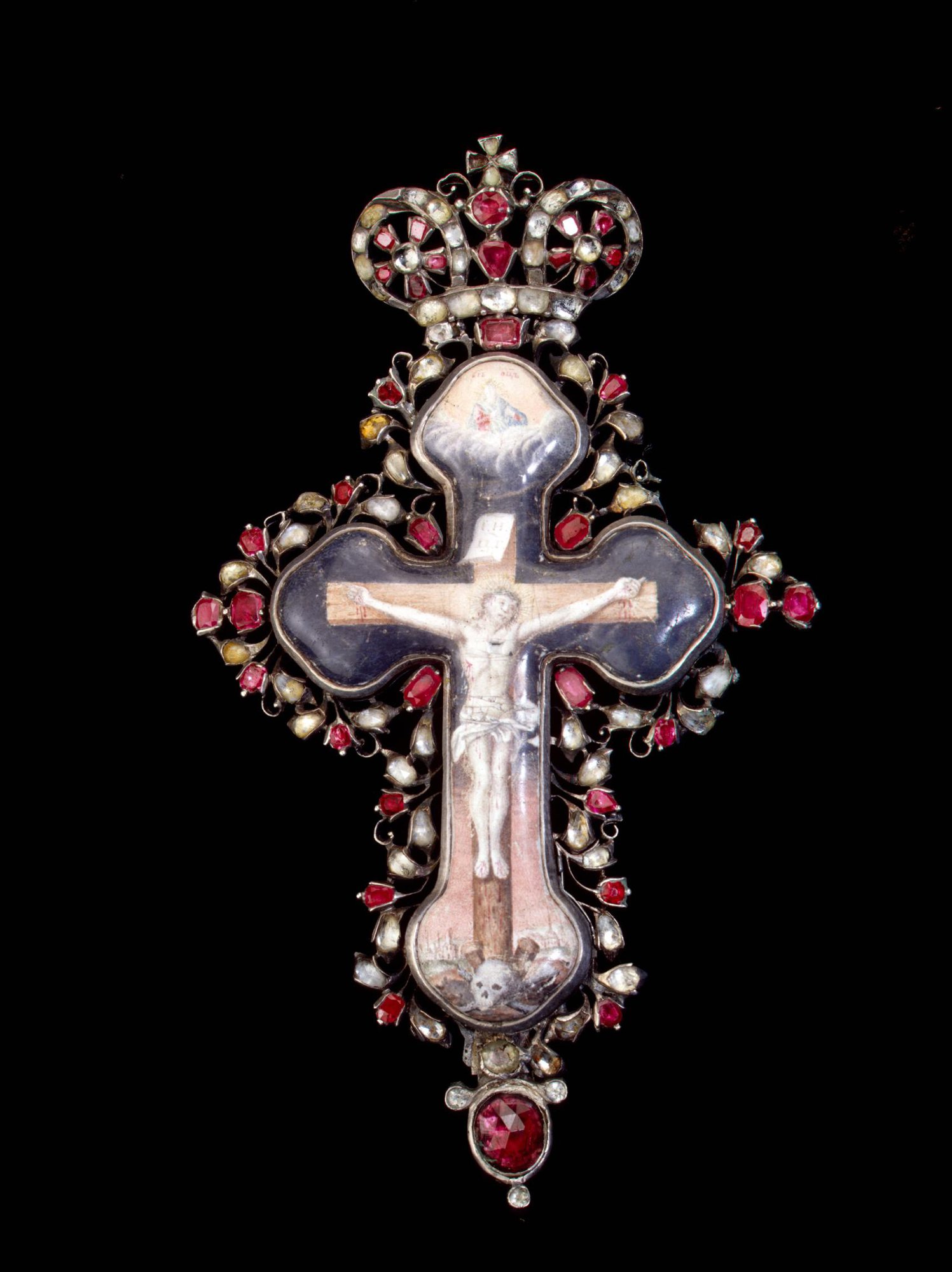
Pectoral Cross: Crucifix. The State Hermitage Museum.
The cross was handed over from the former Museum of the Decorative and Applied Arts, and it was originally in the collection of A. K. Rudanovsky. It is on display in the New Hermitage, in room 124, in the Treasure Gallery.
It is a small, precious object — 12.9 by 7.6 centimetres — made of silver, set with red stones and covered with a painted crucifix under crystal.
The Object
The cross has the shape of a Latin cross, with flared arms and a heavy, rounded base.
On the front, under a cover of rock crystal, a crucifix is painted: Christ on the cross, with a landscape and a skull at the foot. The cross is surrounded by a border of silver branches set with red stones — rubies, garnets and coloured glass.
Above the cross, a crown is mounted, also set with stones, and a large red stone hangs at the bottom.
The Cross
The pectoral cross is a liturgical object.
It is worn by a priest or a bishop on the chest, over the vestments, and it is a sign of office and of faith. Pectoral crosses were made in precious materials — gold, silver, enamel, precious stones — and they were often gifts from a bishop or a sovereign.
This cross is a particularly rich example, and its size and its stones suggest a high-ranking owner.
The Crucifix
The crucifix is painted, not carved.
It is a small painting on a panel, covered by a piece of rock crystal, and it shows Christ on the cross, with the two thieves, a landscape and a skull at the foot. The painting is in the style of Russian icon painting of the eighteenth century.
The crystal protects the painting and gives it a luminous, jewel-like quality: the image seems to float under the transparent stone.
The Crown
A crown is mounted above the cross.
It is made of silver, set with red stones and pearls, and it is shaped like an imperial crown, with a cross at the top. The crown is a symbol of the sovereignty of Christ, and it gives the object a royal, ceremonial character.
Crowns of this kind are common on Russian church objects: they mark the cross as a sign of the Kingdom of God.
The Stones
The stones are the cross’s colour.
Rubies, garnets, citrines and coloured glass are set in silver branches around the cross and in the crown. Their reds and yellows glow against the silver, and they catch the light.
Red stones were especially valued in Russian church silver: they symbolised the blood of Christ, and they gave the object its warmth.
The Silver
The silver is chased and nielloed.
The branches around the cross are chased, with leaves and scrolls; the back of the cross may be nielloed, with a pattern in black silver. Niello is a technique of engraving filled with a black alloy, and it was a speciality of Russian and Moscow silversmiths.
The silver gives the object its structure, and its dark patina sets off the stones.
The Treasure Gallery
The cross is displayed in the Treasure Gallery of the Hermitage.
The gallery is devoted to precious objects: jewellery, gold and silver, weapons and church plate. It is one of the most spectacular parts of the museum, and it is where the smallest objects are the most precious.
The cross is a good example of the gallery’s holdings: a small, rich object, made for a specific use and a specific owner.
Russian Church Silver
Russian church silver has a long tradition.
Moscow was the centre of the silversmith’s art, and its workshops produced chalices, crosses, censers and covers for icons. The objects were made for churches and monasteries, and they were often donated by the tsar, the boyars or wealthy merchants.
This cross belongs to that tradition, and it shows the richness of Russian liturgical art in the eighteenth century.
The Painted Image
The crucifix is a painting, not a carving.
It was painted on a small panel, in the tradition of Russian icon painting, and it is covered by rock crystal. The image shows Christ on the cross, with the spear and the sponge, a landscape and a skull at the foot.
Painting under crystal is a technique of Russian church art: it protects the image and gives it a luminous, jewel-like quality.
The Crystals
The rock crystal is the cross’s transparent cover.
It is a piece of clear quartz, cut and polished, and it fits over the painted image. The crystal protects the painting, and it catches the light.
Crystal was a precious material in the eighteenth century, and it was used for reliquaries, crosses and icons.
The Owner
The cross was made for a high-ranking owner.
Its size, its stones and its painting suggest a bishop, an archimandrite or a wealthy patron. Pectoral crosses of this kind were signs of office, and they were worn on solemn occasions.
The cross later passed into the Rudanovsky collection, and from there to the Hermitage.
The Crown’s Cross
The crown is topped by a small cross.
It is a detail, but it completes the object: the crown of Christ, surmounted by the sign of his death and victory. The small cross is set with stones, and it catches the light.
Crosses on crowns are a common motif in Christian art, and here they link the crown to the crucifix below.
The Chain
The cross was worn on a chain.
The chain is not preserved, or it is not shown, but the cross has a loop at the top, behind the crown, for suspension. The loop is small and functional, and it is part of the object’s design.
A pectoral cross without a chain is still a cross, but it was made to hang on the chest, over the heart.
The Shape
The cross has flared arms and a rounded base.
It is not a simple Greek or Latin cross: its arms widen at the ends, and its base is a rounded lobe. This shape is characteristic of Russian pectoral crosses of the eighteenth century.
The shape gives the object its elegance, and it makes the cross look like a piece of jewellery as much as a liturgical object.
Provenance
The cross carries the inventory number E-10926. It was handed over from the former Museum of the Decorative and Applied Arts (the Central School of Technical Drawing of Baron A. L. Stieglitz), and it was originally in the collection of A. K. Rudanovsky.
In the Hermitage
The cross is on display in the New Hermitage, in room 124, in the Treasure Gallery.
It is a small, precious object, and it preserves a world of faith and craftsmanship: a cross, a crown, a painted crucifix and a border of red stones, all made in Moscow in the eighteenth century.