Artist: Quiringh van Brekelenkam (1622/30–1669/79)
Origin: Holland
Date: 1663
Material: panel
Technique: oil
Dimensions: 23 × 19 cm
Current Collection: The State Hermitage Museum
Inventory Number: GE-6324
Hermitage ID: 44622
Rudanovsky Connection: Entered the Hermitage in 1926 from the collection of A. K. Rudanovsky.
A small Dutch painting of 1663 showing an old teacher and a boy reading at a table.
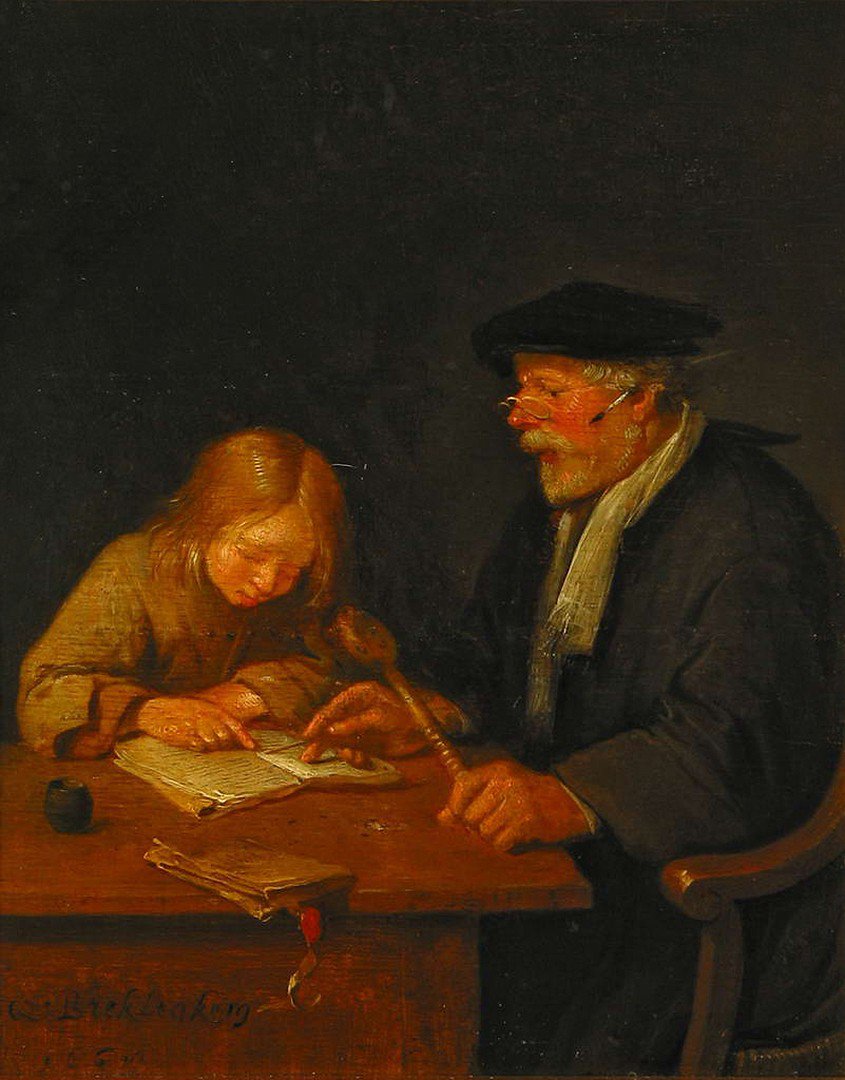
An Old Teacher and his Pupil. The State Hermitage Museum.
The painting entered the Hermitage in 1926 from the collection of A. K. Rudanovsky. It is on display in the New Hermitage, in room 250.
It is a small panel — 23 by 19 centimetres — with two figures at a table, lit from the left against a dark background.
The Object
The painting shows an old man and a boy.
The man sits at the right, wearing a dark coat, a white collar and a black cap, with spectacles on his nose. He holds a pipe or a pointer in one hand and gestures with the other toward a book.
The boy sits at the left, leaning over the book, his finger on the page. A wooden table fills the foreground, with an inkwell and a second book on it.
The Teacher
The old man is the painting’s central figure.
His face is weathered and ruddy, with a white beard and a pointed nose, and his spectacles catch the light. He leans forward, his mouth slightly open, as if he were speaking or correcting the boy.
He is a schoolmaster of the old kind: patient, severe, and entirely absorbed in his task.
The Pupil
The boy is young, with long fair hair and a plain brown jacket.
He leans over the book, his head down, his finger on the page, and his face is concentrated. He is learning to read, and the whole of his attention is on the text.
The contrast between the old man and the boy — age and youth, experience and ignorance — is the painting’s emotional core.
The Book
The book is the centre of the composition.
It lies open on the table, and both figures are oriented toward it: the boy reading, the teacher pointing. It is a large, thick book, probably a Bible or a school primer.
The book is the object that connects the two figures, and it is the reason for the painting: without it, they would be two people at a table.
The Light
The light comes from the left.
It falls on the boy’s hair, the open book and the teacher’s face, and it leaves the background in darkness. The shadows are deep and warm, and the highlights are small and precise.
This lighting is characteristic of the Leiden fijnschilders, the «fine painters» who specialised in small, detailed interior scenes.
Brekelenkam
Quiringh van Brekelenkam (1622/30–1669/79) was a Dutch painter from Leiden.
He was a pupil of Gerrit Dou, and he specialised in genre scenes: tailors, cobblers, schoolrooms, kitchens and domestic interiors. His paintings are small, carefully finished and full of quiet observation.
This panel belongs to his schoolroom subjects, and it shows his characteristic attention to faces, hands and light.
The Panel
The painting is on panel, not canvas.
Panel was the preferred support for small, highly finished paintings in the seventeenth century: it is smooth, rigid and takes fine detail. The panel is thin, and it was probably framed when new.
The small size of the panel — 23 by 19 centimetres — invites close looking, and it makes the painting an intimate object.
The Schoolroom
The schoolroom was a popular subject in Dutch art.
Painters showed teachers, pupils, books and the small dramas of learning: a boy who cannot read, a master who loses patience, a lesson that goes on too long. The subject allowed for humour, sentiment and moral comment.
This painting is gentler than most: the teacher is patient, the boy is willing, and the lesson is calm.
The Table
The table is the painting’s stage.
It is a plain wooden table, with a drawer and a carved edge, and it fills the lower foreground. On it lie the open book, a closed book and an inkwell with a quill.
The table is where the lesson happens, and it is painted with care: the grain of the wood, the shadow of the books, the small reflections of the inkwell.
The Hands
The hands are the painting’s most expressive detail.
The old man’s hand is broad and weathered, with a raised finger; the boy’s hand is small and pale, resting on the page. The two hands are close together, and their difference in age is the story of the painting.
Hands are difficult to paint, and Brekelenkam gives them as much attention as the faces.
The Inkwell
The inkwell sits at the left of the table.
It is a small, dark object, with a quill and a faint reflection, and it is one of the details that make the scene believable. Writing and reading were practical skills, and the inkwell is the tool of the lesson.
Small objects like this are the fingerprints of Dutch genre painting: they anchor the scene in everyday life.
Small Paintings
The panel is a small painting, and smallness was a virtue in Leiden.
The fijnschilders painted for a market of collectors who valued finish, detail and intimacy. Their paintings were meant to be held, examined and admired at close range, and their subjects were often domestic and quiet.
This panel belongs to that market: a small, finished image for a private collector.
The Frame
The painting would have been framed when new.
Small Dutch panels were usually set in dark wooden frames, sometimes with a gilded inner edge, and they were hung in domestic interiors among other small pictures.
The frame is lost or replaced, but the painting still carries the scale of the room for which it was made.
The Cap
The old man wears a black cap.
It is soft and shapeless, with a slight brim, and it covers his white hair. Caps of this kind were worn by scholars, schoolmasters and old men, and they are a sign of age and learning.
The cap also frames his face, and its darkness contrasts with his white beard and his ruddy skin.
The Silence
The painting is silent.
There is no music, no crowd, no movement: only two people, a book and a table. The silence is part of the subject, and it gives the scene its intimacy.
In a room full of Dutch paintings, this one asks for quiet.
Provenance
The painting carries the inventory number GE-6324 and entered the Hermitage in 1926 from the collection of A. K. Rudanovsky.
In the Hermitage
The painting is on display in the New Hermitage, in room 250, among the Dutch paintings of the seventeenth century.
It is a small, quiet image, and it preserves a scene that has not changed much: an old man, a boy and a book, in the light of a window.
Three centuries later, the lesson is still going on: the old man leans forward, the boy reads, and the light falls on the page.
It is a small painting, and it has outlasted everyone in it, and it is still teaching.