Artist: Lambert Sustris (ca. 1520 – after 1591)
Origin: Italy
Date: 18th century
Material: canvas
Technique: oil
Dimensions: 174 × 264 cm
Current Collection: The State Hermitage Museum
Inventory Number: GE-5492
Hermitage ID: 32496
Rudanovsky Connection: Entered the Hermitage in 1919 from the collection of A. K. Rudanovsky.
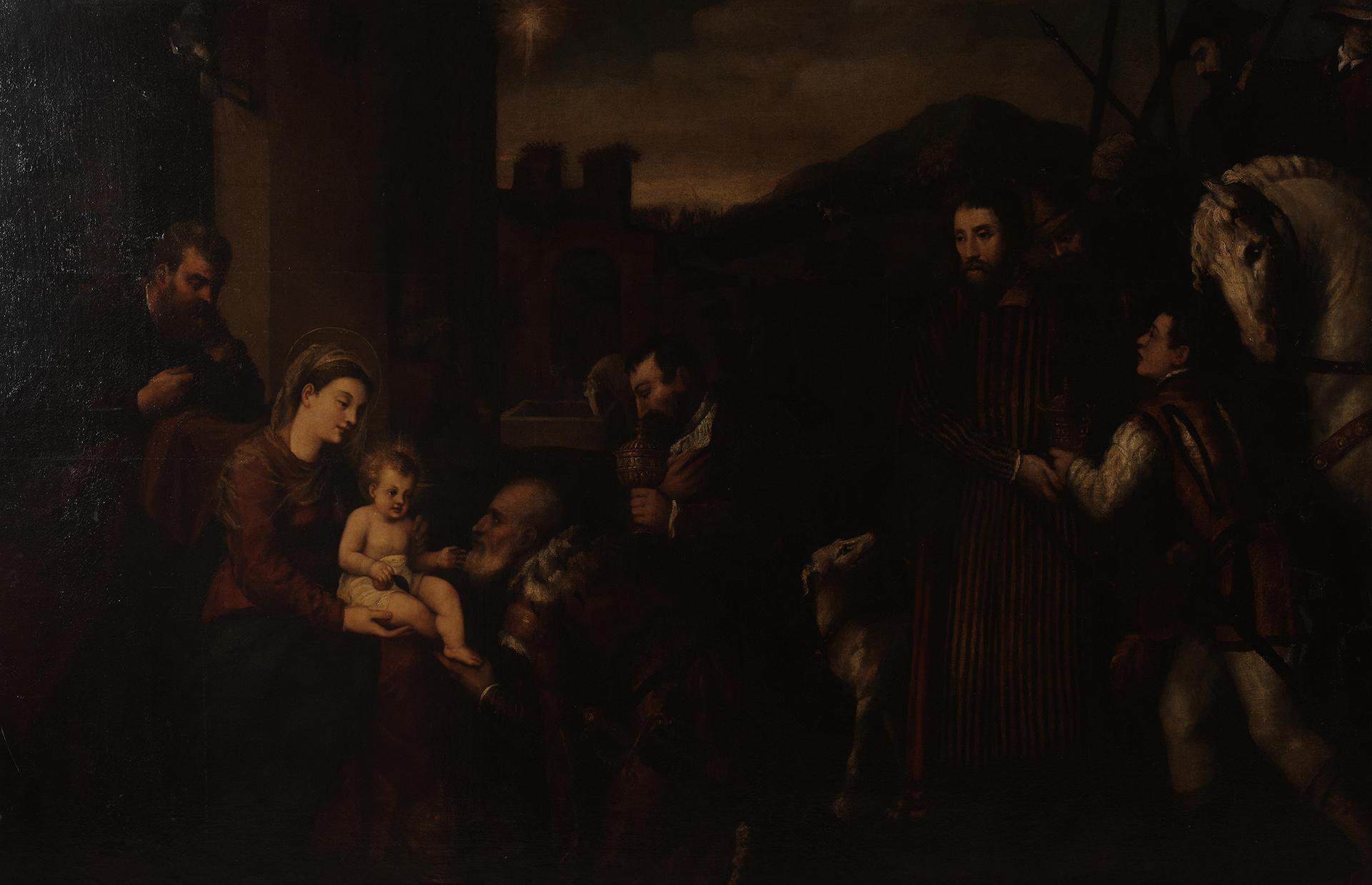
A large, dark painting of the Adoration of the Magi, attributed to Lambert Sustris and described in the museum record as an eighteenth-century work.
The Adoration of the Magi. The State Hermitage Museum.
The painting entered the Hermitage in 1919 from the collection of A. K. Rudanovsky. It is not currently on permanent display.
It is a large canvas — 174 by 264 centimetres — painted almost entirely in darkness, with a few figures emerging from the shadows.
The Object
The scene is the Adoration of the Magi.
At the left, Mary sits with the Christ Child on her lap, and an old magus kneels before them, his hands extended. Behind him, another magus holds a vessel; at the right, a bearded man stands in a striped robe, with a servant and a white horse beside him.
The background is a dark landscape with buildings and a mountain, and a star shines faintly at the top.
The Subject
The Adoration of the Magi is one of the oldest subjects of Christian art.
According to the Gospel of Matthew, wise men from the East followed a star to Bethlehem and brought gifts of gold, frankincense and myrrh. The scene was painted by every major artist of the Renaissance and Baroque.
It allowed painters to combine the sacred and the exotic: the Holy Family, the kings, their servants, their animals and their gifts, all in a single composition.
The Magi
The three kings are the painting’s human centre.
One kneels before the Child, his back to the viewer, his hands raised. Another stands behind him, holding a vessel — a reliquary or a casket. The third stands at the right, in a striped robe, with a servant and a horse.
Their costumes are rich and foreign: robes, turbans, fur and gold, the attributes of the East.
The Darkness
The painting is almost entirely dark.
The background is a brown-black, the landscape is barely visible, and the figures emerge from the shadows. Only the faces, the hands and a few details catch the light.
This darkness is a deliberate effect: it concentrates attention on the Holy Family and the kneeling king, and it gives the scene a solemn, nocturnal atmosphere.
The Light
The light comes from the left, and it falls on Mary, the Child and the old king.
It is a warm, golden light, painted with glazes and highlights, and it models the faces and the hands. The star at the top of the painting is a second, distant light, which guides the Magi.
The contrast between the warm light and the dark ground is the painting’s main visual drama.
Sustris
Lambert Sustris (ca. 1520 – after 1591) was a Dutch painter who worked in Italy.
He was associated with Titian and with the Venetian school, and he painted landscapes, mythologies and religious subjects. His style is characterised by warm colour, soft modelling and a taste for landscape.
The attribution to Sustris places the painting in the Venetian tradition of the sixteenth century.
The Date
The museum record gives the date as the eighteenth century.
This is difficult to reconcile with the attribution to Sustris, who died in the 1590s, and with the style of the painting, which belongs to the Venetian painting of the sixteenth century. The record may reflect a later repetition, a copy, or an uncertainty in the documentation.
The painting is presented here with that discrepancy noted, rather than resolved.
The Size
At 174 by 264 centimetres, the painting is large.
It was made for a church, a chapel or a grand interior, and it was meant to be seen from a distance. Its darkness is partly a function of that scale: at close range, the shadows are almost opaque; from afar, the figures emerge.
Large religious paintings were a staple of the Venetian workshops, and this one belongs to that production.
Mary and the Child
Mary sits at the left, with the Child on her lap.
She is painted in warm flesh tones and a dark red dress, and her face is turned toward the kneeling king. The Child is naked, plump and pale, and he reaches toward the magus with one hand.
The group of mother and child is the painting’s brightest area, and it is the centre of the devotion.
The Gifts
The Magi bring gifts.
One holds a vessel — a reliquary or a casket — and another may hold a golden object. In the Gospel, the gifts are gold, frankincense and myrrh, and they symbolise the kingship, divinity and death of Christ.
In the painting, the gifts are part of the treasure that surrounds the Holy Family: vessels, robes and animals, all signs of the wealth of the East.
The Horse
A white horse stands at the right, behind the third king.
It is a large animal, painted in pale grey and white, with a dark harness and a flowing mane. It catches the light and gives the composition a note of movement and scale.
Horses were a favourite motif of Venetian painting, and this one is a reminder that the Magi came from far away, with a caravan.
The Landscape
The landscape is dark and bare.
A mountain rises in the background, with buildings and a tower, and the sky is a brown-grey. The landscape is not a setting but a backdrop: it gives the scene depth and a sense of night.
At the top, a small star shines, the star of Bethlehem, which guided the Magi.
The Composition
The composition is built on a diagonal.
Mary and the Child sit at the left, the kneeling king at the centre, the standing king and the horse at the right. The eye moves from the bright group to the dark figures, and then to the star at the top.
This arrangement gives the painting its balance: a dark mass on the right, a bright group on the left, and the kneeling figure between them.
The Varnish
The painting is dark, and part of that darkness is age.
Old varnish yellows and darkens, and it can obscure the original colours. The painting may have been brighter when new, with more contrast between the figures and the background.
Conservation can reveal what the varnish hides, but it also changes the object: the darkness is now part of its history.
Provenance
The painting carries the inventory number GE-5492 and entered the Hermitage in 1919 from the collection of A. K. Rudanovsky.
In the Hermitage
The painting is preserved in the State Hermitage Museum in Saint Petersburg and is not on permanent display.
It is a dark, solemn image, and it preserves a scene of adoration in the Venetian manner: the Holy Family, the kings, a white horse and a star, all emerging from the shadows.
In the darkness, the faces are what remain — and they are enough, as they were meant to be, and as they still are, in the shadows of a Venetian night.