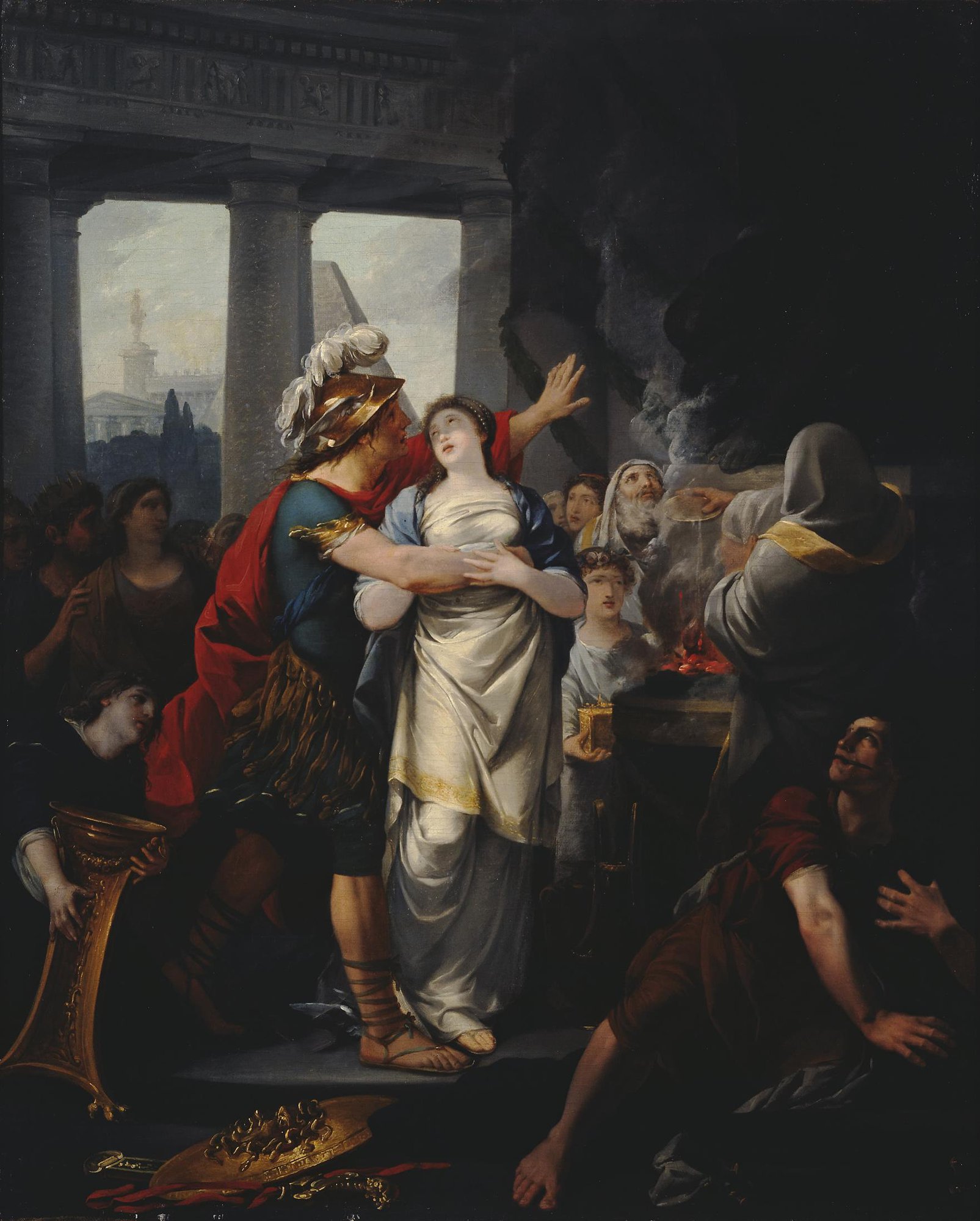
Artist: Jean-Baptiste Regnault (1754–1829)
Origin: France
Date: 1782
Material: canvas
Technique: oil
Dimensions: 90 × 72 cm
Current Collection: The State Hermitage Museum
Inventory Number: GE-5297
Hermitage ID: 37604
Rudanovsky Connection: Entered the Hermitage in 1919 from the collection of A. K. Rudanovsky.
A painting of 1782 by Jean-Baptiste Regnault showing Andromeda returned to land after her rescue, with Perseus beside her.
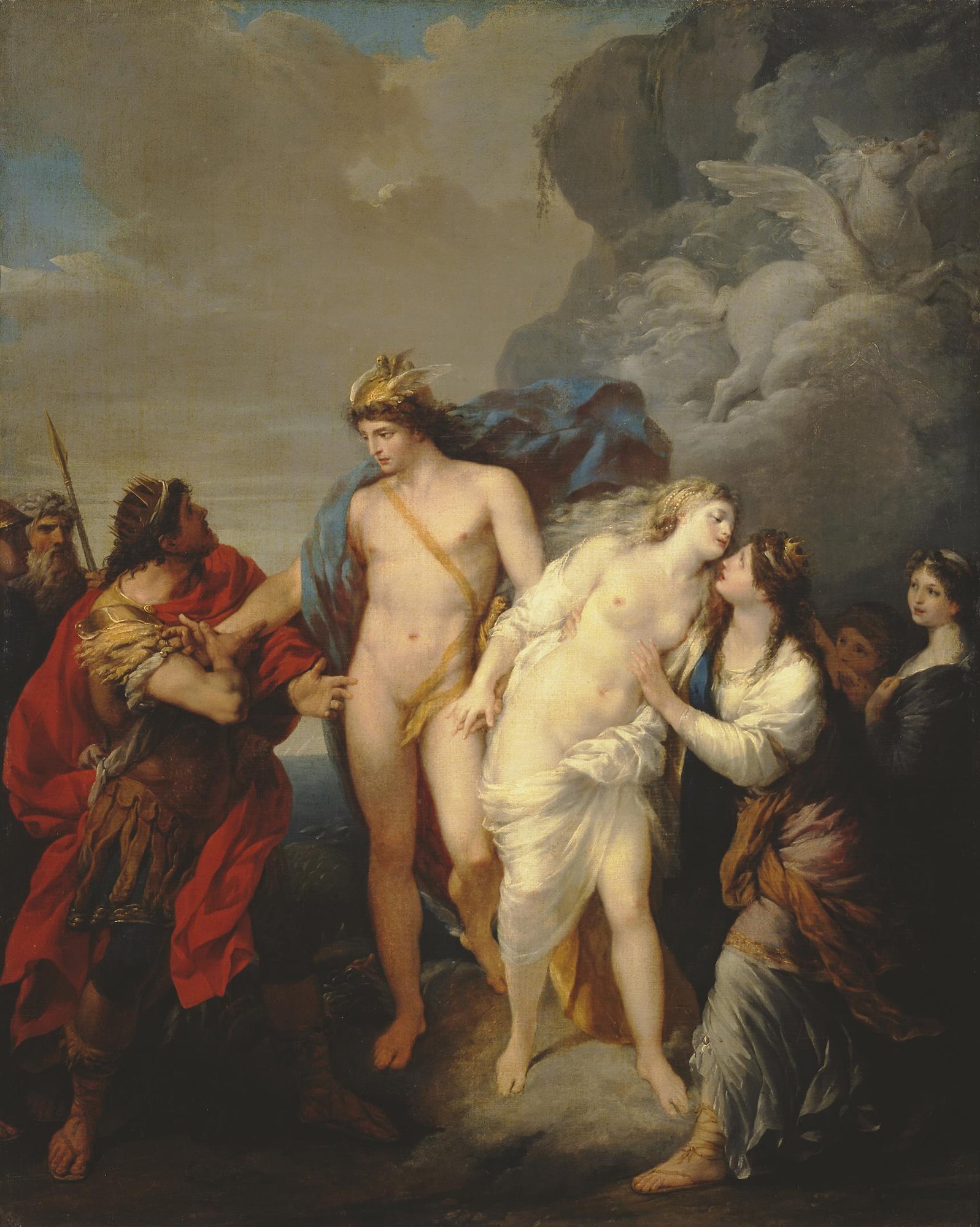
Andromeda’s Return. The State Hermitage Museum.
The painting entered the Hermitage in 1919 from the collection of A. K. Rudanovsky. It is not currently on permanent display.
It is the pair to another painting in the collection, The Wedding of Perseus and Andromeda, and it shows the moment between the rescue and the marriage.
The Object
The painting is a vertical canvas, 90 by 72 centimetres.
In the centre, a nude Perseus stands with a golden winged cap and a blue mantle, looking down. Beside him, Andromeda, nude and wrapped in white drapery, is supported by a woman in a dark dress.
At the left, a bearded king in a red cloak gestures toward Perseus; at the right, two women watch. Above, in the clouds, the winged horse Pegasus rises.
The Subject
The subject is the myth of Perseus and Andromeda.
Andromeda, a princess, was chained to a rock as a sacrifice to a sea monster. Perseus, returning from killing Medusa, saw her, killed the monster and freed her. The myth ends with their marriage.
This painting shows the moment after the rescue: Andromeda is back on land, weak and supported by her companions, and Perseus stands beside her.
Perseus
Perseus is the painting’s central figure.
He is young, nude and beautiful, with a golden cap with wings — the helmet of Hades, given to him by Hermes — and a blue mantle over his shoulder. He holds a spear or a staff, and he looks down at Andromeda.
His pose is calm and slightly detached: the hero has done his work, and he is now a spectator of its consequences.
Andromeda
Andromeda is the painting’s emotional centre.
She is pale and exhausted, her body limp, her head thrown back, and she is supported by a woman who holds her from behind. Her white drapery falls around her, half covering her nudity.
Her weakness contrasts with the strength of Perseus, and it makes the rescue visible: she is alive, but only just.
The King
The bearded king at the left is Andromeda’s father, Cepheus.
He wears a crown and a red cloak, and he gestures toward Perseus with an open hand — a gesture of gratitude, or of command. His face is dark and anxious.
The king is the painting’s link to the story: he is the one who ordered the sacrifice, and he is the one who now welcomes the hero.
Pegasus
The winged horse rises in the clouds at the upper right.
It is painted in pale grey and white, with spread wings, and it is partly hidden by the clouds. Pegasus sprang from the blood of Medusa, and he is Perseus’s companion and emblem.
The horse gives the composition its upward movement, and it opens the scene to the sky.
Regnault
Jean-Baptiste Regnault (1754–1829) was a French painter.
He trained in Paris and Rome, and he painted mythological and historical subjects in the neoclassical style. His work is characterised by clear outlines, smooth modelling and a taste for the nude.
He was a successful academic painter, and his mythologies were admired for their elegance and their finish.
1782
The date 1782 places the painting in the years before the Revolution.
It was a period of transition in French art: the Rococo was giving way to neoclassicism, and painters were turning to antiquity, mythology and moral subjects.
Regnault’s painting belongs to that moment: a mythological scene, painted with the smooth finish and the clear forms of the new style.
The Pair
The painting is one of a pair.
Its companion, The Wedding of Perseus and Andromeda, shows the marriage that follows the rescue. Together, the two paintings tell the story from the sea to the altar.
Pairs like this were common in the eighteenth century: they allowed a collector to own a complete narrative, and they were hung together as a single decoration.
The Nude
The painting is a study in the nude.
Perseus and Andromeda are both nearly naked, and the painter has given their bodies a smooth, ideal finish: pale flesh, soft modelling, clear outlines. The draperies that remain — his blue mantle, her white cloth — frame the bodies rather than cover them.
The nude was the great subject of neoclassical painting, and Regnault uses it to display both beauty and vulnerability.
The Sky
The sky is full of movement.
Clouds roll across the upper part of the canvas, grey and gold, and the winged horse rises out of them. The light is diffuse, as if the scene were taking place at dawn or dusk.
The sky gives the painting its atmosphere, and it opens the composition beyond the figures.
The Sea Monster
The sea monster is absent from this painting.
It belongs to the moment of the rescue, which is not shown: the painting begins after the fight, when the beast is dead and the princess is free. The absence is deliberate: the drama is over, and what remains is the aftermath.
That choice is characteristic of eighteenth-century narrative painting: the moment after the action, rather than the action itself.
The Neoclassical Nude
The neoclassical nude was a moral and aesthetic ideal.
It was derived from antique sculpture, and it was supposed to combine beauty, simplicity and restraint. Painters studied casts and statues, and they applied the lessons to their figures.
Regnault’s nudes belong to that tradition: they are smooth, idealised and slightly cold, and they are meant to be admired as much as felt.
The Composition
The composition is built as a triangle.
Perseus and Andromeda form the apex, the king and the women the base, and Pegasus the upper corner. The eye moves from the hero down to the princess, and then out to the figures around her.
This stable, classical arrangement is typical of neoclassical painting, and it gives the scene its calm, sculptural quality.
The Costume
The costumes are a mixture of antiquity and invention.
Perseus’s winged cap, mantle and spear are classical attributes, but his body is idealised rather than archaeological. Andromeda’s drapery is a classical formula, not a reconstruction.
Neoclassical painters aimed at the spirit of antiquity rather than its exact details, and their costumes are imaginative rather than scholarly.
Provenance
The painting carries the inventory number GE-5297 and entered the Hermitage in 1919 from the collection of A. K. Rudanovsky.
In the Hermitage
The painting is preserved in the State Hermitage Museum in Saint Petersburg and is not on permanent display.
It is a fine example of French neoclassical mythology, and it preserves a moment of transition: the rescue is over, the marriage is coming, and Andromeda is learning to stand again.
The painting is also a study in aftermath: what happens after the hero has done his work, and the princess must live with the consequences, and stand up on her own, in the end, and on her own feet.