Artist: Jean-Baptiste Regnault (1754–1829)
Origin: France
Date: 1782
Material: canvas
Technique: oil
Dimensions: 91 × 73 cm
Current Collection: The State Hermitage Museum
Inventory Number: GE-5783
Hermitage ID: 37731
Rudanovsky Connection: Entered the Hermitage in 1919 from the collection of A. K. Rudanovsky.
A painting of 1782 by Jean-Baptiste Regnault showing the wedding of Perseus and Andromeda in a classical interior.
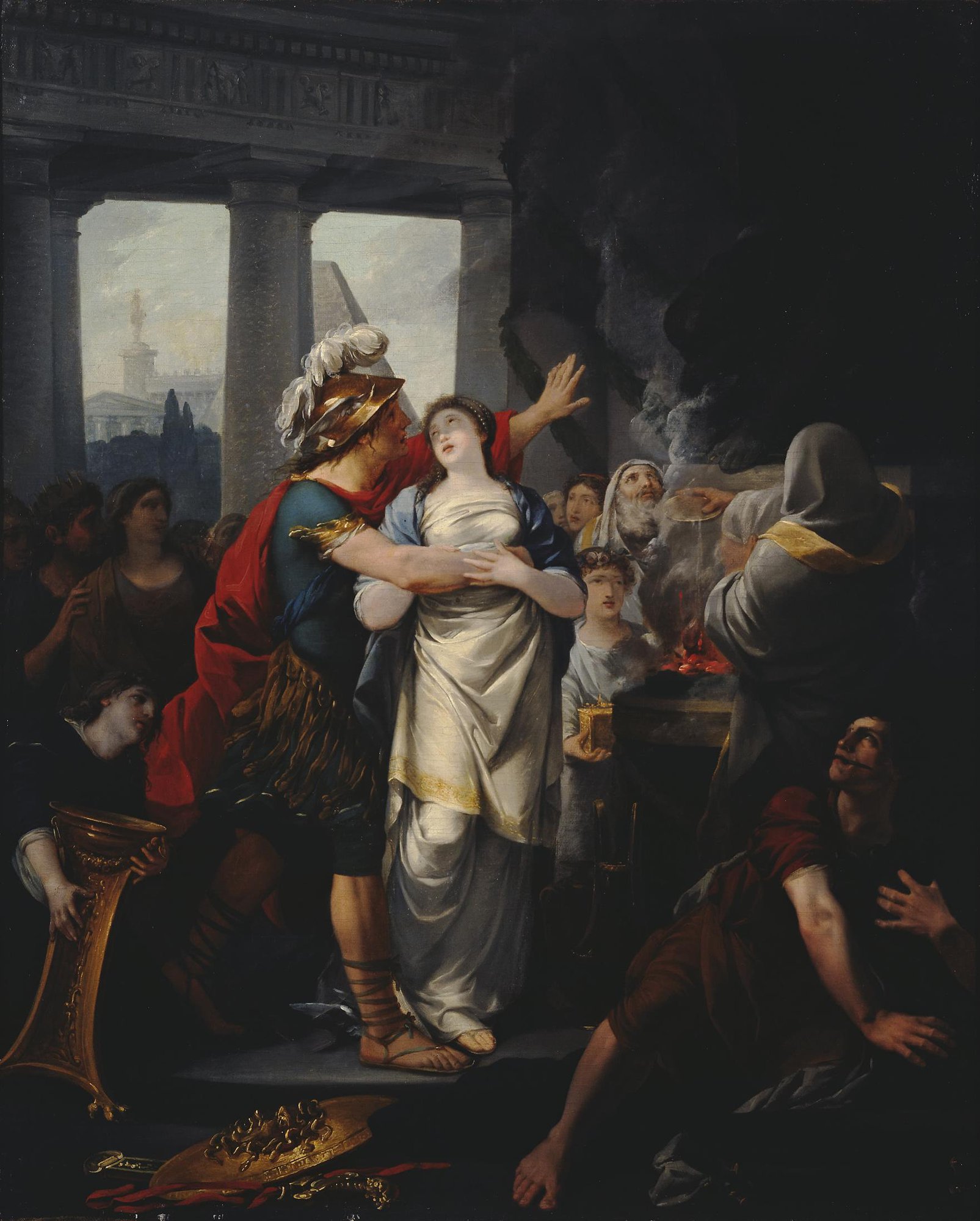
Wedding of Perseus and Andromeda. The State Hermitage Museum.
The painting entered the Hermitage in 1919 from the collection of A. K. Rudanovsky. It is not currently on permanent display.
It is the pair to Andromeda’s Return, and it shows the marriage that follows the rescue: Perseus in armour, Andromeda in white, and a crowd of guests around them.
The Object
The painting is a vertical canvas, 91 by 73 centimetres.
In the centre, Perseus, in armour with a plumed helmet, embraces Andromeda, who wears a white dress with a golden hem. At the right, a priest in a hooded cloak swings a censer over a flaming altar.
Around them, guests crowd the scene, and at the lower left a lyre and a golden shield lie on the floor. Through the columns, a temple and a landscape are visible.
The Subject
The subject is the wedding of Perseus and Andromeda.
After the rescue, the hero married the princess, and the myth ends with a feast. The wedding was a favourite subject of eighteenth-century painters: it allowed them to combine mythology, ceremony and a crowd.
The painting shows the moment of union: the couple at the centre, the priest at the altar, the guests around them.
The Couple
Perseus and Andromeda are the painting’s centre.
Perseus wears a helmet with a white plume, a blue tunic, a red cloak and a lion’s skin, and he holds Andromeda by the arm. She leans back slightly, her head tilted, her eyes raised.
Their pose is theatrical: the hero holds the princess, and she seems to swoon into his arms.
The Priest
The priest stands at the right.
He is wrapped in a dark hooded cloak, and he swings a censer over a small altar with a fire. The smoke rises in a grey plume, and the fire glows red.
The priest is the painting’s ritual centre: he turns the embrace into a marriage, and he gives the scene its religious weight.
The Guests
The guests fill the background and the sides.
They are men and women in classical dress, painted in quick, lively strokes: a woman with a basket, a man with a lyre, a young face looking out from behind the couple, an old man with a white beard.
The crowd gives the painting its festive character, and it turns the wedding into a public event.
The Setting
The setting is a classical interior.
Two columns frame the scene, with an entablature above, and through the opening a temple and a landscape are visible in the distance. The floor is dark, and the altar smokes at the right.
The architecture gives the marriage a monumental setting, and it connects the painting to the neoclassical taste for antiquity.
Regnault
Jean-Baptiste Regnault (1754–1829) was a French painter.
He trained in Paris and Rome, and he painted mythological and historical subjects in the neoclassical style. His work is characterised by clear outlines, smooth modelling and a taste for the theatrical.
He was a successful academic painter, and his mythologies were admired for their elegance and their finish.
1782
The date 1782 places the painting in the years before the Revolution.
It was a period of transition in French art: the Rococo was giving way to neoclassicism, and painters were turning to antiquity, mythology and moral subjects.
Regnault’s painting belongs to that moment: a mythological scene, painted with the smooth finish and the clear forms of the new style.
The Pair
The painting is one of a pair.
Its companion, Andromeda’s Return, shows the moment after the rescue. Together, the two paintings tell the story from the sea to the altar.
Pairs like this were common in the eighteenth century: they allowed a collector to own a complete narrative, and they were hung together as a single decoration.
The Armour
Perseus wears armour and a lion’s skin.
The armour is a breastplate and greaves, painted in dark metal with gold highlights, and the lion’s skin hangs over his shoulder — the skin of the Nemean lion, or a reference to Hercules. The plumed helmet completes the costume.
The armour marks him as a hero, and it contrasts with the white dress of the bride.
The Altar
The altar is the painting’s ritual centre.
It is a small stone block with a fire on top, and the priest swings a censer over it. Smoke rises in a grey plume, and the fire glows red.
The altar turns the embrace into a ceremony: without it, the scene would be a reunion; with it, it is a marriage.
The Lyre
A lyre lies at the lower left.
It is a large wooden instrument with strings and a curved frame, and it rests on the floor beside a golden shield. It is the instrument of the wedding feast, and it suggests music, poetry and celebration.
The objects on the floor — the lyre, the shield, a red ribbon — are the painting’s still life, and they give the scene its material richness.
The Ceremony
The ceremony is the subject.
The painting does not show the battle or the rescue; it shows the moment of union, when the hero and the princess are joined. The priest, the altar and the guests all serve that moment.
It is a quiet scene compared with its companion, and it completes the story with a ritual rather than an action.
The Columns
Two columns frame the scene.
They are Doric or Tuscan, with simple capitals and a heavy entablature, and they give the interior a monumental scale. Behind them, the temple and the landscape open the composition to the distance.
Columns were a standard device of neoclassical staging: they frame the action, give it dignity and connect it to the architecture of antiquity.
The Colours
The colours are strong and simple.
Red, blue, white and gold dominate: Perseus’s red cloak and blue tunic, Andromeda’s white dress, the golden shield and the red fire of the altar. The palette is clear and legible, and it gives the painting its festive character.
Neoclassical painting favoured clear, unmixed colours, and this painting is a good example of that taste.
Provenance
The painting carries the inventory number GE-5783 and entered the Hermitage in 1919 from the collection of A. K. Rudanovsky.
In the Hermitage
The painting is preserved in the State Hermitage Museum in Saint Petersburg and is not on permanent display.
It is a fine example of French neoclassical mythology, and it completes the story of Perseus and Andromeda: the rescue, the return and the wedding, in two canvases painted in the same year.
Seen together, the two paintings are a small lesson in how a story is told: one canvas for the aftermath, one for the ceremony, and the action itself left out — the monster killed somewhere offstage, between the two frames, and neither of them shows it at all, and that is the point.