Artist: Jean-Baptiste Regnault (1754–1829)
School: French
Collection: The State Hermitage Museum
Historical Hermitage ID: 37604
Rudanovsky Connection: A. K. Rudanovsky Collection
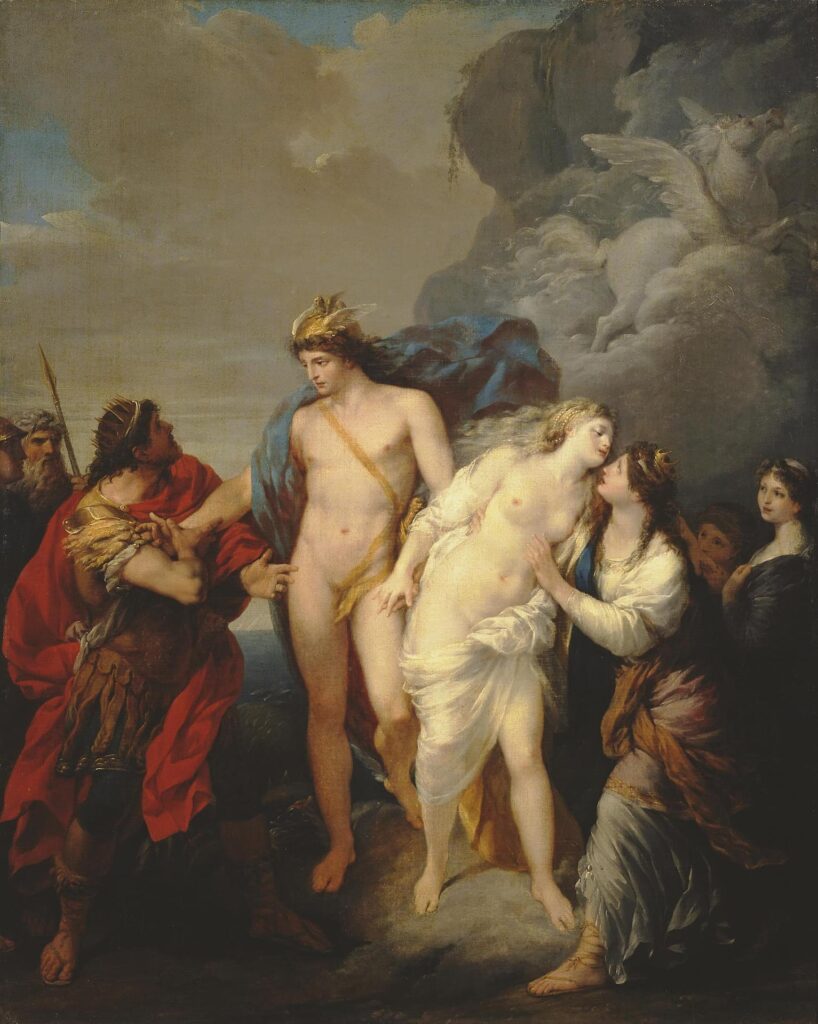
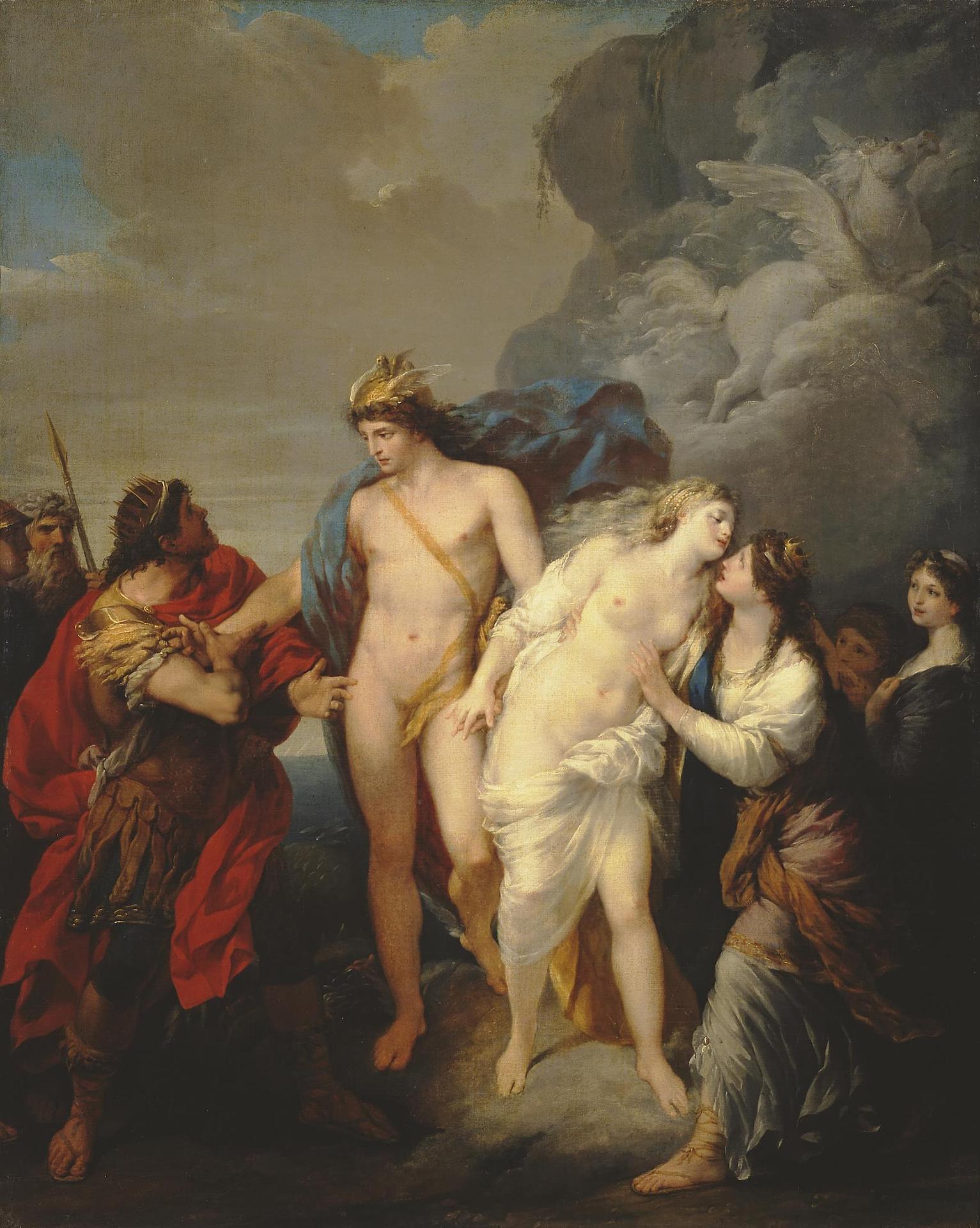
Andromeda’s Return is a mythological painting by the French artist Jean-Baptiste Regnault (1754–1829), one of the prominent representatives of French history painting during the late eighteenth and early nineteenth centuries.
The work is preserved in the State Hermitage Museum in Saint Petersburg and appears in the historical records of the A. K. Rudanovsky Collection.
The former digital catalogue of the Hermitage identified the painting under record 37604.
The Story of Andromeda
The story of Andromeda belongs to one of the great cycles of ancient Greek mythology.
Andromeda was the daughter of Cepheus, King of Ethiopia, and Queen Cassiopeia. According to the myth, Cassiopeia boasted that she — or, in some versions, her daughter — surpassed the sea nymphs in beauty.
The boast angered Poseidon, who sent destruction upon the kingdom.
To save his people, Cepheus was told that Andromeda had to be sacrificed. The princess was therefore chained to a rock beside the sea and left to be devoured by a sea monster.
It was there that she was discovered by Perseus.
Perseus and Andromeda
Perseus was returning from his encounter with the Gorgon Medusa, whom he had defeated and beheaded.
Seeing Andromeda chained to the rock, he became captivated by her and agreed to rescue her.
When the sea monster appeared, Perseus attacked and killed it, freeing Andromeda from the fate prepared for her.
The rescue of Andromeda became one of the most frequently represented episodes of classical mythology in European art.
Painters and sculptors were attracted to the story because it combined nearly every element required for dramatic history painting: beauty, danger, heroism, monsters, divine intervention and love.
But Andromeda’s Return focuses attention on what comes after the heroic confrontation.
After the Rescue
The return of Andromeda represents a different stage of the myth.
The immediate danger has passed.
Instead of the princess chained helplessly to the rocks or Perseus engaged in combat with the monster, the narrative moves toward reunion, restoration and the consequences of her rescue.
This change in emphasis gives the subject a different emotional character.
The dramatic tension of the sacrifice gives way to the return of a daughter who had effectively been surrendered to death.
Andromeda is no longer simply the victim awaiting rescue. Her story begins to move toward her future with Perseus.
Jean-Baptiste Regnault
Jean-Baptiste Regnault was born in Paris in 1754 and became an important French painter of historical and mythological subjects.
His early life was unusually international. He spent part of his youth outside France before returning to Paris and pursuing formal artistic training.
Regnault eventually won the prestigious Prix de Rome, allowing him to continue his studies in Italy.
The experience of Rome and the study of ancient and Renaissance art became fundamental to the development of many French painters of his generation.
Regnault subsequently established a successful career in France and became a member of the Académie Royale de Peinture et de Sculpture.
His paintings frequently drew upon classical mythology, ancient history and allegory — subjects regarded by the academic tradition as belonging to the highest category of painting.
Mythology and Neoclassicism
Regnault worked during a period of profound change in French art.
During the later eighteenth century, artists increasingly turned toward the ancient Greek and Roman world for subjects, ideals and visual inspiration.
This movement contributed to the development of Neoclassicism.
Mythological subjects were not simply illustrations of ancient stories. They provided artists with opportunities to explore heroism, sacrifice, virtue, beauty and human emotion.
The story of Perseus and Andromeda was particularly suitable for this purpose.
It offered both dramatic action and idealised figures while allowing the artist to construct an imagined world derived from classical antiquity.
A Story Regnault Returned To
The mythology of Perseus and Andromeda appears more than once among the works of Jean-Baptiste Regnault associated with the Rudanovsky collection.
Another painting, Wedding of Perseus and Andromeda, dated 1782, is also preserved in the State Hermitage Museum and was documented in the historical A. K. Rudanovsky Collection.
Together, the two works reveal Regnault’s continuing interest in different episodes from the same mythological narrative.
Andromeda’s Return explores the aftermath of rescue.
Wedding of Perseus and Andromeda moves the story forward to the union of the hero and princess.
Viewed together, they transform separate paintings into episodes from a larger classical story.
From Ancient Myth to European Painting
The survival of the Andromeda story across thousands of years demonstrates the extraordinary influence of classical mythology upon European culture.
Ancient stories were repeatedly rediscovered and reinterpreted.
Renaissance artists transformed them according to the artistic ideals of their own age. Baroque painters emphasised movement and drama. Eighteenth-century artists approached the same stories through academic history painting and the growing fascination with antiquity.
Regnault belonged to this long tradition.
For him, mythology offered a visual language through which human emotion and idealised beauty could be presented on the scale traditionally reserved for the most ambitious forms of painting.
The Rudanovsky Collection
Andromeda’s Return was documented on the historical Rudanovsky collection site as a work associated with the A. K. Rudanovsky Collection.
The original record linked directly to the State Hermitage Museum’s former digital catalogue, where the painting was identified under record 37604.
Nevertheless, its preservation in the Rudanovsky records provides an important connection between the painting and the wider group of European works associated with the family collection.
This group included paintings from the Italian, Flemish, German and French schools, spanning subjects from Christian devotional imagery to portraiture and classical mythology.
Regnault in the Rudanovsky Collection
The presence of more than one work by Jean-Baptiste Regnault is particularly notable.
Rather than representing the artist through a single isolated painting, the historical collection contained works connected through a common mythological narrative.
Both Andromeda’s Return and Wedding of Perseus and Andromeda belong to the world of Perseus and Andromeda.
This creates a rare opportunity to view the collection not simply as a list of individual objects, but as a network of artists, subjects and stories that sometimes intersect with one another.
Within that history, Andromeda’s Return forms part of both the legacy of eighteenth-century French painting and the documented history of the A. K. Rudanovsky Collection.