Artist: Unknown Flemish sculptor, 17th century
Origin: Flanders
Date: 17th century
Material: wood
Technique: carving
Dimensions: 13 × 18 cm
Current Collection: The State Hermitage Museum
Inventory Number: N.sk-1183
Hermitage ID: 52571
Rudanovsky Connection: Entered the Hermitage in 1920 from the collection of A. K. Rudanovsky.
A small Flemish wood relief of the seventeenth century showing the musical contest of Apollo and Marsyas.
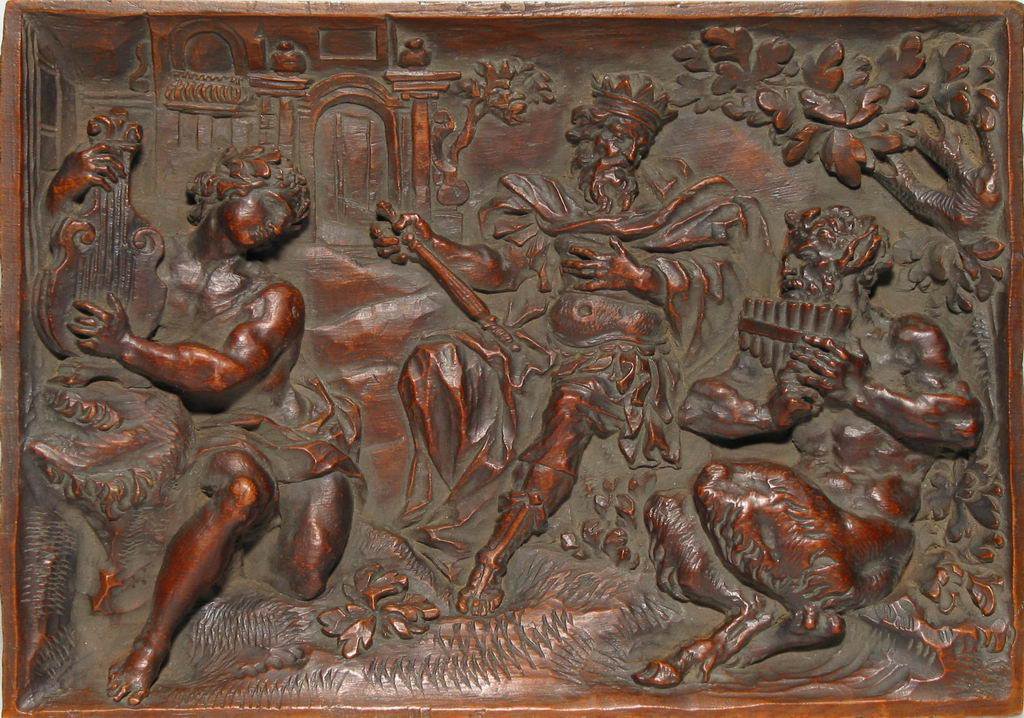
Apollo and Marsyas. The State Hermitage Museum.
The relief entered the Hermitage in 1920 from the collection of A. K. Rudanovsky, through the State Museum Fund. It is not currently on permanent display.
It is a small rectangular panel — 13 by 18 centimetres — carved in dark wood, with three figures and a landscape background.
The Object
The relief is carved in shallow relief, in a single piece of wood.
At the left, a seated figure holds a lyre; in the centre, a bearded figure with a crown and a staff stands between two others; at the right, two satyrs, one with panpipes, crouch on the ground.
Behind them, a carved background suggests a building, a tree and a landscape, and a frame runs around the edge.
The Contest
The subject is the musical contest of Apollo and Marsyas.
According to the myth, Marsyas, a satyr, found the flute that Athena had thrown away and learned to play it so well that he challenged Apollo, the god of music, to a contest. The winner could do as he wished with the loser.
Apollo won, and he flayed Marsyas alive. The story was a favourite of Renaissance and Baroque art, and it was read as an allegory of divine and earthly music, of reason and passion.
Apollo
Apollo sits at the left.
He is a young, muscular figure with curly hair, and he holds a lyre on his knee. His body is turned toward the centre, and his head is raised, as if he were listening or singing.
The lyre is his attribute, and it identifies him as the god of music. His pose is calm and confident: he knows he will win.
Marsyas
Marsyas is at the right.
He is a satyr, with pointed ears, a goat’s legs and a hairy body, and he holds panpipes in his hands. He crouches on the ground, and his face is turned toward Apollo.
The satyr’s pose is defensive and slightly comic: he is a creature of the woods, and he is out of his depth in a contest with a god.
The Judge
A bearded figure stands between them.
He wears a crown and a long robe, and he holds a staff or a sceptre. He may be Midas, the king who judged the contest, or a generic judge.
The judge is the pivot of the composition: he separates the two contestants and gives the scene its legal, formal character.
The Wood
The relief is carved in wood.
The wood is dark and close-grained, and it has been polished by time. The carving is shallow, with soft transitions and rounded forms, and it relies on light and shadow to define the figures.
Wood was a common material for small reliefs and devotional objects in the seventeenth century, and it allowed the sculptor to work quickly and cheaply.
The Sculptor
The sculptor is unknown.
The style of the relief is Flemish, and it belongs to the seventeenth century: the figures are robust, the composition is crowded and the carving is lively. It may have been made in Antwerp or Brussels.
Small reliefs of this kind were often produced in workshops, as independent objects or as parts of larger pieces, and their sculptors are usually anonymous.
The Subject’s Meaning
The contest of Apollo and Marsyas had a moral meaning.
It was read as a contest between divine and earthly music, between harmony and noise, between reason and the passions. Apollo’s victory was the victory of order; Marsyas’s punishment was the price of presumption.
The relief does not show the punishment, but it implies it: the contest is decided, and the satyr is doomed.
The Frame
The relief has a carved frame.
It runs around the edge of the panel, with a simple moulding, and it turns the carving into a picture. The frame is part of the same piece of wood, and it defines the scene.
Frames of this kind are common in small reliefs: they protect the carving, and they give it the look of a framed image.
The Landscape
The background is a carved landscape.
A building with an arched doorway stands at the left, a tree grows at the right, and the ground is rough and uneven. The background is shallow, but it gives the figures a setting.
Carved landscapes of this kind are a convention of relief sculpture: they provide depth without distracting from the figures.
The Satyr
The satyr at the right is the relief’s most vivid figure.
He is hairy, with pointed ears and goat’s legs, and he crouches on the ground with his pipes. His body is twisted, and his face is turned toward the god.
The satyr is the image of the wild: half man, half beast, he is the opposite of the calm, harmonious Apollo.
Small Reliefs
Small reliefs were common objects in the seventeenth century.
They were made for cabinets, for collectors and for private devotion, and they were often carved in wood, ivory or boxwood. Their small size invited close looking, and their subjects ranged from myth to religion.
This relief belongs to that tradition: a small, finely carved object, made for a collector’s cabinet.
The Costume
The figures are lightly dressed.
Apollo wears a cloth over one shoulder, the judge a robe and a crown, and the satyrs are naked or covered with hair. Their costumes are classical, or what the seventeenth century imagined to be classical.
The light draperies allow the sculptor to show the bodies, and they give the figures their movement and their energy.
The Light and Shadow
The relief depends on light and shadow.
Its forms are shallow, and they are defined by the way the light falls across them: a raised arm casts a shadow, a fold of cloth catches a highlight. The carving is deepest where the figures are most important.
This play of light is what makes a small relief legible, and it is the sculptor’s main tool.
The Myth’s Afterlife
The myth of Apollo and Marsyas has never lost its power.
It has been painted by Titian, Rubens and Jusepe de Ribera, set to music, and read as an allegory of art, of punishment and of the rivalry between the divine and the human. The flaying is one of the most violent images in classical mythology.
This small relief does not show the violence, but it holds the tension: the contest is under way, and the outcome is certain.
Provenance
The relief carries the inventory number N.sk-1183 and entered the Hermitage in 1920 from the collection of A. K. Rudanovsky, through the State Museum Fund.
In the Hermitage
The relief is preserved in the State Hermitage Museum in Saint Petersburg and is not on permanent display.
It is a small, lively object, and it preserves one of the oldest myths of music: the god, the satyr and the contest that ends in a flaying.