
Artist: German sculptor, 15th century
Origin: German Lands
Date: 15th century
Material: wood
Technique: carving
Dimensions: 43 × 25 cm
Current Collection: The State Hermitage Museum
Inventory Number: N.sk-1192
Hermitage ID: 52573
Rudanovsky Connection: Entered the Hermitage in 1920 from the collection of A. K. Rudanovsky.
A German carved wood Lamentation of the fifteenth century, showing the Virgin holding the dead Christ.
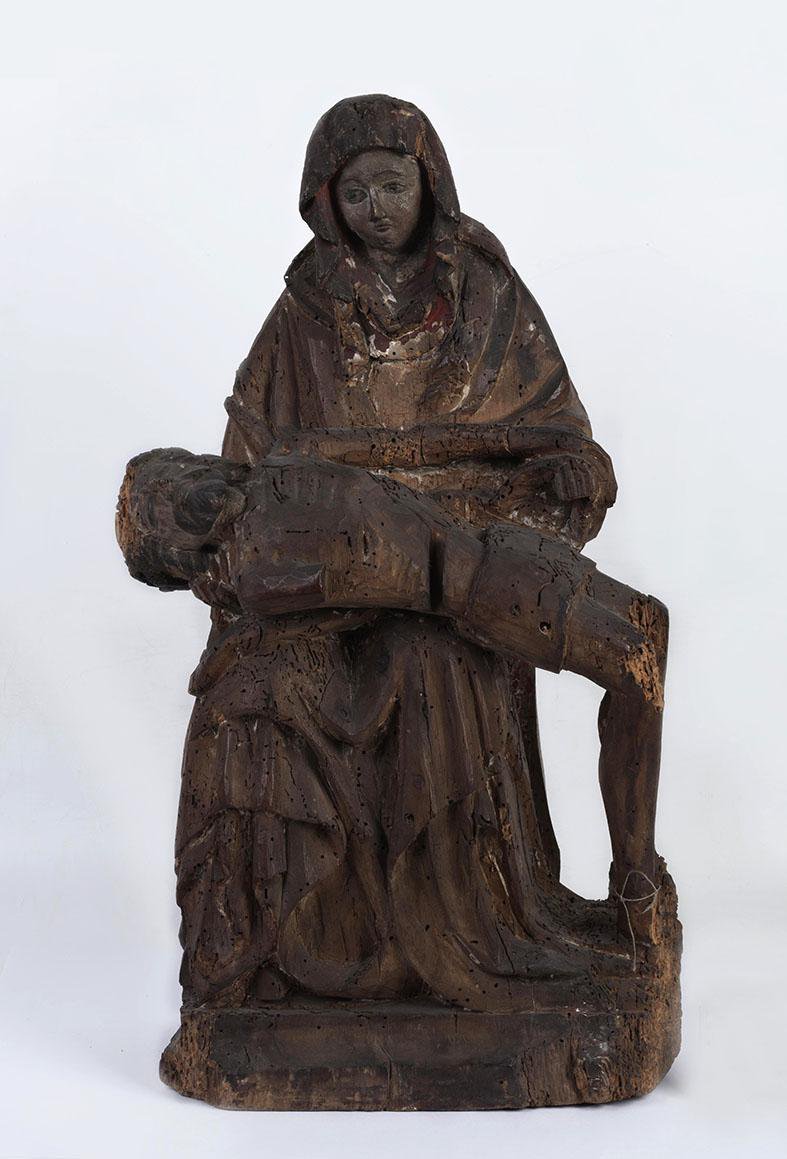
The Lamentation. The State Hermitage Museum.
The sculpture entered the Hermitage in 1920 from the Rudanovsky family collection, through the State Museum Fund. It is not currently on permanent display.
It is a small carved group — 43 by 25 centimetres — of the Virgin seated, with the body of Christ across her lap.
The Object
The group is carved in wood, in the round, and it is dark with age.
The Virgin sits on a low base, her head covered by a hood, her hands supporting the body of Christ. Christ lies across her lap, his head to the left, his legs hanging down to the right, his body thin and rigid.
The surface is rough and damaged: the wood is cracked, the paint is lost, and parts of the carving are worn away.
The Pietà
The subject is the Pietà — the Virgin with the dead Christ.
It is one of the most emotional subjects of Christian art: Mary, the mother, holds the body of her son after the crucifixion. The image is not a narrative scene but a devotional one, made to move the viewer to compassion.
The Pietà developed in Germany in the fourteenth century, and it became one of the most popular subjects of late medieval sculpture.
Mary
Mary is the group’s dominant figure.
She sits upright, her body forming a throne for the dead Christ, and her face is calm and sorrowful. Her hood covers her hair, and her cloak falls in heavy folds to the base.
Her expression is the key to the sculpture: she does not weep, but her face is full of grief. The sculptor has given her a dignity that makes the scene almost unbearable.
Christ
Christ lies across her lap.
His body is thin and rigid, his ribs visible, his head fallen back, his arms limp. His legs hang down at the right, and his feet rest on the base.
The body is carved with attention to anatomy, and its weakness contrasts with the stillness of the Virgin. The dead Christ is the object of the viewer’s compassion, and the Virgin is the model of grief.
The Wood
The sculpture is carved in wood.
Wood was the most common material for German devotional sculpture in the fifteenth century: it was cheaper than stone, easier to carve and light enough to be carried in processions.
The wood here is dark and worn, and its surface shows the marks of time: cracks, losses and the traces of old paint.
The German Sculptor
The sculptor is unknown.
The style of the group is German, and it belongs to the fifteenth century: the heavy draperies, the expressive faces and the emotional intensity are characteristic of late Gothic sculpture in the German lands.
Workshops in the Rhine valley, in Swabia and in Bavaria produced thousands of such groups, and their sculptors are usually anonymous.
Polychromy
The sculpture was originally painted.
Medieval wood sculpture was usually polychromed: the flesh was painted in flesh tones, the robes in red, blue and gold, and the whole was varnished and gilded. The paint gave the carving its realism and its splendour.
Almost all of the paint is gone, and the wood is now bare. The loss changes the object: it is no longer a coloured image but a dark, severe carving.
Devotion
The group is a devotional object.
It was made to be prayed before, and it was probably placed in a church, a chapel or a private house. Its small size suggests a private devotion, perhaps in a convent or a noble household.
Images of the Pietà were especially popular in times of plague and war, when the sorrow of the Virgin spoke directly to the sorrow of the faithful.
The Base
The group stands on a carved base.
It is a rocky mound, rough and uneven, and it supports the Virgin and the body of Christ. The base is part of the sculpture, and it gives the group its stability.
Bases of this kind were common in medieval sculpture: they provided a ground for the figures, and they could be carved with stones, grass or rocks.
The Hands
The hands are the group’s most expressive detail.
Mary’s hands support the body of her son: one under his shoulders, one under his arm. Christ’s hands are limp, and his fingers are curled.
Hands are difficult to carve, and this sculptor has given them attention: they are the point where the mother’s care and the son’s death meet.
The Face
Mary’s face is the sculpture’s emotional centre.
It is oval, with a high forehead and a long nose, and her expression is calm and sorrowful. Her eyes are downcast, and her mouth is closed.
The face is carved with care, and it has survived the loss of paint better than the rest of the group. It is the part of the sculpture that speaks most directly to the viewer.
Late Gothic
The sculpture belongs to late Gothic art.
Late Gothic sculpture in Germany was characterised by expressive faces, heavy draperies and emotional subjects. It was made for churches and for private devotion, and it aimed to move the viewer rather than to instruct.
This group is a good example of that art: small, intense and deeply human.
The Drapery
The drapery is heavy and simple.
Mary’s cloak falls in broad folds from her shoulders to the base, and it forms the volume of the group. The folds are carved deeply, and they catch the light.
Drapery was one of the great subjects of Gothic sculpture, and this group shows its mastery: the cloth is heavy, and it gives the figures their weight.
The Size
At 43 by 25 centimetres, the group is small.
It was made for a private setting: a chapel, a cell or a room in a house. Its size makes it an intimate object, meant to be seen up close and prayed before.
Small devotional sculptures were common in the fifteenth century, and they allowed ordinary people to own an image of the sacred.
The Cracks
The wood is cracked and scored.
The cracks run across the surface, and the darker areas show where the paint has been lost. These damages are part of the object’s history: they record five centuries of use, movement and neglect.
A damaged sculpture is still a sculpture, and sometimes the damage makes it more eloquent than the carving was when it was new.
Provenance
The sculpture carries the inventory number N.sk-1192 and entered the Hermitage in 1920 from the Rudanovsky family collection, through the State Museum Fund.
In the Hermitage
The sculpture is preserved in the State Hermitage Museum in Saint Petersburg and is not on permanent display.
It is a moving image, and it preserves a moment of late medieval devotion: a mother, a son and a piece of dark wood, carved five hundred years ago.
