Artist: Jacques-Dominique Rachette (1744–1809), author of the model
Organization: Imperial Porcelain Factory, St Petersburg
Origin: Russia, St Petersburg
Date: second half of the 18th century
Material: bisque
Dimensions: 27 × 23.5 cm
Current Collection: The State Hermitage Museum
Inventory Number: ERF-454
Hermitage ID: 909242
Rudanovsky Connection: Entered the Hermitage in 1919 from the collection of A. K. Rudanovsky.
A white bisque porcelain relief of the second half of the eighteenth century, made at the Imperial Porcelain Factory after a model by Jacques-Dominique Rachette.
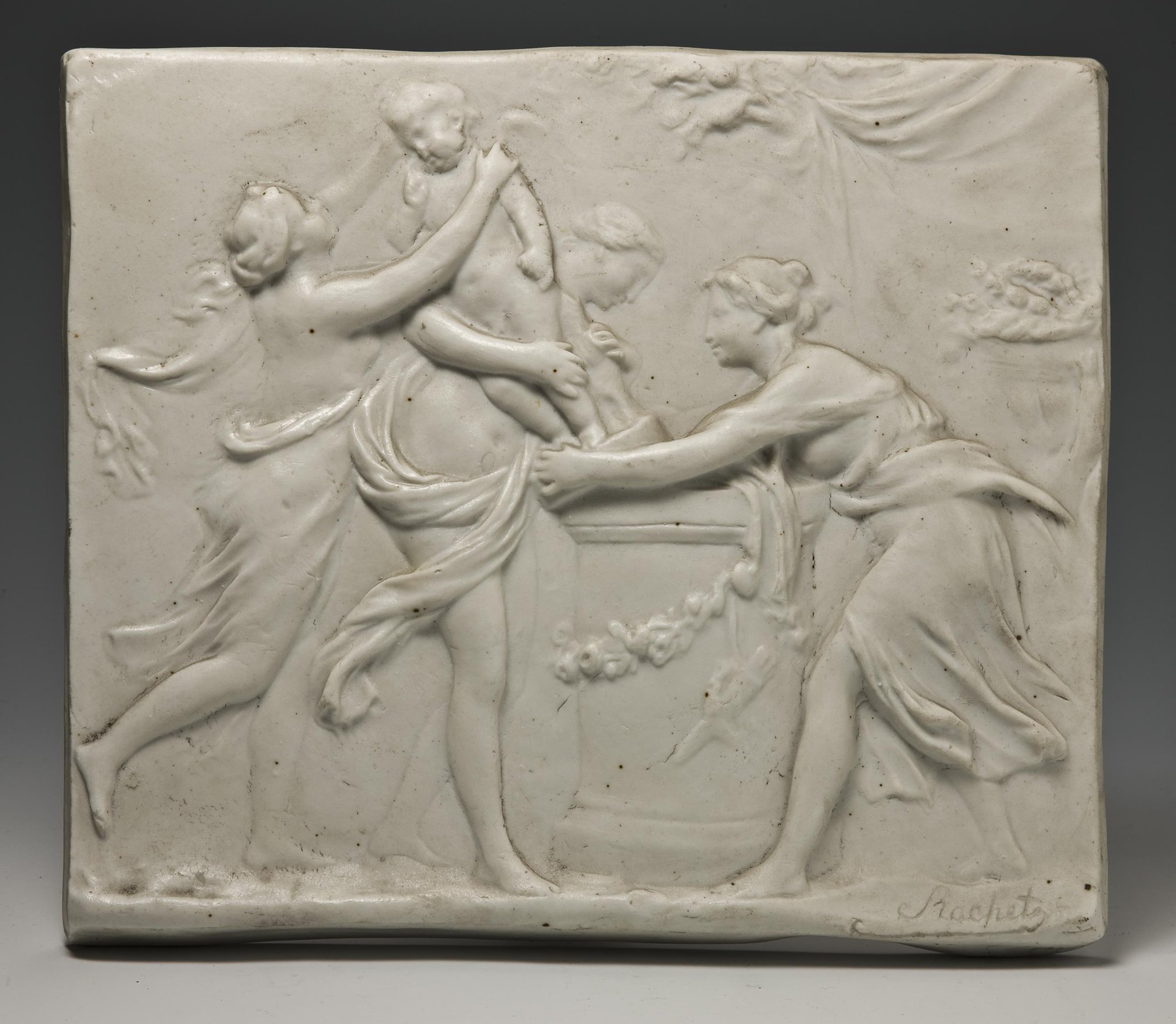
Bas-relief. The State Hermitage Museum.
The relief entered the Hermitage in 1919, transferred through the Department for the Protection of Monuments of Art and Antiquities from the collection of A. K. Rudanovsky. It is not currently on permanent display.
It is a rectangular panel — 27 by 23.5 centimetres — in white unglazed porcelain, with three women, a child and a garlanded altar.
The Object
The relief is carved in shallow, soft modelling, in white bisque.
At the left, a woman in flowing drapery holds a small child up in her arms; at the right, another woman reaches out to receive or support him; behind them, a third figure bends forward. At the base, a rectangular altar with a garland.
The panel is signed «Rachette» at the lower right, and it is bordered by a simple moulding.
The Figures
Three women animate the scene.
They are dressed in classical drapery, and their poses are soft and graceful: one lifts the child, one receives him, one leans over the altar. Their bodies are modelled with attention to the folds of the cloth.
The figures belong to the classical vocabulary of the late eighteenth century: elegant, restrained and idealised.
The Child
The child is the centre of the action.
He is small and naked, held up between the two women, and his pose is passive: he is being carried, offered or handed over. His body is modelled in soft, rounded forms.
The child may represent a mythological infant — Bacchus, Achilles, or another hero — but the relief gives no attribute to identify him.
The Altar
An altar stands at the base.
It is a rectangular block, with a moulding, and it is decorated with a garland of flowers and leaves. The altar gives the scene its ritual character: the women are not simply holding the child, they are bringing him to a place of offering.
Altars of this kind are common in classical reliefs, and they turn a narrative into a ceremony.
The Bisque
The relief is made of bisque.
Bisque is unglazed porcelain, fired once, and it has a matte, slightly granular surface. It was used for reliefs, busts and groups, and it imitates the appearance of marble.
Bisque was a speciality of the Imperial Porcelain Factory, and it was used for objects that were meant to look like sculpture.
Rachette
Jacques-Dominique Rachette (1744–1809) was a French sculptor who worked in Russia.
He was a professor at the Academy of Arts in St Petersburg, and he was the author of many models for the Imperial Porcelain Factory. His work is characterised by classical subjects, elegant figures and careful composition.
The signature on the relief identifies his model, and it connects the object to his studio.
The Imperial Factory
The relief was made at the Imperial Porcelain Factory in St Petersburg.
The factory produced not only table services but also figures, reliefs and groups, and it employed sculptors and modellers to supply models. Bisque reliefs were among its most ambitious products.
The factory’s wares were collected by the court and the nobility, and they were displayed in cabinets and galleries.
The Signature
The relief is signed «Rachette» at the lower right.
The signature is incised into the surface, and it is part of the object’s documentation. It identifies the author of the model, and it allows the relief to be connected to his work.
Signatures of this kind are rare on porcelain, and they mark the object as a work of art rather than a simple product.
The Drapery
The drapery is the relief’s great subject.
The women’s robes are classical: thin, clinging and full of folds. The cloth wraps around their bodies, and it is modelled in soft, flowing lines.
Drapery is a test of a modeller’s skill: it must be classical in its forms, natural in its fall and expressive in its rhythm. Here it is fluent and elegant, and it gives the figures their movement.
The Background
The background is almost empty.
It is a plain white surface, with a few faint clouds and a hint of drapery at the upper right. The emptiness concentrates attention on the figures, and it makes the relief read like a marble panel.
Bas-reliefs often have a plain background: it isolates the figures and gives them the purity of sculpture.
The Moulding
The panel has a simple moulding.
It runs around the edge, and it frames the scene like a picture. The moulding is part of the relief, and it turns the panel into a complete object.
Mouldings of this kind were standard in porcelain reliefs, and they gave the object a finished, architectural look.
Neoclassicism
The relief belongs to neoclassicism.
The style dominated European art in the second half of the eighteenth century, and it valued clarity, order and the imitation of antiquity. Its subjects were drawn from myth and history, and its forms were simple and restrained.
This relief is a good example: a classical subject, a clear composition and figures that follow the proportions of antique sculpture.
The Light
The relief depends on light.
Its forms are shallow, and they are defined by the way light falls across them: a raised arm casts a shadow, a fold of cloth catches a highlight. The modelling is deepest where the figures are most important.
This play of light is what makes a relief legible, and it is the modeller’s main tool.
The Porcelain’s White
The relief is white.
Its colour is the colour of unglazed porcelain, a warm, slightly creamy white. The white gives the relief a marble-like quality, and it makes the figures appear to be carved rather than moulded.
Whiteness was valued in bisque porcelain: it imitated sculpture, and it allowed the object to be displayed alongside marble.
Provenance
The relief carries the inventory number ERF-454. It entered the Hermitage in 1919, transferred through the Department for the Protection of Monuments of Art and Antiquities from the collection of A. K. Rudanovsky.
In the Hermitage
The relief is preserved in the State Hermitage Museum in Saint Petersburg and is not on permanent display.
It is a fine example of Russian bisque porcelain, and it preserves a classical scene: three women, a child and an altar, modelled in white and signed by their author, and still waiting to be recognised, in a store, in a city far from the studio where it was made.
The three women, the child and the altar remain unexplained, and that is part of the relief’s charm: it invites the viewer to invent a story, and it gives no answer. It is a classical image, and it is also an open question.
It is a small panel, and it carries a whole neoclassical world: grace, restraint and a story that has been lost.