Artist: Henri-Albert Adams (1766–1820/41), painter
Organization: Imperial Porcelain Factory
School: St Petersburg
Origin: Russia
Date: 1810s–1820s
Material: porcelain
Technique: overglaze polychrome painting, gilding
Dimensions: diameter 24.4 cm
Current Collection: The State Hermitage Museum
Inventory Number: ERF-8802
Hermitage ID: 931298
Rudanovsky Connection: Entered the Hermitage in 1919 from the collection of A. K. Rudanovsky.
A Russian porcelain plate of the 1810s–1820s painted with a scene called «Lesson of Drawing».
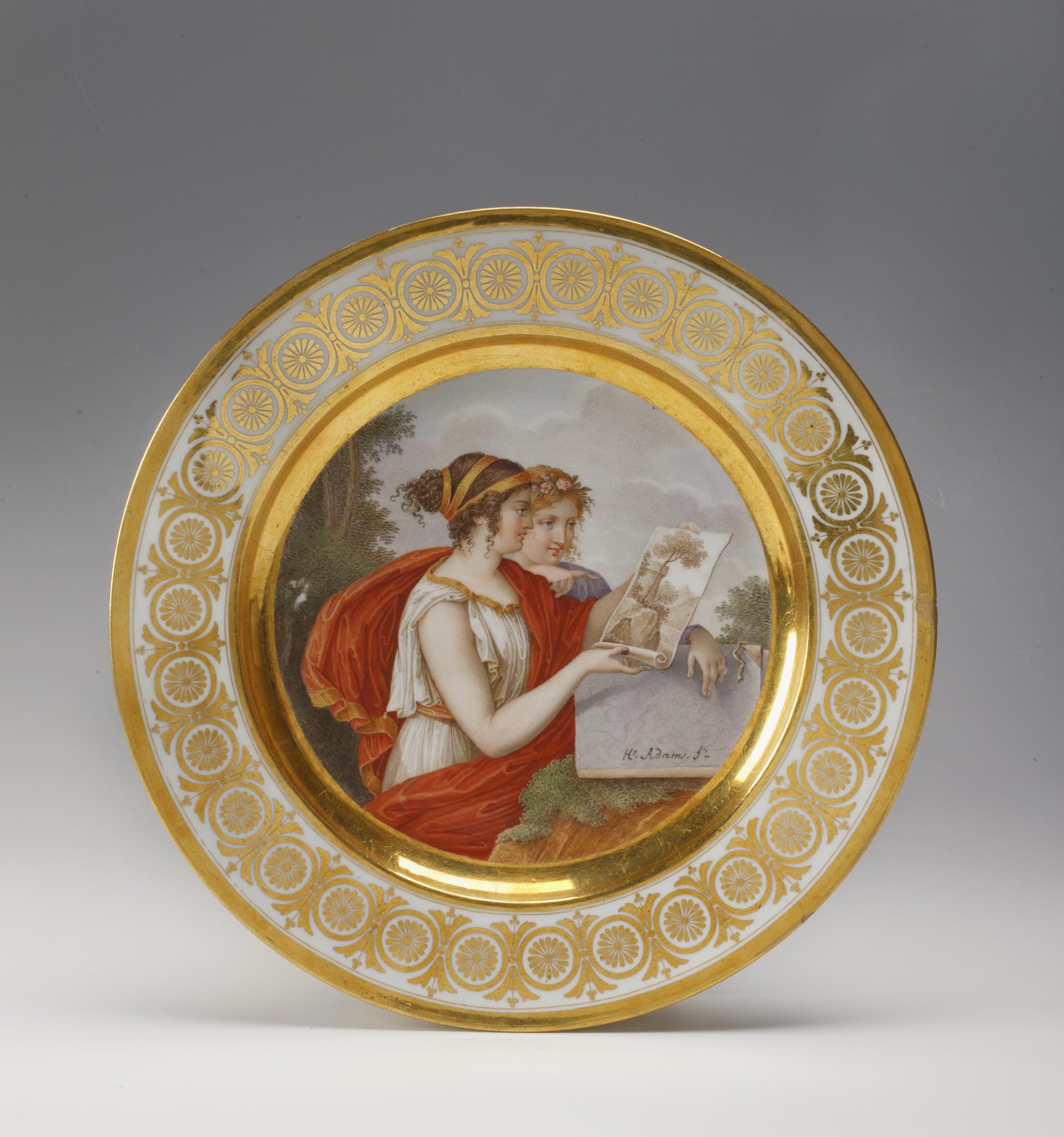
Plate ‘Lesson of Drawing’. The State Hermitage Museum.
The plate entered the Hermitage in 1919, handed over by the Department for the Protection of Monuments of Art and Antiquities, and it was formerly in the collection of A. K. Rudanovsky. It is not currently on permanent display.
It is a round plate — 24.4 centimetres in diameter — with a painted scene in the centre and a wide gilded border.
The Object
The plate is white, with a plain rim and a shallow well.
The centre is painted with a scene: two young women, seated at a table, look at a sheet of paper that one of them holds. The sheet carries a drawing of a tree and a landscape, and the woman beside her points at it.
The border is decorated with a gold pattern of rosettes and palmettes, on a white ground, and the edge is gilded.
The Lesson
The subject is a drawing lesson.
Two young women are studying a drawing: one holds the sheet, the other points at it, and both are looking at the image. It is a scene of instruction and of pleasure, and it belongs to the culture of the amateur arts.
Drawing was an essential accomplishment of the educated woman in the early nineteenth century, and scenes of drawing lessons were popular in art and in porcelain.
The Two Women
The two women are the painting’s figures.
They wear classical dresses: one in white with a red cloak, the other in a pale blue dress. Their hair is curled and bound with ribbons, and their faces are young and attentive.
They are idealised rather than individual, and they belong to the neoclassical taste of the period: elegant, calm and slightly abstract.
The Drawing
The drawing is the plate’s centre.
It is a sheet of paper, painted in pale tones, with a tree and a landscape sketched on it. The woman holds it up, and the light falls on the paper.
The drawing within the painting is a device: it shows the subject of the lesson, and it allows the painter to display his skill at two scales.
The Border
The border is gold.
It is painted with a repeating pattern of rosettes and palmettes, on a white ground, and it is framed by gold bands. The pattern is classical, and it gives the plate its richness.
Borders of this kind were standard on Imperial Porcelain Factory plates of the period, and they framed the central scene like a picture.
Adams
Henri-Albert Adams (1766–1820/41) was a painter at the Imperial Porcelain Factory.
He specialised in figure painting, and he painted scenes after prints, paintings and his own designs. His work is characterised by careful drawing and a delicate palette.
The plate is signed «H. Adams f.» on the sheet of paper in the scene, a signature that is also part of the picture.
The Imperial Factory
The plate was made at the Imperial Porcelain Factory in St Petersburg.
In the early nineteenth century, the factory produced services decorated with scenes: landscapes, figures, military subjects and genre scenes. These plates were part of the «cabinet» services, made for display as much as for use.
The factory’s painters were trained in drawing and in the techniques of overglaze painting, and their work is among the finest of Russian porcelain.
The 1810s
The plate was made in the 1810s or 1820s.
It was a period of neoclassical taste in Russia, when the imperial court favoured classical subjects and elegant, restrained decoration. The plate belongs to that moment: a calm, refined image, painted with care.
The scene of the drawing lesson is also a reflection of the period’s interest in education and in the arts.
The Table
The women sit at a table.
It is a simple stone or wooden table, painted in pale greys, and it holds a portfolio, a sheet of paper and the drawing they are studying. The table is the scene’s ground, and it gives the figures their support.
Tables of this kind are a convention of genre painting: they provide a surface for the action, and they keep the composition stable.
The Colours
The colours are soft and clear.
White, red, blue, green and gold: the palette of neoclassical porcelain. The red cloak of the first woman and the blue dress of the second are the painting’s strongest notes, and the gold border frames them.
The colours are applied as overglaze enamels and fired, and they have a soft, slightly glossy quality.
The Rim
The rim of the plate is white.
It is plain, without decoration, and it frames the gold border and the central scene. The white rim is a deliberate choice: it gives the eye a rest, and it makes the decoration appear richer.
Plate rims were often left plain in the Imperial Porcelain Factory services, and the decoration was concentrated in the centre and the border.
The Plate as Picture
The plate is a picture.
Its central scene is painted like a small canvas, with figures, a landscape and a composition. The border frames it, and the plate becomes a support for a painting.
This combination of painting and object is characteristic of eighteenth- and nineteenth-century porcelain: the plate is both a vessel and an image.
The Landscape
A landscape is behind the figures.
It is a soft, pale background: trees, a hill, a sky, painted in muted greens and blues. The landscape gives the scene depth, and it suggests that the women are in a garden or a park.
Landscapes of this kind are a convention of porcelain painting: they provide a setting without distracting from the figures.
The Portfolio
A portfolio lies on the table.
It is a large, flat object, painted in pale brown, and it holds the drawings and prints that the women are studying. The portfolio is the scene’s attribute: it identifies the activity, and it anchors the composition.
Portfolios and albums were part of the equipment of the amateur artist, and their presence tells us that this is a scene of cultivation and leisure.
Provenance
The plate carries the inventory number ERF-8802. It entered the Hermitage in 1919, handed over by the Department for the Protection of Monuments of Art and Antiquities, and it was formerly in the collection of A. K. Rudanovsky.
In the Hermitage
The plate is preserved in the State Hermitage Museum in Saint Petersburg and is not on permanent display.
It is a fine example of Russian porcelain, and it preserves a small scene of teaching and looking: two women, a drawing and a gilded border, painted in St Petersburg two centuries ago, and still teaching its small lesson.
It is a plate, a painting and a lesson, and it has outlasted the hands that made it and the hands that held it.
And it is still, in its quiet way, a lesson.