Artist: Daiz (recorded name)
Origin: England
Date: late 18th – early 19th century
Material: vellum paper
Technique: pencil, brush and ink
Dimensions: 8.9 × 12 cm
Current Collection: The State Hermitage Museum
Inventory Number: OR-27461
Hermitage ID: 358418
Rudanovsky Connection: Entered the Hermitage in 1922 from the collection of A. K. Rudanovsky.
A small drawing on vellum of Belinda, the heroine of Alexander Pope’s Rape of the Lock, confronted by a kneeling admirer while her companions sit at a card table behind.
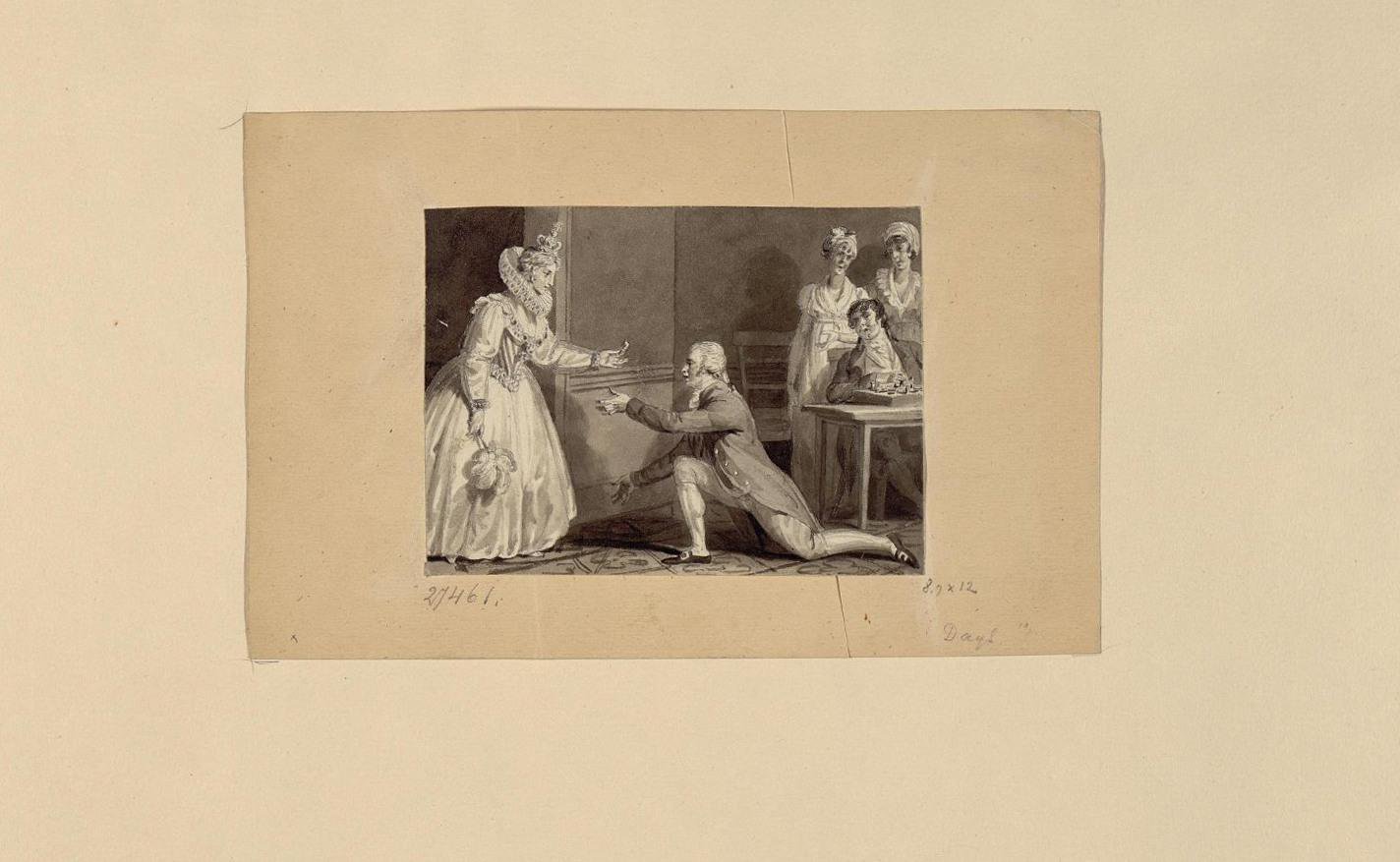
Belinda. Illustration to Alexander Pope’s Poem ‘The Rape of the Lock’. The State Hermitage Museum.
The drawing entered the Hermitage in 1922 from the collection of A. K. Rudanovsky. It is not currently on permanent display.
It is tiny — smaller than a postcard — and it shows a scene of gallantry in an interior, drawn in pencil and ink with delicate washes.
The Object
The sheet is mounted on a larger paper, which carries inscriptions: the number 27461 at the lower left, the dimensions at the lower right, and the name «Daiz» in pencil.
The drawing shows a woman in a white dress, holding a fan or a small parasol, standing on the left. A man in a coat kneels before her, his hands extended. Behind them, two women and a seated man are grouped around a table, on which a game is laid out.
Belinda
Belinda is the heroine of Pope’s poem.
She is a young lady of fashion, beautiful, idle and admired, whose beauty is the subject of the poem. Her world is one of cards, coffee, gossip and flirtation, and the poem treats it with irony and affection.
In the drawing, she is the centre of attention: the kneeling man, the watching companions, the light on her white dress. She is a small figure, but she commands the scene.
Pope’s Poem
The Rape of the Lock was published in 1712 and expanded in 1714.
It is a mock-epic: a trivial incident — the theft of a lock of Belinda’s hair — is treated with the grandeur of Homer and Virgil. The poem is a satire on fashionable society, and it is also a celebration of its elegance.
The poem was enormously popular in the eighteenth century, and it was illustrated many times. This drawing belongs to that tradition of illustration.
The Scene
The scene is a drawing-room drama.
The kneeling man is a suitor or an admirer; his pose is theatrical, almost operatic. Belinda stands above him, calm and slightly distant. The companions at the table watch, and the card game continues.
The composition is small but complete: a stage with three groups — the couple, the watchers, the game — arranged in a shallow space.
The Artist
The artist is recorded only as «Daiz».
Nothing certain is known about him, and the name may be a variant of another name or a misreading. The drawing is English in style and subject, and it belongs to the late eighteenth or early nineteenth century.
The anonymity of the artist is not unusual. Many illustrators of the period worked for publishers and are known only through their signatures or their style.
Vellum
The drawing is made on vellum paper — a smooth, slightly translucent support.
Vellum takes pencil and ink well, and it gives the drawing a fine, even surface. In the eighteenth century, vellum was used for finished drawings and miniatures, and it was more expensive than ordinary paper.
The choice of vellum suggests that the drawing was intended as a finished work, not a sketch.
The Format
The drawing is small, 8.9 by 12 centimetres.
It was made for a portfolio or an album, not for a wall. Such drawings were collected, pasted into albums and shown to friends; they were intimate objects, meant to be held and examined.
The small format also suits the subject: a drawing-room scene, delicate and private.
Illustration
The drawing is an illustration, and it belongs to a particular culture of illustration.
In the eighteenth century, literature was illustrated by painters and engravers, and the images circulated widely in books and prints. Illustrations shaped the way readers imagined the characters and the scenes.
This drawing is a small contribution to that culture: a visual interpretation of Pope’s Belinda, made for a reader who wanted to see her.
The Mock-Heroic
The Rape of the Lock is a mock-heroic poem.
It takes a trivial event — the stealing of a lock of hair — and treats it with the machinery of epic: gods, battles, sacrifices, a descent to the underworld. The effect is both comic and affectionate.
The poem laughs at the vanity of fashionable society, but it also celebrates its elegance. Belinda is ridiculous and enchanting at the same time, and the poem’s illustrations had to capture both.
The Card Table
The card table in the background is a key to the scene.
Cards were a central ritual of eighteenth-century society: ombre, quadrille and whist were played for hours, and the card table was the stage of flirtation, gossip and fortune.
In Pope’s poem, the game is described as a battle, and the cards become heroes. In the drawing, the table is a quiet background detail — but it places the scene in the world the poem describes.
The Small World of the Album
Small drawings like this belonged to albums.
Collectors pasted them into books, arranged by subject or by artist, and leafed through them in the evening. The album was a private museum, and the drawings were its exhibits.
This sheet, with its inscriptions and its mount, carries the marks of that world: the number, the dimensions, the artist’s name, all written for a collector’s eye.
The Dress
Belinda’s white dress is the brightest thing in the drawing.
It is painted with light washes and left almost unshaded, so that it catches the eye against the darker interior. The dress is high-waisted and long, with a small train, and it belongs to the fashion of the years around 1800.
The white dress makes Belinda the centre of the composition and marks her as the heroine: she is the only figure in white, and the others are grouped around her in darker tones.
The Fan
Belinda holds a fan or a small parasol in her right hand.
The fan was an essential accessory of eighteenth-century society: it was used to cool, to hide a smile, to signal, to flirt. In portraits and illustrations, it is almost as common as the glove or the letter.
Here it hangs from her hand, closed or half-closed, and it completes the image of the fashionable woman — a small object that carries a world of social meaning.
Provenance
The drawing carries the inventory number OR-27461 and entered the Hermitage in 1922 from the collection of A. K. Rudanovsky.
In the Hermitage
The drawing is preserved in the State Hermitage Museum in Saint Petersburg and is not on permanent display.
It is a small, charming sheet, and it opens a window onto the world of eighteenth-century illustration: a world of gallantry, cards and literature, drawn in pencil and ink on a piece of vellum.
It is a small drawing of a small world, and it is complete in a way that larger pictures rarely are, even now, after all this time.