Organization: Gardner Porcelain Factory
Origin: Russia, Moscow Governorate, Verbilki Village
Date: second half of the 18th century
Material: porcelain
Technique: polychrome overglaze painting
Dimensions: 12.2 × 5.1 × 4.2 cm
Current Collection: The State Hermitage Museum
Inventory Number: ERF-227
Hermitage ID: 909330
Rudanovsky Connection: Entered the Hermitage in 1919 from the collection of A. K. Rudanovsky.
A porcelain figure of a boy in oriental dress, made at the Gardner factory near Moscow in the second half of the eighteenth century.
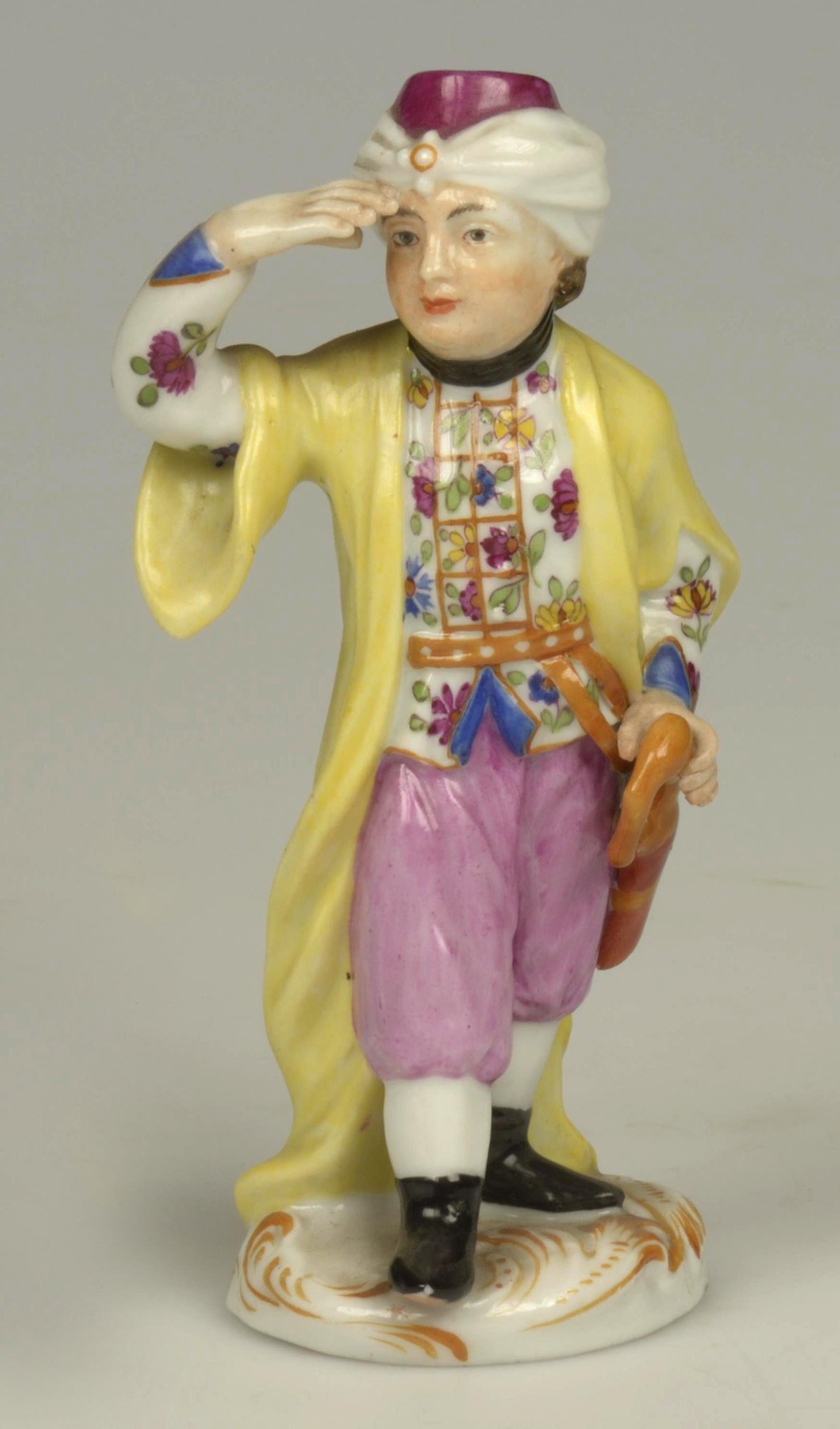
Figure of a Boy in Oriental Dress. The State Hermitage Museum.
The figure entered the Hermitage in 1919 from the collection of A. K. Rudanovsky. It is not currently on permanent display.
It is a small sculpture — twelve centimetres high — of a boy standing on a low, scroll-shaped base, one hand raised to his forehead as if shading his eyes, the other holding a hat.
The Object
The boy wears a white turban with a purple crown and a jewelled ornament at the front.
His costume is a fantasy of the East: a long yellow robe, open over a white tunic painted with flowers, loose pink trousers and black shoes. The tunic has a grid pattern of orange lines, filled with small blossoms in blue, purple and yellow.
The base is white, painted with scrolls of orange and brown, and the figure is finished with a glossy glaze.
The Oriental Figure
Figures in «oriental» dress were popular in European and Russian porcelain of the eighteenth century.
They represented an imagined East — Turkey, Persia, China — and they were used as decorative objects on tables and in cabinets. The costumes were invented rather than observed, and they mixed elements from different cultures.
The boy’s turban, robe and trousers belong to that vocabulary: a costume that signals «the East» without belonging to any particular place.
The Gardner Factory
The figure was made at the Gardner porcelain factory, one of the most important in Russia.
The factory was founded in 1766 by Francis Gardner, an English merchant, in the village of Verbilki near Moscow. It produced services, figures and decorative objects, and it became one of the leading suppliers of porcelain to the Russian court and nobility.
Gardner’s figures were often based on Western models — Meissen, Sèvres, Höchst — adapted to Russian taste.
The Pose
The pose is the figure’s most expressive element.
The boy raises his right hand to his forehead, shading his eyes, and looks into the distance. It is a gesture of looking, of searching, of gazing across a landscape.
The pose gives the small figure a narrative: the boy is not simply standing, he is looking at something. The viewer is invited to imagine what.
The Costume
The costume is painted with care.
The yellow robe is a soft, slightly greenish yellow, shaded in the folds. The white tunic is decorated with a grid of orange lines and small flowers. The pink trousers are a strong note of colour, and the black shoes anchor the figure.
The painting is overglaze enamel, applied in several colours and fired at a low temperature.
The Base
The base is a small, rocaille-shaped plinth.
It is white, painted with orange and brown scrolls, and it raises the figure and gives it stability. The scrolls echo the Rococo vocabulary of the period, and they connect the figure to the tradition of European porcelain sculpture.
The base is also a practical device: it allows the figure to stand on a table without a support.
The Scale
At 12.2 centimetres, the figure is small enough to be held in the hand.
It was made for a table, a cabinet or a dessert display, not for a pedestal. Its size invites close looking: the details of the costume, the expression of the face, the gesture of the hand.
Small figures like this were collected and arranged in groups, and they were part of the decorative life of the eighteenth-century interior.
The Painting
The painting is the work of a specialist.
Overglaze enamel painting requires a steady hand and a good eye for colour: each colour is applied separately, and each firing can alter the result. The flowers on the tunic, the folds of the robe, the face and the hands are all painted with a fine brush.
The palette is limited but effective: yellow, pink, white, blue, green and a little gold.
The Face
The face is the most delicate part of the figure.
It is painted with a light touch: the eyes are small dark dots, the cheeks are touched with pink, the mouth is a small red line. The expression is calm and slightly abstract, like the face of a doll.
This stylisation is characteristic of porcelain figures, where the modelling and the painting together create the illusion of life.
The Turban
The turban is the figure’s most emphatic attribute.
It is built up in white folds, with a purple crown and a jewelled ornament at the front, and it transforms the boy from a Russian child into an oriental type. The turban was a standard sign of the East in European art, and it was used on porcelain figures, in paintings and in masquerade costumes.
The turban’s whiteness contrasts with the yellow robe and the pink trousers, and it draws the eye to the face.
Verbilki
The factory was built in the village of Verbilki, near Moscow.
The site was chosen for its clay and its fuel, and the factory grew into a small industrial settlement with workshops, kilns and housing for the workers. Gardner’s enterprise was one of the first large porcelain factories in Russia.
The factory’s products were sold in Moscow and St Petersburg and exported to the provinces and to the East.
The Figure in the Interior
Figures like this were made for interiors.
They stood on tables, mantelpieces, cabinets and dessert tables, among porcelain, glass and silver. They were part of the decorative texture of a room, and they were arranged in groups: shepherds, gardeners, orientals, musicians.
The boy in oriental dress would have been one of several figures, and his pose — looking into the distance — suggests that he was meant to be seen in company.
The Glaze
The glaze of the figure is glossy and slightly uneven.
It pools in the folds of the robe and the recesses of the base, and it gives the surface a soft, liquid quality. The glaze also protects the painting and gives the colours their depth.
The slight unevenness of the glaze is a sign of hand production: each figure was dipped or brushed individually, and each has its own surface.
Provenance
The figure carries the inventory number ERF-227 and entered the Hermitage in 1919 from the collection of A. K. Rudanovsky.
In the Hermitage
The figure is preserved in the State Hermitage Museum in Saint Petersburg and is not on permanent display.
It is a small, charming object, and it represents a particular moment in Russian porcelain: the adaptation of European models by a factory that would become one of the great names of Russian decorative art.
It is also a small lesson in how the eighteenth century imagined the world: a boy in a turban, looking into the distance, on a table in Moscow, in the 1790s.