Origin: Western Europe
Date: 19th century
Material: bronze
Technique: casting, gilding
Dimensions: height 17.5 cm; diameter 13.9 cm
Current Collection: The State Hermitage Museum
Inventory Number: E-15403
Hermitage ID: 205345
Rudanovsky Connection: Entered the Hermitage in 1919 from the collection of A. K. Rudanovsky.
A gilt-bronze wine cooler in the shape of a classical bucket, its sides hung with vine leaves and grapes, made in Western Europe in the nineteenth century.
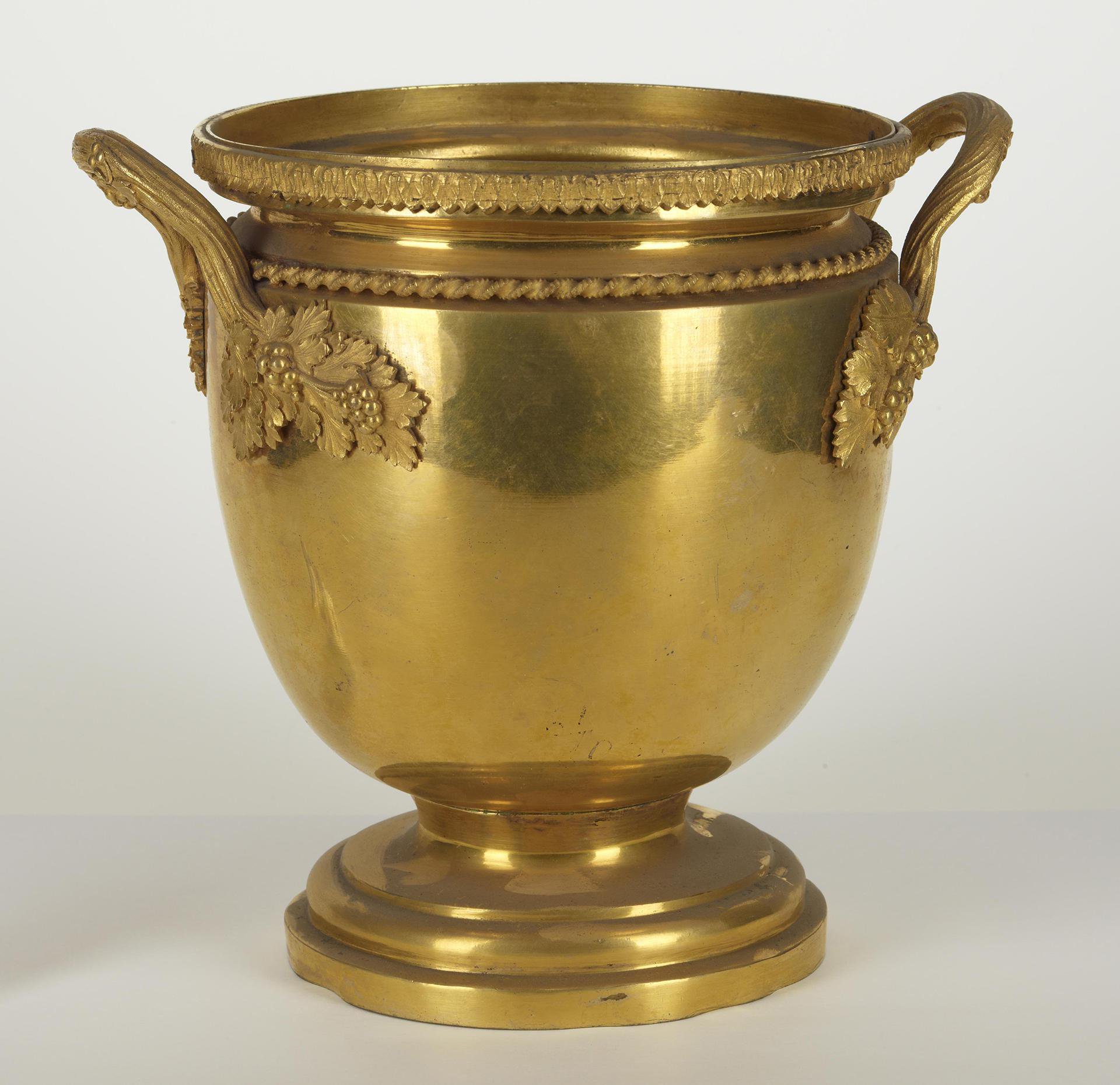
Bottle Tray (E-15403). The State Hermitage Museum.
The cooler entered the Hermitage in 1919 from the collection of A. K. Rudanovsky. It is not currently on permanent display.
It is a vessel for cooling a bottle of wine: a bucket, in effect, made of gilded bronze and decorated as if it were a piece of antique silver.
The Object
The cooler is a deep, rounded bucket standing on a circular foot.
The body is smooth and highly polished, with a broad rim decorated with a band of foliage and a beaded moulding below. Two handles rise from the sides in elegant curves, ending in scrolls.
At the point where each handle meets the body, a cluster of vine leaves and grapes is applied in relief. The foot is a stepped disc, and the whole object is gilded, so that it glows with a warm, even gold.
A Wine Cooler
A wine cooler — seau à bouteille — was a table object, not a kitchen one.
It held a bottle of wine in a mixture of ice and water, keeping it cold during a long dinner. In the eighteenth and nineteenth centuries, cooling wine was a sign of a well-appointed table, and the cooler was often the most decorative object on it.
Coolers were made in silver, porcelain, faience and bronze. A gilt-bronze cooler was a cheaper alternative to silver, and it could be produced in series.
Gilt Bronze
The object is made of bronze, cast and then gilded.
Bronze is an alloy of copper and tin; it is strong, takes a fine cast and can be gilded by mercury or electroplating. In the nineteenth century, electroplating made gilding cheaper and more uniform, and gilt-bronze objects became common in middle-class homes.
The gilding here is even and bright, with some wear at the edges where the object was handled. The surface is polished, so that it reflects the room and the table around it.
The Grapevine
The vine leaves and grapes are the object’s only ornament.
They are a natural choice for a wine cooler: the grape is the source of wine, and the vine is one of the oldest motifs of European decorative art. In classical antiquity, the vine was associated with Bacchus, and it remained a symbol of wine and celebration.
The clusters are cast separately and applied to the body, so that they stand out in relief. Their modelling is soft and naturalistic, with the leaves curling and the grapes round and full.
The Handles
The handles are the most elegant part of the design.
They rise from the body in a long curve, turn outward and end in a scroll. The curve is not simply decorative: it allows the hand to pass through and lift the heavy bucket.
Handles of this kind are a feature of neoclassical metalwork, derived from ancient bronze vessels and from the designs of Piranesi and his contemporaries.
The Base
The cooler stands on a circular foot with a stepped profile.
The foot raises the bucket above the table, gives it stability and provides a visual base for the rounded body. It is cast in one piece with the body or soldered to it, and it is gilded like the rest.
The proportions are carefully calculated: the height is a little more than the diameter, so that the object looks generous without being unstable.
The Nineteenth Century
The cooler belongs to the nineteenth century, when the classical vocabulary of the eighteenth was repeated in cheaper materials for a broader market.
Gilt-bronze tableware was produced in large quantities in France, England and Germany. It imitated the silver and porcelain of the previous century, and it allowed a bourgeois household to set a table in the grand manner.
The cooler is therefore both a revival object and a democratic one: a piece of luxury made available by industrial techniques.
The Table
A wine cooler belongs to the ceremonial of the table.
In the eighteenth and nineteenth centuries, a formal dinner was a sequence of services, and wine was part of the choreography. Bottles were brought to the table in coolers, decanted, and poured by servants; the cooler stood at the centre or at the side, visible to the guests.
A gilt-bronze cooler was therefore a piece of theatre as much as a utensil. It announced that the host took wine seriously, and it added a gleam of gold to the white of the cloth.
Neoclassicism in Metal
The cooler is a neoclassical object, made long after the style it imitates.
Its form derives from ancient bronze vessels — buckets, situlae and cauldrons — that were excavated in Italy and published in the eighteenth century. The grapevine mounts and the scroll handles are quotations from that repertoire.
In the nineteenth century, such forms were produced in large numbers for a market that wanted the look of antiquity without the cost of an original. The cooler is a revival object, and it is honest about it.
Ice
Cooling wine required ice, and ice was a luxury.
Before mechanical refrigeration, ice was cut in winter from lakes and ponds, stored in ice houses and used through the summer. A host who could chill wine in July was a host of means.
The cooler was designed to hold a bottle surrounded by ice and water. Its depth and its wide mouth allowed the ice to be packed around the bottle, and its handles allowed it to be carried when full.
The Silversmith’s Rival
Gilt bronze was the silversmith’s rival.
Silver was expensive and could be melted down in hard times; gilt bronze was cheaper, could be cast in moulds and looked almost as rich. In the nineteenth century, it filled the tables of households that could not afford plate.
The cooler is a product of that economy. It gives the impression of a silver vessel, but it is made of base metal and gold, and it was produced in numbers rather than commissioned as a unique piece.
Provenance
The cooler carries the inventory number E-15403 and entered the Hermitage in 1919 from the collection of A. K. Rudanovsky.
In the Hermitage
The cooler is preserved in the State Hermitage Museum in Saint Petersburg and is not on permanent display.
It is a handsome object, but an ordinary one: a piece of nineteenth-century tableware, made to look older than it is. In the Rudanovsky collection it represents the decorative background of a nineteenth-century interior — the gilded objects that made a table feel festive.
It is also a reminder that the nineteenth century was an age of revival: objects made to look ancient, in materials that were modern, for rooms that wanted the past.
Seen in the hand, it is light, hollow and a little theatrical — a piece of tableware that knows it is playing a role, and plays it well.