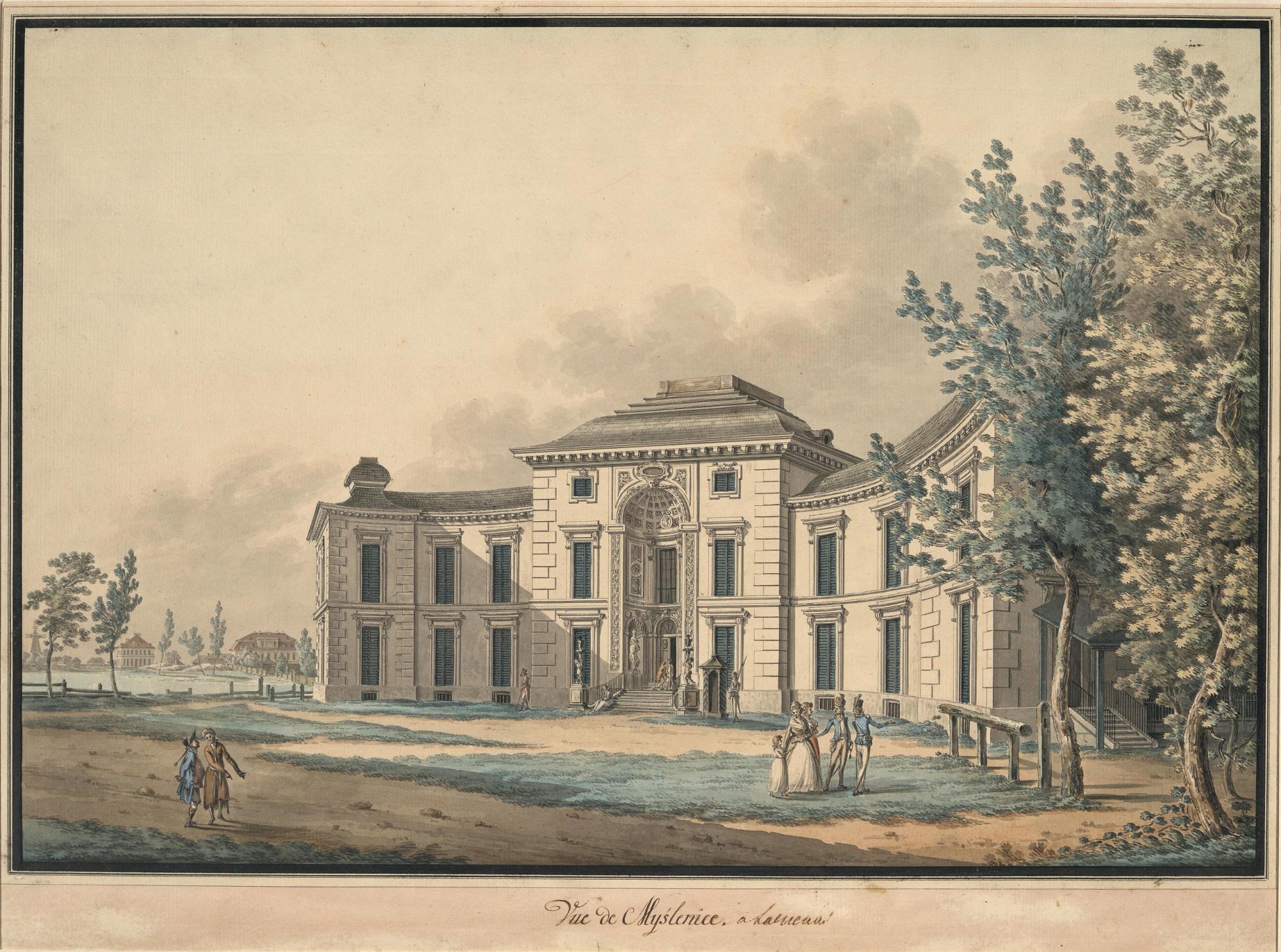
Artist: Zygmunt Vogel (1764–1826)
Date: 1794
Material: paper
Technique: watercolour
Dimensions: 42.3 × 58.3 cm
Current Collection: The State Hermitage Museum
Inventory Number: OR-27273
Hermitage ID: 358085
Rudanovsky Connection: Entered the Hermitage in 1922 from the collection of A. K. Rudanovsky.
A watercolour view of the Palace on the Isle at Łazienki, seen across the water from the side of the cascade, painted by Zygmunt Vogel in 1794.
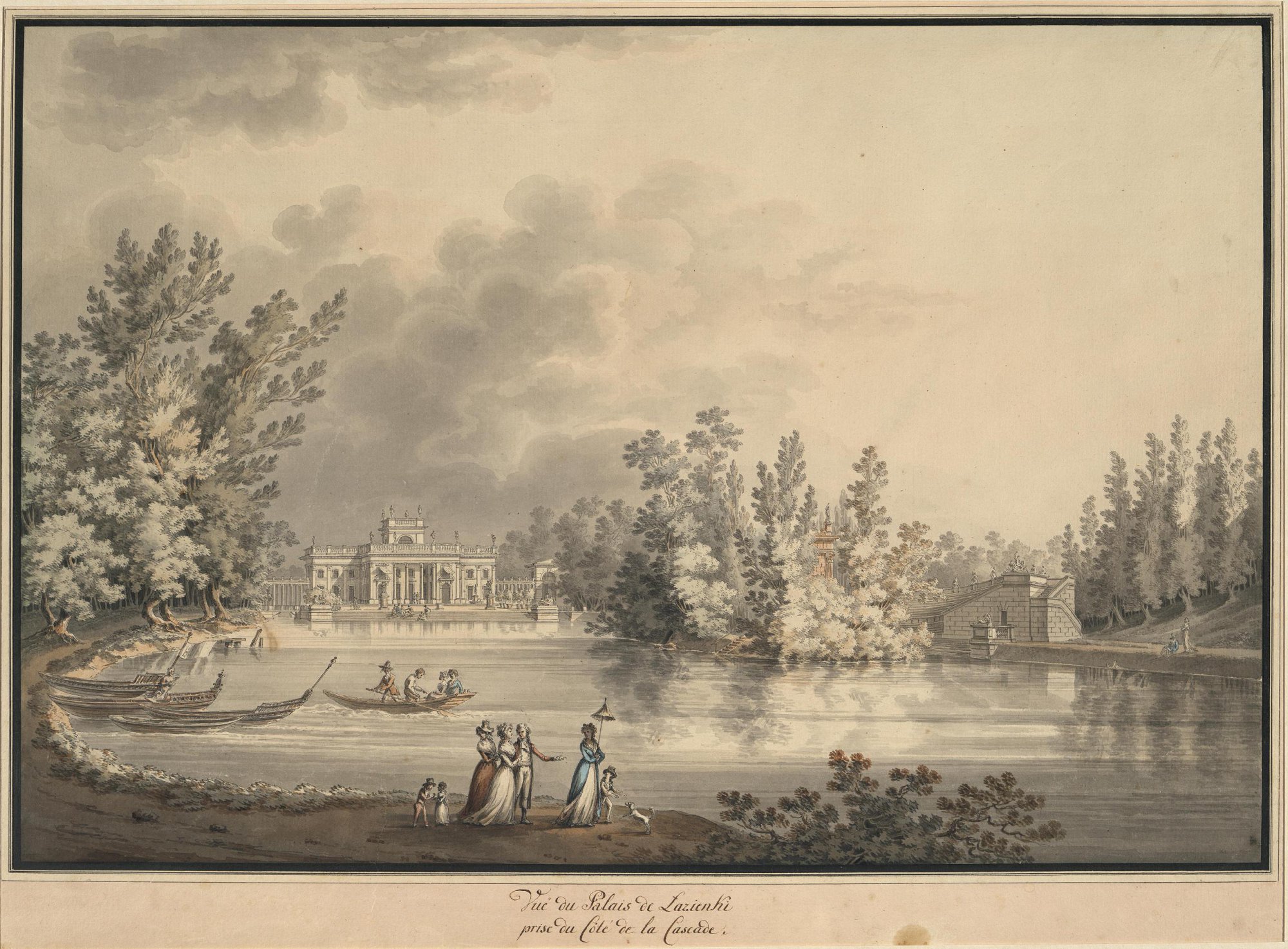
Łazienki. View of the Palace on the Island from the Side of the Waterfall. The State Hermitage Museum.
The watercolour entered the Hermitage in 1922 from the collection of A. K. Rudanovsky. It is not currently on permanent display.
It shows a broad sheet of water, a classical palace on an island, boats, trees and a group of figures on the near shore, all under a sky of soft, rolling clouds.
The Object
The drawing is large for a watercolour — more than half a metre wide — and it is worked in delicate washes of grey, blue and brown.
The composition is divided into three bands: the sky, which occupies half the sheet; the middle ground of water, trees and buildings; and the foreground shore, where figures stand and boats are moored.
A dark border frames the image, and below it, on the mount, an inscription in French identifies the subject: Vue du Palais de Lazienki prise du côté de la cascade.
Zygmunt Vogel
Zygmunt Vogel (1764–1826) was one of the most important Polish draughtsmen of his generation.
He trained in Warsaw, worked for King Stanisław August Poniatowski, and became known for his views of Polish towns, castles and palaces. His nickname, Ptaszek — «little bird» — suggests his lightness of touch and his early talent.
Vogel’s watercolours are topographical: they record places with care, but they are also composed pictures, with staffage, atmosphere and a sense of occasion.
Łazienki
Łazienki was the summer residence of the last king of Poland.
The estate, on the southern edge of Warsaw, was transformed by Stanisław August into a landscape park with pavilions, canals, bridges and a palace on an island. It was a place for concerts, receptions and private retreat, and it became one of the symbols of the Polish Enlightenment.
The name means «the Baths», from a seventeenth-century bath house that once stood on the site.
The Palace on the Isle
The Palace on the Isle — Pałac na Wyspie — was rebuilt for the king between 1772 and 1793.
The architect was Domenico Merlini, who transformed an earlier baroque bath house into a neoclassical villa. The palace is symmetrical, with a central portico, a colonnade and a low dome, and it stands on an island connected to the shore by bridges.
In Vogel’s view, the palace appears across the water, its white façade reflected in the surface — a small classical temple in a landscape.
The View
The view is carefully constructed.
The palace is placed slightly left of centre, at the point where the water, the trees and the sky meet. The boats lead the eye across the water, and the trees frame the composition on both sides.
The foreground is low and dark, the middle ground is bright with water, and the sky is a mass of soft clouds. The effect is of a calm, ordered landscape — an Arcadia on the outskirts of Warsaw.
The Staffage
The figures in the foreground are staffage: small figures added to give scale and life to a landscape.
A group of women and men stand on the shore, accompanied by children and a small dog. One woman holds a parasol. Further out, a boat carries passengers across the water, and other boats are moored at the bank.
Staffage was a convention of topographical drawing. It turned a view into a scene, and it allowed the artist to suggest the social life of the place.
1794
The date is significant.
1794 was the year of the Kościuszko Uprising, the last attempt to save Poland from partition. Warsaw was the centre of the revolt, and the city was besieged and stormed by Russian troops.
Vogel’s watercolour shows none of this. It is a peaceful view of a royal garden, painted in the year the Polish state was disappearing. The contrast between the calm of the image and the violence of the moment is one of the things that makes it moving.
The Inscription
The French inscription on the mount is a small historical document.
Vue du Palais de Lazienki prise du côté de la cascade — «View of the Palace of Łazienki taken from the side of the cascade». The use of French is typical of the period: French was the language of polite society in Poland, and it was the language of the international art market.
The inscription also tells us how the drawing was meant to be seen: as a view, a record of a place, labelled for a viewer who might not know it.
Watercolour
Watercolour was the medium of the topographical view.
It allowed the artist to work quickly out of doors, to record effects of light and atmosphere, and to produce finished sheets that could be sold or collected. The transparency of the medium suited the pale skies and the reflections on water.
Vogel’s handling is delicate: the washes are built up in layers, the details are drawn with a fine brush, and the whole image has a silvery, almost monochrome tonality.
Vedute
The watercolour belongs to the genre of the veduta — the painted or drawn view of a city, a building or a landscape.
Vedute were among the most popular souvenirs of the eighteenth century. Travellers on the Grand Tour bought views of Venice, Rome and Naples; kings commissioned views of their palaces; and artists made albums of the places they had seen.
Vogel’s views of Warsaw belong to that tradition, but they also have a national purpose: they record the monuments of Poland at the moment when the country was disappearing from the map.
The Park
Łazienki was more than a palace; it was a landscape park.
The estate was laid out in the English manner, with winding paths, water, bridges and pavilions. It was designed to be walked through, and its views were composed to be discovered one after another.
Vogel’s watercolour is one of those views, framed and labelled like a stop on a walk. It shows the park as it was meant to be seen: a sequence of pictures.
The Cascade
The inscription says the view was taken «from the side of the cascade».
Łazienki was a landscape of water: a lake, canals, ponds and a cascade that fed the system. The cascade was one of the picturesque features of the park, and it provided a natural viewpoint for the palace.
In the drawing, the cascade is not prominent; it is implied by the lie of the land and by the water in the foreground. The inscription, however, records it, and reminds us that the view was conceived as part of a designed landscape.
Provenance
The watercolour carries the inventory number OR-27273. It entered the Hermitage in 1922 from the collection of A. K. Rudanovsky.
In the Hermitage
The watercolour is preserved in the State Hermitage Museum in Saint Petersburg and is not on permanent display.
It belongs to the collection of drawings, one of the quieter parts of the museum, and it records a place and a moment that no longer exist in the same form: the royal garden of Warsaw in the last year of the Polish-Lithuanian Commonwealth.