Organization: Imperial Porcelain Manufactory, Vienna
Origin: Austria, Vienna
Date: 1797
Material: porcelain
Technique: monochrome painting, gilding
Dimensions: height 20.3 cm; diameter 17 cm
Current Collection: The State Hermitage Museum
Inventory Number: ZF-17005
Hermitage ID: 354505
Rudanovsky Connection: Entered the Hermitage in 1919 from the collection of A. K. Rudanovsky.
A Viennese porcelain bottle tray of 1797, with two handles, a blue band and small blue flowers.
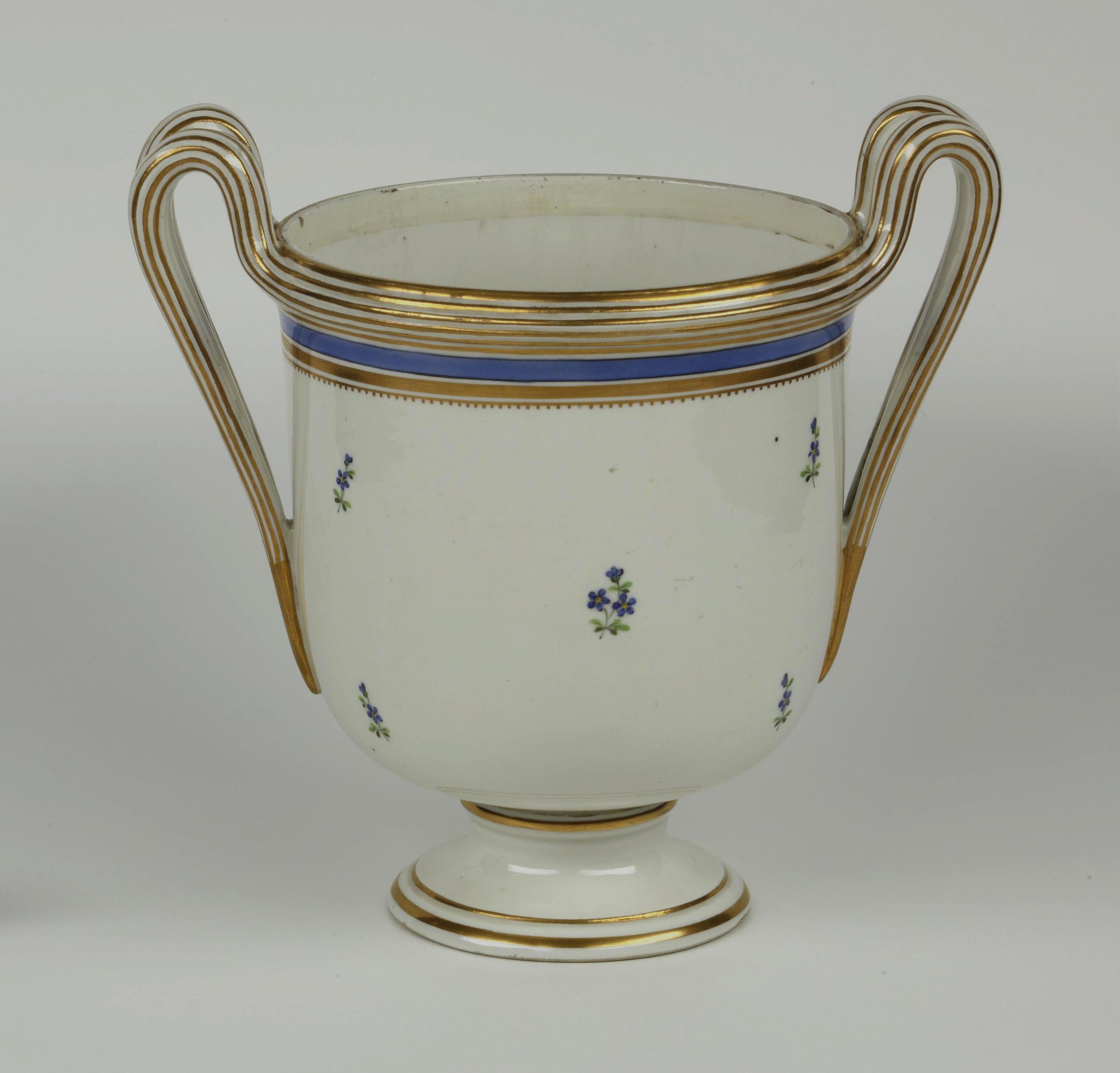
Bottle Tray (ZF-17005). The State Hermitage Museum.
The tray entered the Hermitage in 1919, transferred through the Department for the Protection of Monuments of Art and Antiquities from the collection of A. K. Rudanovsky. It is not currently on permanent display.
It is a two-handled vessel — 20.3 centimetres high — with a white ground, a blue band and scattered blue flowers.
The Object
The tray is a deep bowl on a spreading foot, with two high loop handles.
Its upper part is decorated with a blue band, framed by gold lines and a row of gold dots. Below, the body is white, scattered with small blue flowers on green stems.
The handles are white, with gold lines along their edges, and the foot is banded with gold.
The Bottle Tray
The object is a bottle tray, or bottle cooler.
It held a bottle — of wine, water or liqueur — and it stood on the table, with the bottle cooling in it or simply displayed. Its two handles allowed it to be carried.
Vessels of this kind were part of the table service: they protected the cloth, cooled the bottle and framed it for the guests.
The Blue Band
The blue band is the object’s structure.
It runs around the upper part of the body, and it is framed by gold lines and a row of small gold dots. The blue is deep and even, and it contrasts with the white ground.
Bands of this kind are a feature of Viennese porcelain of the 1790s: they frame the decoration and give the object a clear architecture.
The Flowers
The flowers are the object’s ornament.
They are small blue blossoms on green stems, scattered across the white body. Each flower is painted with a few strokes, and the effect is delicate and airy.
Flowers of this kind are a Viennese speciality: small, naturalistic and evenly spaced.
The Handles
The object has two high loop handles.
They rise from the rim and curve down to the body, and they are painted with gold lines. The handles are practical — they allow the vessel to be carried — and they give it its elegant silhouette.
Handles of this kind are a feature of Viennese bottle trays of the period.
Vienna
The tray was made in Vienna.
The Imperial Porcelain Manufactory of Vienna was one of the earliest in Europe, and it produced services, figures and decorative objects. In the late eighteenth century, it was known for its clear forms, its fine painting and its gilding.
The tray belongs to that production, and it shows the Viennese taste for restraint and precision.
1797
The tray is dated 1797.
It was made in the last years of the eighteenth century, when Vienna was the capital of the Habsburg empire and a centre of European culture. The porcelain factory was at its height.
The date places the object precisely, and it allows it to be compared with other Viennese wares of the period.
The Foot
The tray stands on a spreading foot.
It is white, with gold bands, and it raises the body from the table. The foot gives the vessel stability, and it is one of the signs of the object’s quality.
A spreading foot under a wide bowl is a classical proportion: it makes the vessel look lighter than it is.
The Body
The body is broad and rounded.
It swells from the foot to the rim, and it is designed to hold a bottle securely. Its surface is white, with the blue band and the scattered flowers.
The body is the object’s main surface, and it is where the painter’s work is most visible.
The Blue
The blue is a single, deep band.
It is painted in a solid colour, with a clear edge, and it is framed by gold lines. The blue is the object’s strongest colour, and it gives the white ground its contrast.
A single blue band is a classical device: it marks the rim and gives the vessel its architecture.
The Gold Line
The gold lines frame the blue band.
They are thin and precise, and they are drawn with a steady hand. The gold separates the blue from the white, and it gives the band its finish.
Gold lines of this kind are the most fragile part of the decoration, and they wear first.
The Table
The tray was made for a table.
It stood with a bottle in it, among glasses and other vessels, and it was used for wine or water. Its blue and white would have caught the candlelight.
That table is gone, but the tray still carries its logic: a vessel made to hold and display a bottle.
The Collector
The tray came to the Hermitage with the Rudanovsky collection.
Rudanovsky collected European porcelain alongside paintings, drawings, glass and miniatures, and his collection included Viennese services and decorative objects.
The tray is therefore a double document: of Vienna in 1797 and of a Russian collector’s taste.
The Rim
The rim of the tray is wide and gilded.
It is banded with gold and a row of dots, and it frames the opening. The rim is where the bottle is inserted and removed, and it is the part most exposed to wear.
Rims of this kind are a feature of Viennese bottle trays, and they give the object its finish.
The Size
At 20.3 centimetres high, the tray is a substantial object.
It is large enough to hold a wine bottle, and heavy enough to be stable on the table. Its size makes it a centrepiece, and its handles make it portable.
A vessel of this size was an object of display as much as of use.
The Flowers’ Colour
The flowers are blue.
They are small, five-petalled blossoms, painted in a clear, slightly greyish blue, with green stems and leaves. The blue of the flowers echoes the blue band, and it unites the object.
Blue flowers were a favourite of Viennese painters in the 1790s: they were cheap to paint, and they gave the white ground a delicate pattern.
Provenance
The tray carries the inventory number ZF-17005. It entered the Hermitage in 1919, transferred through the Department for the Protection of Monuments of Art and Antiquities from the collection of A. K. Rudanovsky.
In the Hermitage
The tray is preserved in the State Hermitage Museum in Saint Petersburg and is not on permanent display.
It is a fine example of Viennese porcelain, and it preserves a small ceremony: a bottle, a blue band and a few flowers, on a table two centuries ago.
It is a vessel for a bottle, and it is also a small architecture: a foot, a bowl, a blue band and two handles, holding a bottle and a moment of hospitality. It is, in the end, a small monument to a bottle.