Artists: Jacques-François Micaud père and Philippe Xhrowet (painters)
Organization: Sèvres Porcelain Manufactory
Origin: France
Date: 1764
Material: soft-paste porcelain
Dimensions: height 26.6 cm; diameter 24 cm
Current Collection: The State Hermitage Museum
Inventory Number: ZF-16291
Hermitage ID: 352386
Rudanovsky Connection: Entered the Hermitage in 1919 from the collection of A. K. Rudanovsky.
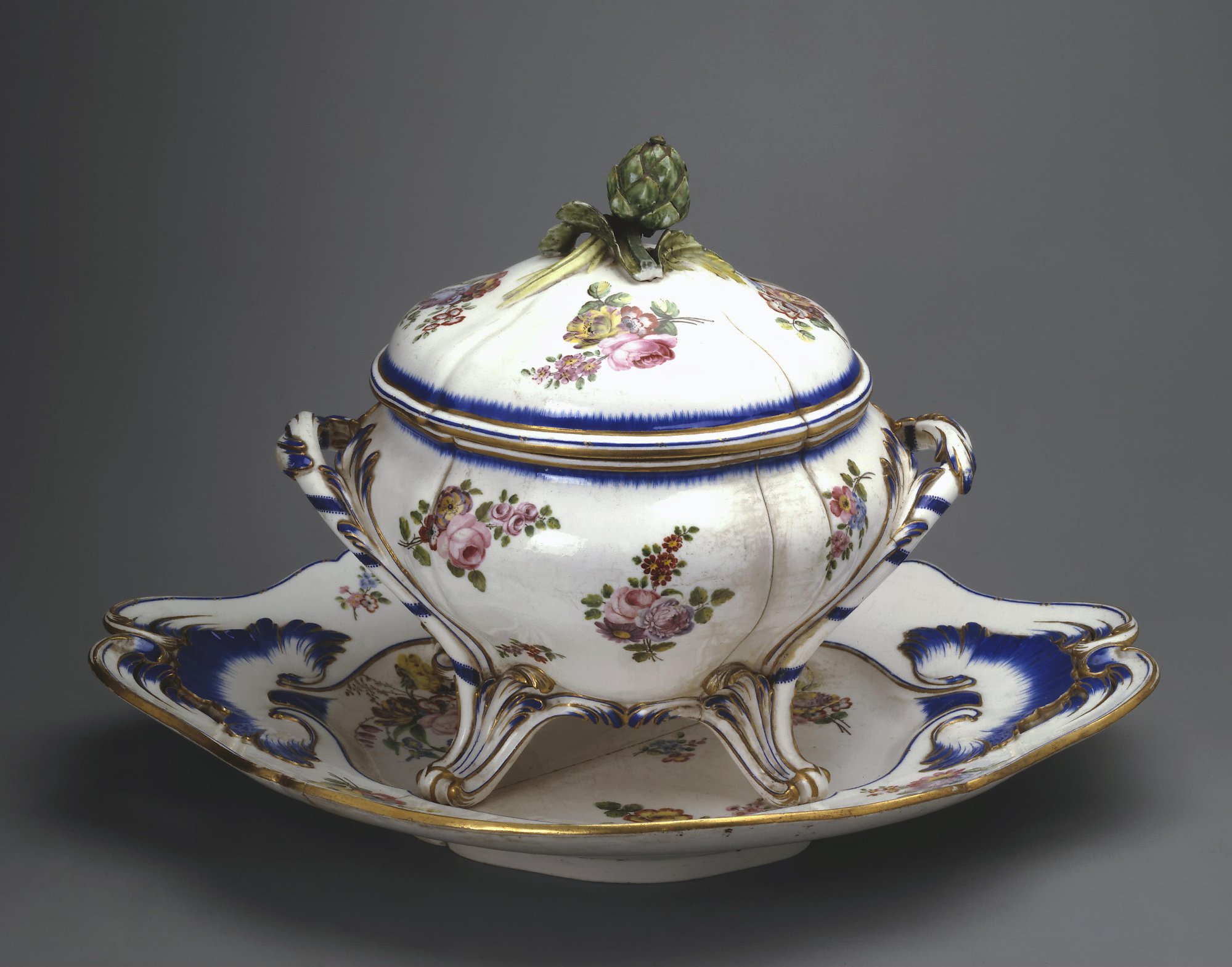
A Sèvres tureen of 1764, its white body painted with flowers and bound with a deep blue band, crowned by a green artichoke.
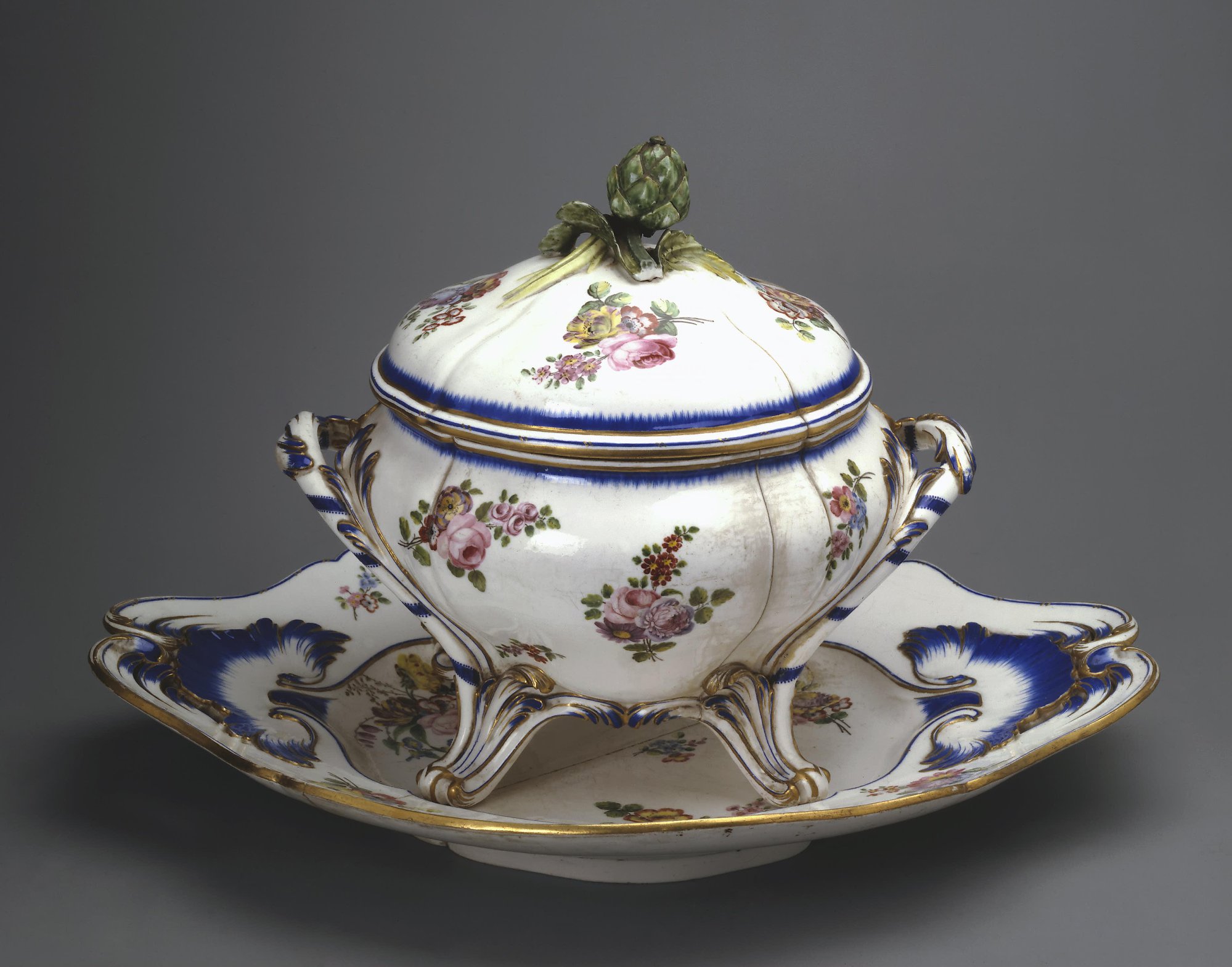
Bowl with a Lid. The State Hermitage Museum.
The bowl entered the Hermitage in 1919 from the collection of A. K. Rudanovsky. It is not currently on permanent display.
It is a tureen — a covered serving dish — with two handles, four scroll feet, and a lid crowned by a modelled artichoke. It stands on an oval stand, which is recorded separately as a tray.
The Object
The tureen is white, with a slightly lobed body and a domed lid.
A deep blue band runs around the rim of the lid and the neck of the body, edged with gold lines. On the white ground, bouquets of flowers are painted: roses, carnations, small blossoms and green leaves, scattered across the body and the lid.
The handles are scrolls, painted with blue and gold. The feet are curved and gilded. The artichoke on the lid is modelled in the round, with overlapping leaves in two shades of green.
The Tureen
A tureen is a vessel for serving soup or stew.
It is one of the grandest objects of a dinner service: large, covered, often decorated with a sculpture on the lid. It stood at the centre of the table, and its lid kept the food hot.
Tureens were made in silver, porcelain and faience, and they were among the most expensive pieces of a service.
The Artichoke
The artichoke on the lid is the tureen’s crowning detail.
It is modelled in the round, with overlapping leaves and a small stem, and painted in two greens. It is a naturalistic object, but it is also a decorative finial: it gives the lid a handle and a silhouette.
Vegetable finials were popular in eighteenth-century porcelain: cabbages, artichokes, lemons and pears appeared on tureens and bowls, turning the lid into a small sculpture.
The Blue Band
The blue band is the tureen’s strongest colour.
It runs around the lid and the neck, and it is painted with a feathered edge, as if it had been brushed. Gold lines frame it above and below.
This kind of blue band — a deep, saturated ground with a soft edge — is characteristic of Sèvres in the 1760s, and it gives the white porcelain a rich, framed appearance.
The Flowers
The flowers are painted in the naturalistic style of the period.
Bouquets of roses, carnations and small blossoms are scattered across the white body, with leaves and stems. The colours are soft: pinks, reds, yellows, blues and greens.
The flowers are not arranged in a single composition; they are distributed around the object, so that each side has its own bouquet.
Sèvres in 1764
In 1764, Sèvres was at the height of its production of soft-paste porcelain.
The factory was a royal manufactory, and it supplied the court and the aristocracy with services of extraordinary quality. Its painters, gilders and modellers were among the most skilled in Europe.
The tureen belongs to that period: a large, ambitious object, decorated with flowers and blue bands, and crowned with a modelled vegetable.
The Painters
The tureen is attributed to two painters: Jacques-François Micaud père and Philippe Xhrowet.
Micaud was a flower painter, and his name appears on many Sèvres pieces of the period. Xhrowet is less well known, but he is recorded as a painter at the factory.
The collaboration of two painters on a single object was common: one might paint the flowers, another the birds or the ornaments.
Soft Paste
The tureen is made of soft-paste porcelain.
Soft paste is a mixture of clay and glass, fired at a lower temperature than hard paste. It is more translucent and more fragile, and it allows a wider range of colours, but it is difficult to fire in large pieces.
A tureen of this size — 26.6 centimetres high — is a technical achievement in soft paste, and its survival is a testament to the skill of the factory.
The Stand
The tureen stands on an oval tray.
The tray is recorded separately in the collection, but it was made for the tureen and belongs with it. It is painted with the same blue scrolls and flowers, and its shape follows the oval of the tureen’s foot.
The pair — tureen and stand — is the complete object; separated, each is only half.
The Handles
The tureen has two scroll handles.
They curve out from the body and turn inward, and they are painted with blue and gold. Their shape echoes the scrolls of the feet and the curve of the lid, and they give the object a symmetrical silhouette.
Handles of this kind were both practical and decorative: they allowed the heavy tureen to be lifted, and they framed the body like brackets.
The Feet
The tureen stands on four curved feet.
They are painted with blue and gold, and they raise the body above the stand, giving it a light, almost floating appearance. The feet are shaped like scrolls, echoing the handles and the Rococo vocabulary of the period.
Four feet were standard for tureens: they gave stability and allowed the vessel to sit securely on its stand.
The Lid
The lid is domed, with a blue band around its edge and a bouquet of flowers on top.
It fits into the rim of the tureen, and its artichoke finial serves as a handle. The lid is painted on both sides — the visible top and the inner surface — with flowers and blue bands.
A lid turns a bowl into a vessel: it keeps the food hot, protects it from dust and gives the object a closed, sculptural form.
The Service
The tureen belongs to a service.
It was made with a stand, and probably with plates, dishes and other pieces decorated in the same style. The blue band and the scattered flowers are the service’s signature.
The service is now dispersed, but the tureen and its stand survive together, and they allow us to imagine the table for which they were made.
Provenance
The tureen carries the inventory number ZF-16291 and entered the Hermitage in 1919 from the collection of A. K. Rudanovsky.
In the Hermitage
The tureen is preserved in the State Hermitage Museum in Saint Petersburg and is not on permanent display.
It is one of the grandest pieces of the Rudanovsky porcelain collection, and it shows how a serving dish could become a sculpture: a white body, a blue band, a garden of flowers and a green artichoke on top.
For a tureen, that is a great deal of theatre — and it was meant to be seen at the centre of a table, with the steam rising around it, in the candlelight of a long dinner.
It is, in its way, a monument made of clay and fire, and a little vanity, too.