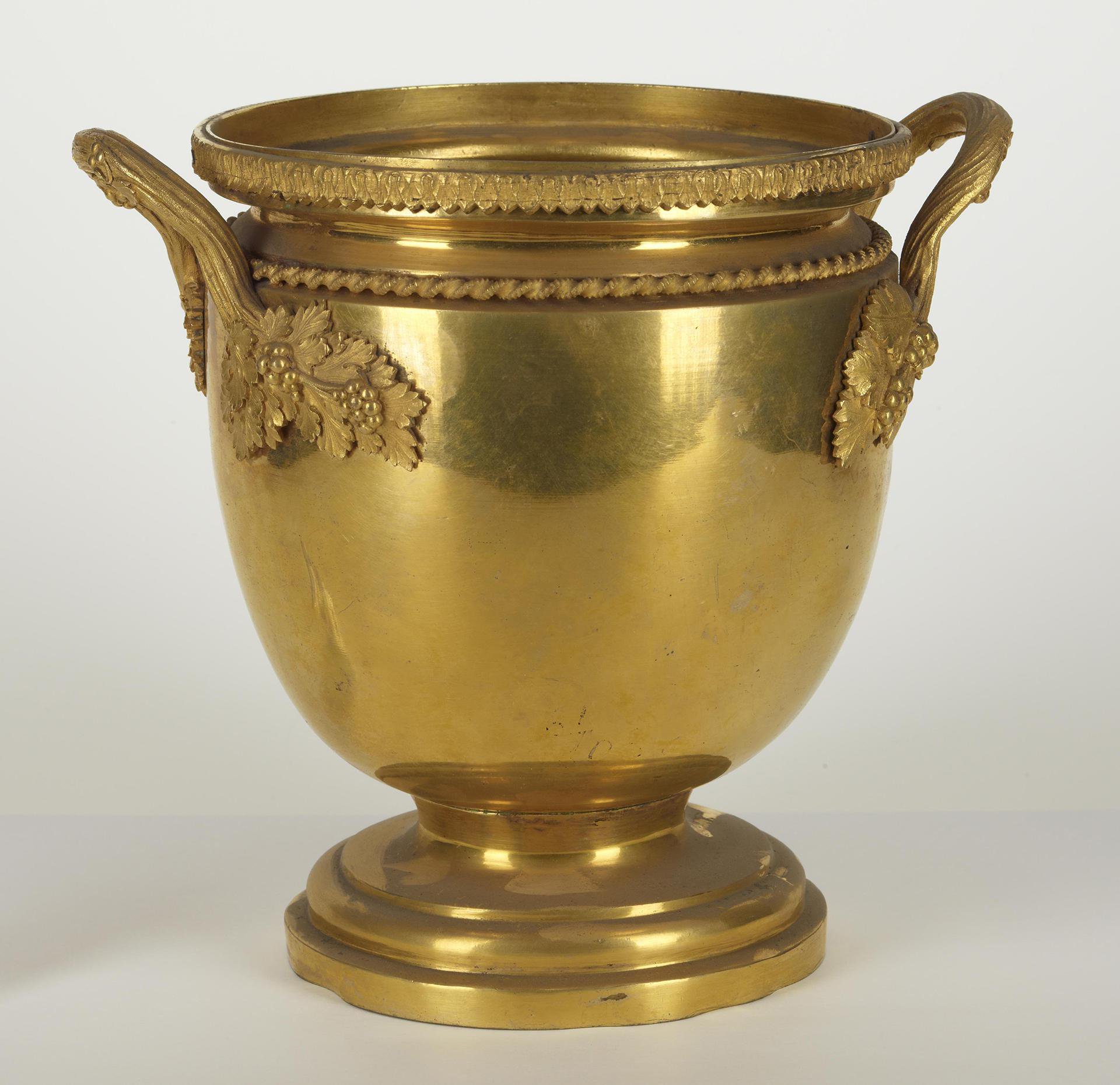
Origin: Western Europe
Date: 19th century
Material: agate, bronze
Technique: carving, grinding, polishing, casting, repoussé, gilding
Dimensions: 4.9 × 8.2 cm
Current Collection: The State Hermitage Museum
Inventory Number: E-12151
Hermitage ID: 152109
Rudanovsky Connection: Entered the Hermitage in 1919 from the collection of A. K. Rudanovsky.
A small rectangular box of banded agate in a gilt-bronze mount, made in Western Europe in the nineteenth century.
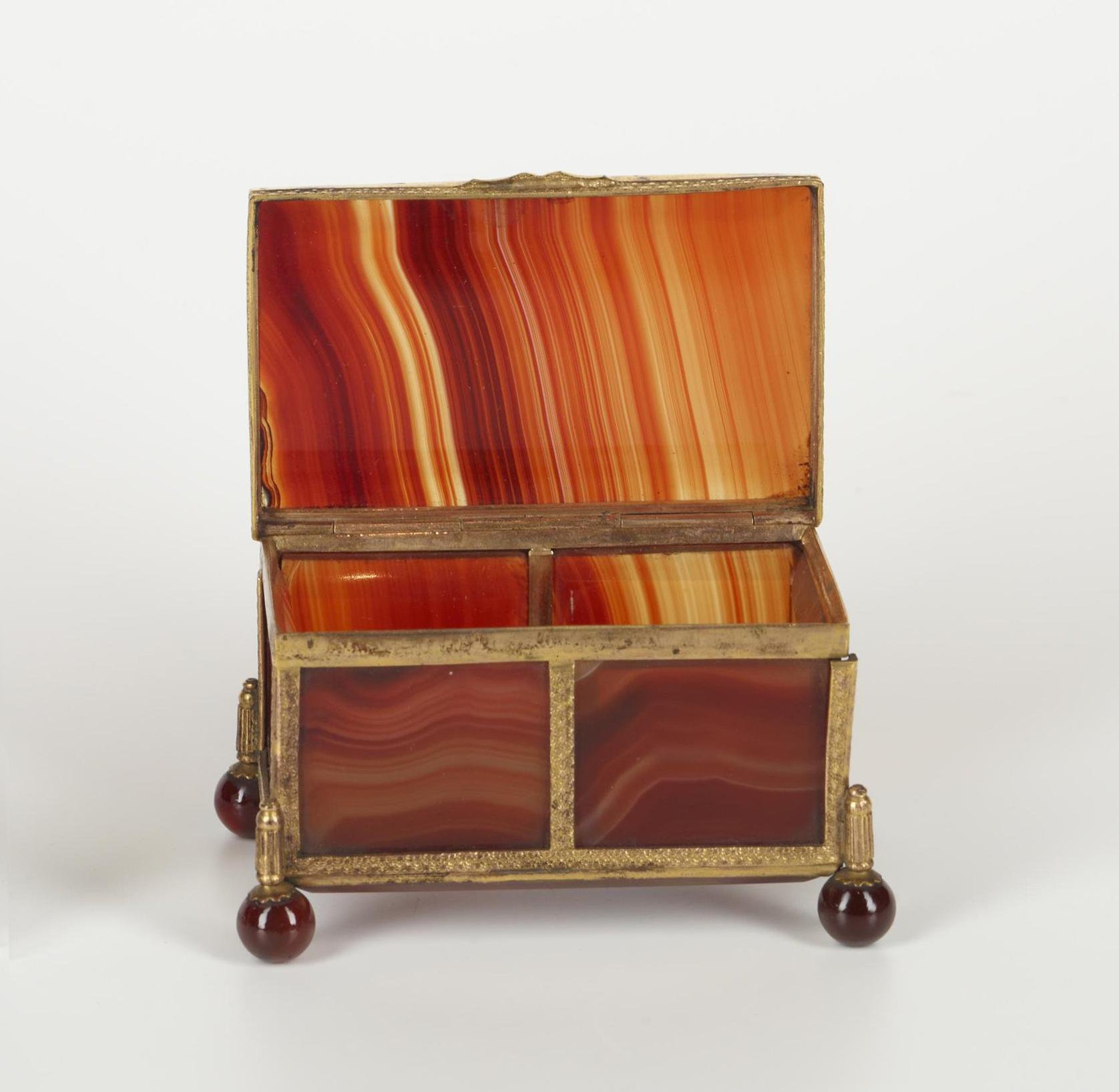
Box. The State Hermitage Museum.
The box entered the Hermitage in 1919 from the collection of A. K. Rudanovsky. It is not currently on permanent display.
It is small enough to close in one hand, and it is made of a stone that looks like a slice of sunset: orange, red and cream bands running through the agate in waves.
The Object
The box is rectangular, with a hinged lid and four ball feet.
The panels — the lid, the sides and the base — are cut from banded agate, polished to a high shine. The bands are natural: layers of silica deposited in a cavity, coloured by iron oxides, and revealed when the stone is cut.
The frame is gilt bronze, cast and chased, with a fine engraved pattern along the edges. It holds the agate panels like a setting holds a jewel.
The Agate
Agate is a variety of chalcedony formed in layers.
The layers are deposited in cavities in volcanic rock, each one a different colour depending on the minerals present. When the stone is cut and polished, the layers appear as bands — straight, wavy or concentric — and the effect is one of the most decorative in all of stone.
The agate in this box is strongly banded, with deep reds and oranges alternating with pale cream. The cutting has been planned to show the bands at their most dramatic, especially on the lid.
The Mount
The gilt-bronze mount is as important as the stone.
It holds the panels, protects the edges, provides the hinge and the feet, and gives the box its shape. The bronze is cast, chased and gilded, and the gilding has worn in places, revealing the metal beneath.
Mounts of this kind were made by specialist bronziers, who worked closely with the lapidaries. The combination of stone and gilt bronze was one of the characteristic luxuries of the eighteenth and nineteenth centuries.
The Feet
The four feet are small balls of dark red stone, mounted on gilt-bronze stems.
They lift the box off the surface, protect the base and add a decorative detail. The colour of the feet echoes the darkest bands of the agate, tying the object together.
Details like this show the care that went into the design of small luxury objects. The feet are not necessary to the function of the box, but they are necessary to its appearance.
A Box for What?
What was the box for?
Small boxes of this kind were used for many things: snuff, jewellery, seals, counters, patches, sweets. The compartments inside — two, side by side — suggest a division of contents, perhaps between two kinds of object.
The box could also have been a purely decorative object, kept on a table or in a cabinet and admired for its stone. In the nineteenth century, such boxes were collected as specimens of lapidary work.
The Compartments
The interior is divided into two compartments by a low partition.
The division is practical: it keeps the contents separate and doubles the usefulness of a small space. It is also aesthetic: a single empty box would look plain, while two compartments give the interior a structure.
The inside of the lid is lined with agate, so that the bands continue across the whole object when it is open. This continuity is one of the pleasures of the box.
Hardstone Boxes
Boxes of agate, jasper, malachite and other hardstones were a specialty of European and Russian lapidary workshops.
They were made in the eighteenth and nineteenth centuries in Paris, Dresden, Florence and St Petersburg, and they were collected alongside gems and cameos. The combination of a colourful stone with a gilt-bronze mount was particularly popular.
Such boxes were luxury objects, but they were also useful ones: they held the small things that people carried and kept.
The Nineteenth-Century Interior
In the nineteenth century, the interior was filled with small objects.
Tables, cabinets and shelves held boxes, vases, seals, miniatures and curiosities. A box like this one would have stood on a desk or a dressing table, catching the light and inviting the hand.
The taste for hardstone boxes was part of a broader taste for materials: marble, malachite, porphyry, agate. The nineteenth century loved the look of polished stone.
Banding
The bands in the agate are a record of time.
Agate forms when silica-rich water seeps into cavities in volcanic rock and deposits layer after layer of chalcedony. Each layer records the chemistry of the water at that moment: iron oxide gives red and orange, manganese gives purple and black, and the absence of impurities gives white and grey.
The result is a stone that is literally made of time — a stack of geological moments, cut and polished so that the layers become visible.
The Hinge
The hinge is the smallest mechanical part of the box, and one of the most important.
It must hold the lid in line with the base, allow it to open smoothly and close without a gap. On a box of stone, the hinge is also a point of stress: the lid is heavy, and the bronze must take the load.
The hinge here is a simple gilt-bronze knuckle, worn at the edges from use. It is a small piece of engineering that makes the object work.
Russian Collecting
Hardstone boxes were popular with Russian collectors.
Russia had its own great lapidary tradition — malachite, jasper, porphyry — and Russian collectors were familiar with the combination of coloured stone and gilt bronze. A Western European box of agate would have fitted easily into a Russian cabinet.
The Rudanovsky collection included such objects alongside its paintings, porcelain and gems, which suggests a collector interested in the whole range of decorative arts rather than in a single category.
Polishing
Polishing is the last stage and the one that gives the box its character.
The agate is ground with successively finer abrasives, then polished with a soft wheel and a fine powder until the surface is smooth and reflective. The bronze is gilded and burnished; the stone is waxed.
The finished box is a play of surfaces: hard, cold, glossy stone against warm, slightly matte gilding. That contrast is the whole point of the object, and it depends on the final polish.
Provenance
The box carries the inventory number E-12151 and entered the Hermitage in 1919 from the collection of A. K. Rudanovsky.
In the Hermitage
The box is preserved in the State Hermitage Museum in Saint Petersburg and is not on permanent display.
It is a small object, but it is a complete one: stone, metal, design and function all in a space of eight centimetres. Open, it shows its bands like a slice of geology; closed, it is a quiet rectangle of colour on a polished table, waiting to be opened again.