Origin: Western Europe
Date: 19th century
Material: gold
Technique: chased, engraved and polished
Dimensions: diameter 3.3 cm
Current Collection: The State Hermitage Museum
Inventory Number: E-10632
Hermitage ID: 147896
Rudanovsky Connection: Entered the Hermitage in 1919 from the collection of A. K. Rudanovsky.
A small gold brooch of the nineteenth century, its round face filled with a cupid, doves and flowers.
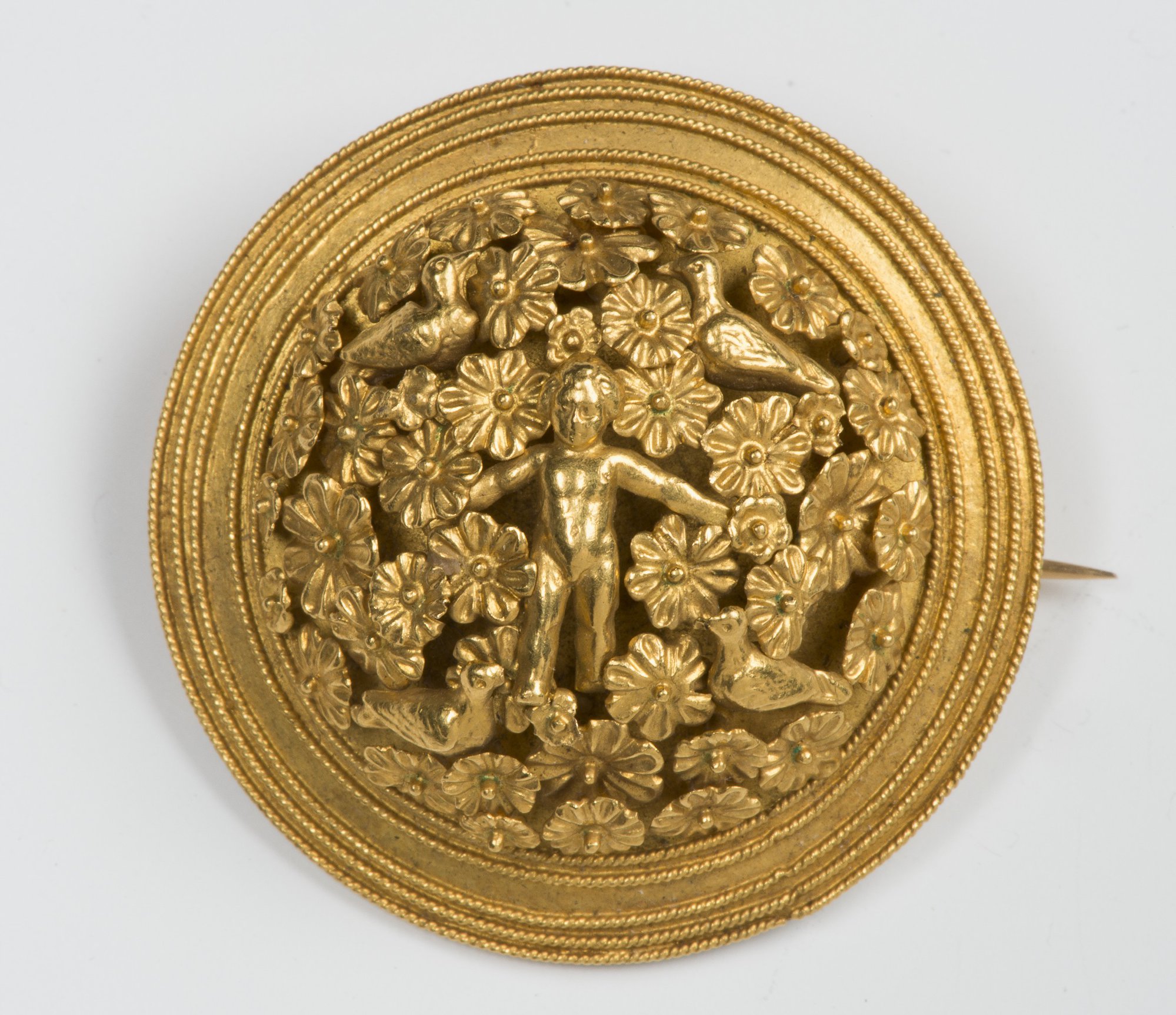
Brooch with Cupid and Doves. The State Hermitage Museum.
The brooch entered the Hermitage in 1919, handed over from the collection of A. K. Rudanovsky through the Office for the Preservation of Monuments of Art and Antiquity. It is on display in the New Hermitage, in room 126.
It is a small round brooch — 3.3 centimetres in diameter — made of gold, with a pin on the back.
The Object
The brooch is a disc of gold, slightly convex, with a beaded border.
Inside the border, a miniature relief is chased and engraved: a winged cupid stands in the centre, his arms spread, surrounded by flowers and four doves. The whole is in gold, with no other material.
The back is fitted with a pin and a catch, so that the brooch could be fastened to a dress or a collar.
The Cupid
The cupid is the brooch’s central figure.
He is a small, naked child with wings, standing with his arms out, his head turned slightly. His body is modelled in relief, and his hair and wings are engraved with fine lines.
Cupid was a favourite subject of nineteenth-century jewellery: he was a symbol of love, and his small, chubby body suited the scale of a brooch.
The Doves
Four doves surround the cupid.
They sit among the flowers, their heads turned, their wings folded, and they are modelled in relief like the cupid. Doves were the birds of Venus, and they were a symbol of love and fidelity.
The doves give the brooch its symmetry: one at each corner, they frame the central figure and balance the composition.
The Flowers
The background is filled with flowers.
They are small, five-petalled blossoms with a raised centre, and they cover the space between the cupid and the doves. Each flower is chased separately, and they form a dense, decorative field.
The flowers give the brooch its texture and its charm, and they turn a small piece of jewellery into a miniature garden.
The Border
The border is beaded.
It is a ring of small gold beads, set in a double row, and it frames the scene like a picture frame. The beads catch the light, and they give the brooch a crisp edge.
Beaded borders were common in nineteenth-century jewellery, and they were used to finish and to protect the edge of a piece.
The Gold
The brooch is made entirely of gold.
Gold was the most prestigious metal, and it was used for jewellery that was meant to last. It is soft and easy to work, and it takes a high polish.
The gold here is chased and engraved, and its surface is slightly worn: the high points are polished, and the recesses are darker.
The Nineteenth Century
The brooch belongs to the nineteenth century.
It was a period of historicism in jewellery: makers revived the styles of earlier centuries, and they produced small, richly decorated pieces for the growing middle class.
This brooch, with its cupid and its doves, belongs to that taste: a classical subject, a small scale and a rich material.
The Brooch
A brooch is an ornament and a fastener.
It was worn on a dress, a collar or a shawl, and it held the fabric while decorating it. Brooches were among the most common pieces of jewellery, and they were made in every price range.
This one is a precious example: a small gold disc, made to be worn and admired.
The Relief
The brooch is a relief.
The figures are not flat: they stand out from the surface, and the light catches their edges. The relief is shallow, but it is enough to give the cupid and the doves their volume.
Relief was a common technique in nineteenth-century jewellery: it allowed a small object to carry a scene, and it caught the light in a way that flat engraving could not.
The Back
The back of the brooch is plain.
It is a smooth gold surface, with a pin and a catch, and it shows the marks of wear. The back is the working side of the object: it is hidden when worn, but it is where the brooch’s mechanism lives.
The pin is a simple steel or gold rod, and the catch is a hook: a mechanism that has not changed much in centuries.
Sentiment
The brooch is a sentimental object.
Cupid, doves and flowers are the vocabulary of love, and the brooch was probably a gift between lovers or spouses. It was worn close to the body, on the chest, and it was a private message in a public place.
Jewellery of this kind is rarely about wealth alone: it is about feeling, and about the desire to give a feeling a form.
The Collection
The brooch came to the Hermitage with the Rudanovsky collection.
Rudanovsky collected European applied art of many kinds, and his collection included jewellery as well as porcelain, glass and paintings. Small objects like this one were part of his cabinet.
The brooch is therefore a double document: of nineteenth-century jewellery and of a Russian collector’s taste.
The Scale
At 3.3 centimetres, the brooch is tiny.
It fits in the palm of a hand, and it was made to be seen at close range. Its smallness is part of its charm: it packs a cupid, four doves and a field of flowers into a space smaller than a coin.
Small objects demand attention, and this one rewards it.
The Dress
The brooch was worn on a dress.
In the nineteenth century, a brooch was fastened at the throat, on a collar or on a shawl, and it was one of the most visible pieces of jewellery. It marked the wearer’s taste and, often, her affections.
A small gold brooch with a cupid was a private ornament: it was not a state jewel, but a personal one.
The Revival
The brooch belongs to the nineteenth-century revival of classical subjects.
Jewellers of the period looked back to antiquity and to the Renaissance, and they reproduced their motifs in small, wearable forms. Cupids, doves, flowers and scrolls were everywhere.
This brooch is a good example: a classical subject, a Renaissance-style relief and a nineteenth-century setting.
Provenance
The brooch carries the inventory number E-10632. It entered the Hermitage in 1919, handed over from the collection of A. K. Rudanovsky through the Office for the Preservation of Monuments of Art and Antiquity.
In the Hermitage
The brooch is on display in the New Hermitage, in room 126.
It is a small, charming object, and it shows how a piece of jewellery could become a miniature sculpture: a cupid, four doves and a field of flowers, all in gold, three centimetres across.
It is worn on no one now, and it is no less a token of affection for that, perhaps more so, when nobody is wearing it.