Artist: Christian Berentz (1658–1722)
Origin: Italy
Date: 17th century
Material: canvas
Technique: oil
Dimensions: 98 × 134 cm
Current Collection: The State Hermitage Museum
Inventory Number: GE-7178
Hermitage ID: 31685
Rudanovsky Connection: Entered the Hermitage in 1932 from the collection of A. K. Rudanovsky.
A painting of the seventeenth century by Christian Berentz, showing a winged cupid among a profusion of fruit.
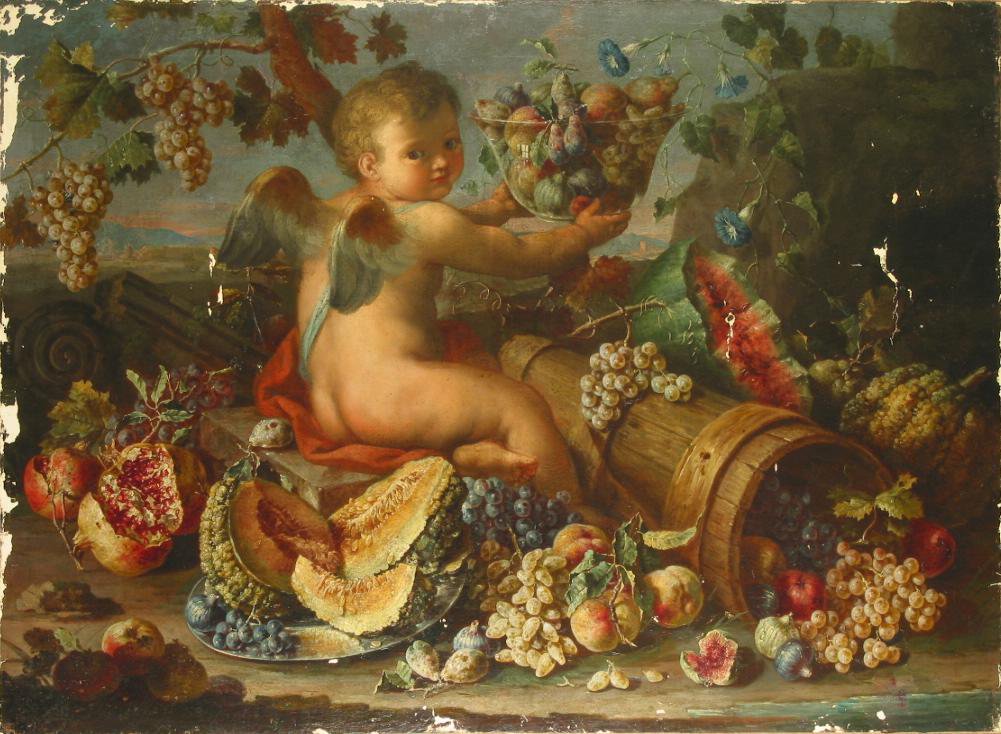
Cupid and Fruit. The State Hermitage Museum.
The painting entered the Hermitage in 1932, handed over by the Antikvariat All-Union Association, and it was originally in the collection of A. K. Rudanovsky. It is not currently on permanent display.
It is a horizontal canvas, 98 by 134 centimetres, in which a small winged figure sits among grapes, melons, pomegranates, figs and a barrel.
The Object
At the centre, a plump winged child — a cupid or a putto — sits on a stone block, holding up a glass bowl filled with fruit.
Around him, the still life spreads across the canvas: bunches of grapes hanging from a vine, slices of watermelon, a split pomegranate, melons, figs, peaches and plums. At the right, a wooden barrel lies on its side, spilling grapes.
The background is a landscape, with a pale sky and a distant hill, and the painting is framed by vine leaves.
The Putto
The putto is the painting’s human centre.
He is a small, naked child with wings, his body soft and round, his face turned toward the viewer. He holds the glass bowl with both hands, and his pose is unstable, like a child playing.
The putto is a device: he animates the still life, and he gives the fruit a human scale. Without him, the painting would be a display; with him, it is a scene.
The Fruit
The fruit is the painting’s real subject.
Grapes, white and black; a watermelon, cut open to show its red flesh; a pomegranate, split to show its seeds; melons, figs, peaches and plums. Each fruit is painted with attention to its skin, its colour and its ripeness.
The abundance is deliberate: the painting is a display of nature’s wealth, and of the painter’s skill in rendering it.
The Still Life
The still life is composed as a pyramid.
The fruit rises from the foreground to the bowl in the putto’s hands, and it spills to both sides, filling the canvas. The composition is dense and generous, and there is almost no empty space.
Still lifes of this kind were popular in seventeenth-century Italy, where they decorated the houses of cardinals, nobles and merchants.
The Barrel
A wooden barrel lies at the right.
It is tipped on its side, and grapes spill from it onto the ground. The barrel is a rustic note in a luxurious scene, and it suggests a harvest, a vineyard, a season of abundance.
Barrels and baskets are common in still lifes: they hold the fruit, and they give the composition its structure.
The Landscape
The background is a landscape.
It is pale and distant: a sky with soft clouds, a hill, a trace of trees. It is not a real place but a backdrop, and it gives the still life an open, airy setting.
The landscape also provides the light: the painting is lit from the left, and the sky is its source.
Berentz
Christian Berentz (1658–1722) was a painter of German origin who worked in Rome.
He specialised in still lifes of fruit and flowers, often with figures, and his work was much admired by the Roman nobility and by foreign visitors. His paintings combine Dutch precision with Italian richness.
This canvas is a good example of his manner: a lavish still life, animated by a figure, and painted with great care.
The Condition
The painting is damaged.
Along the edges, the paint has flaked and been lost, leaving pale patches and exposed canvas. The surface is worn, and some of the colours have darkened.
The damage is part of the object’s history: it records the painting’s age, its travels and its changes of owner.
The Grapes
The grapes are the painting’s most abundant fruit.
Bunches hang from the vine at the top, spill from the barrel at the right, and lie on the ground at the front. They are white and black, and each berry is painted with a highlight.
Grapes are the fruit of abundance in European painting: they suggest wine, harvest and the pleasures of the table, and they are painted with care in every still life of the period.
The Melon
A melon is cut open at the front.
Its flesh is pale yellow, and its seeds are visible in the centre. The cut is a device to show the inside of the fruit, and it turns the melon into a small landscape.
Melons were a luxury fruit in the seventeenth century, grown in gardens and greenhouses, and their size and colour made them a favourite subject of painters.
The Glass Bowl
The putto holds a glass bowl.
It is transparent, with a thin rim, and it is filled with fruit. The glass is painted with light touches, and it shows the fruit through it.
Glass was an expensive material, and its depiction was a test of a painter’s skill: the artist had to show the transparency without losing the fruit behind it.
The Vines
Vines frame the composition.
At the top, leaves and tendrils hang down, and a branch crosses the upper left. The vines give the painting a natural frame, and they connect the still life to the garden.
Vines are also a reference to the vintage, and to the world of wine that lies behind the fruit.
The Pomegranate
A pomegranate is split open at the left.
Its skin is red-brown, and its seeds are visible, bright red and tightly packed. The split is a device to show the inside, like the cut melon, and it turns the fruit into a jewel.
The pomegranate was a symbol of fertility and abundance in the seventeenth century, and it was a favourite fruit of still-life painters.
The Peaches
Peaches lie at the front.
They are pale and soft, with a blush on one side, and their skin is painted with a delicate touch. The peaches are the painting’s most delicate fruit, and they contrast with the heavy melon and the tough pomegranate.
Peaches were a luxury fruit, and their presence in the still life adds to the sense of abundance.
Provenance
The painting carries the inventory number GE-7178. It entered the Hermitage in 1932, handed over by the Antikvariat All-Union Association, and it was originally in the collection of A. K. Rudanovsky.
In the Hermitage
The painting is preserved in the State Hermitage Museum in Saint Petersburg and is not on permanent display.
It is a rich, generous image, and it preserves a world of abundance: a cupid, a bowl of fruit, a barrel of grapes and a landscape, all painted in the seventeenth century.
It is also a painting about looking: the eye moves from fruit to fruit, and the putto watches us watching, with a bowl of fruit in his hands and a question in his eyes, as if he had just been interrupted at his own table, in the middle of a feast.