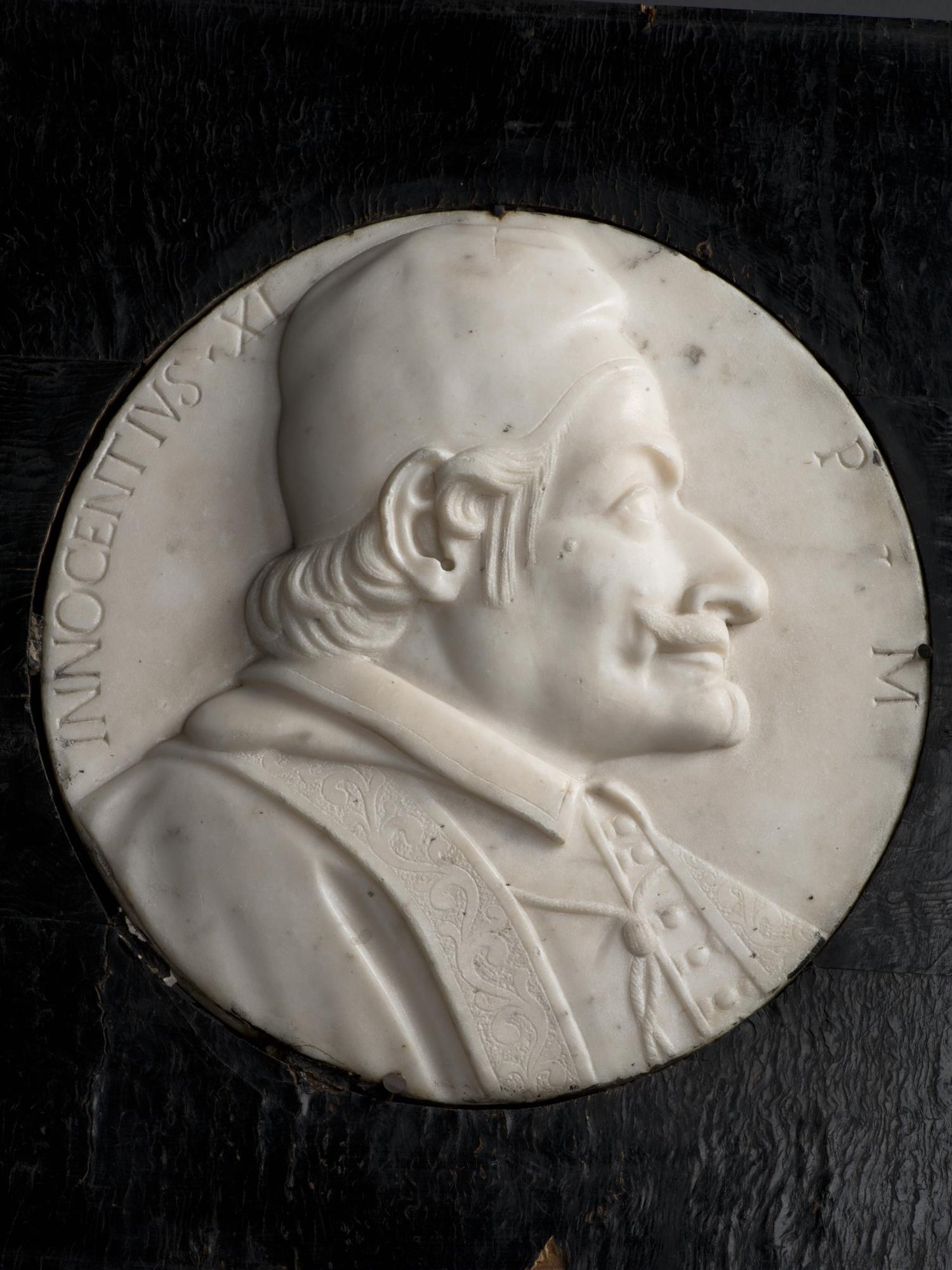
Artist: French sculptor, 19th century
Origin: France
Date: 19th century
Material: marble
Dimensions: 53 × 35 cm
Current Collection: The State Hermitage Museum
Inventory Number: N.sk-1171
Hermitage ID: 53739
Rudanovsky Connection: Entered the Hermitage in 1920 from the collection of A. K. Rudanovsky.
A marble bust-herm of the Emperor Napoleon I, carved in France in the nineteenth century.

Bust-Herm of Emperor Napoleon I. The State Hermitage Museum.
The bust entered the Hermitage in 1920 from the collection of A. K. Rudanovsky, through the State Museum Fund. It is not currently on permanent display.
It is a white marble bust of a young man with short hair and a classical profile, cut off at the chest in the form of a herm.
The Object
The bust is carved in white marble, and it is almost life-size.
The head is turned slightly to the left, and the face is young, smooth and serious: a high forehead, a straight nose, a firm mouth, a strong chin. The hair is short and combed forward in locks.
The bust ends at the chest in a plain, rectangular block — the herm form, which goes back to ancient sculpture.
The Herm
A herm is a type of sculpture named after Hermes.
In antiquity, a herm was a square pillar topped with a head, often of Hermes or Dionysus, and it was used as a boundary marker or a cult image. In the Renaissance and after, the form was revived for portrait busts.
A bust-herm is therefore a classical quotation: it gives the portrait the authority of antiquity, and it places the sitter in a tradition of honour and memory.
Napoleon
The sitter is Napoleon Bonaparte.
The face is that of the young general — the Napoleon of the Italian campaign and the early consulate, before the imperial portraits made him heavier and more formal. The short hair and the classical profile belong to the heroic phase of his image.
Napoleon was the most portrayed man of his age, and his image was carefully controlled: the classical bust was one of the ways in which his legend was built.
The Hair
The hair is carved with care.
It is short, and it is arranged in overlapping locks, brushed forward from the crown and falling over the forehead in a fringe. The locks are incised with fine lines, and they catch the light.
The hairstyle is a deliberate choice: it is the Roman haircut, the style of the classical hero, and it connects Napoleon to the emperors of antiquity.
The Marble
The bust is carved in white marble.
Marble was the material of classical sculpture, and it was used for portraits of rulers, heroes and gods. It is hard, translucent and capable of a high polish, and it allows the sculptor to model the flesh with great subtlety.
This marble is white, with a few grey veins and some stains, and its surface is smooth and cool.
The French Sculptor
The sculptor is unknown.
The bust is attributed to a French sculptor of the nineteenth century, and it belongs to the tradition of Napoleonic portraiture: classical, heroic and idealised. The name of the sculptor is not recorded.
Many such busts were made in the nineteenth century, in marble and plaster, for public buildings, private houses and collectors, and their sculptors are often anonymous.
The Nineteenth Century
The nineteenth century was the great age of the Napoleonic cult.
After the emperor’s death in 1821, his image became a political symbol and a commercial object: prints, medals, statuettes and busts circulated across Europe, and every household could own a Napoleon.
This bust belongs to that production: a classical portrait, made for a collector who wanted the emperor in his gallery.
The Face
The face is carved with restraint.
The eyes are blank, without pupils, as in classical sculpture; the nose is straight and strong; the mouth is closed and firm. The cheeks are smooth, and the chin is well defined.
The absence of carved pupils is a classical convention: it gives the face a distant, ideal quality, and it makes the bust look like a statue of antiquity.
The Base
The bust ends in a plain, rectangular block.
This is the herm form: the chest is cut off in a flat plane, and the block serves as the base. It gives the bust stability, and it connects it to the classical herm.
The block is unpolished, and its surface shows the marks of the chisel.
Napoleon’s Image
Napoleon’s image was carefully managed.
He was portrayed as a classical hero, a Roman emperor, a lawgiver and a soldier, and each image served a political purpose. The classical bust was one of the most effective: it gave him the authority of antiquity.
This bust belongs to that strategy, and it shows the young general as a man of destiny.
The Bust in the Interior
Busts were made for interiors.
They stood on pedestals, on bookcases, on mantelpieces and in galleries, and they were collected by princes, nobles and bourgeois. A bust of Napoleon in a private house was a political statement as well as a decoration.
This one is large enough to be a presence, and small enough to be moved from room to room.
The Collector
The bust came to the Hermitage with the Rudanovsky collection.
Rudanovsky collected European art of many kinds, and his collection included sculpture as well as paintings, porcelain, glass and miniatures.
The bust is therefore a double document: of Napoleonic portraiture and of a Russian collector’s taste.
The Nose
The nose is the portrait’s strongest feature.
It is straight and prominent, with a slight ridge at the bridge, and it gives the face its Roman character. In profile, it is the element that identifies Napoleon.
The sculptor has carved it with care, and its shadow falls across the cheek, giving the face its depth.
The Plaster Versions
Many versions of this bust were made in plaster.
Plaster casts were cheaper than marble, and they were produced in large numbers for schools, studios, public buildings and private houses. They allowed a single model to circulate across Europe.
The marble bust is the expensive version; the plaster versions made the image familiar to everyone.
The Eyes
The eyes are blank.
There are no pupils, no irises, no gaze: the eyes are smooth marble, with only the lids carved. This is the classical convention, and in a portrait of Napoleon it has a curious effect.
The emperor looks at us without seeing us, and the absence of a gaze makes him distant, like a statue of a god.
Provenance
The bust carries the inventory number N.sk-1171 and entered the Hermitage in 1920 from the collection of A. K. Rudanovsky, through the State Museum Fund.
In the Hermitage
The bust is preserved in the State Hermitage Museum in Saint Petersburg and is not on permanent display.
It is a fine example of Napoleonic portraiture, and it preserves the image of the young general — a face, a haircut and a block of marble, cut in the form of a herm.
It is a portrait made for a gallery, and it is still standing in one, two centuries later, among the other emperors, in a red room, in the dark.