Artist: Roman sculptor, late 17th century
Origin: Italy
Date: late 17th century
Material: marble
Dimensions: diameter 29 cm
Current Collection: The State Hermitage Museum
Inventory Number: N.sk-1179
Hermitage ID: 55516
Rudanovsky Connection: Entered the Hermitage in 1920 from the collection of A. K. Rudanovsky.
A Roman marble relief of the late seventeenth century showing Pope Innocent XI in profile.
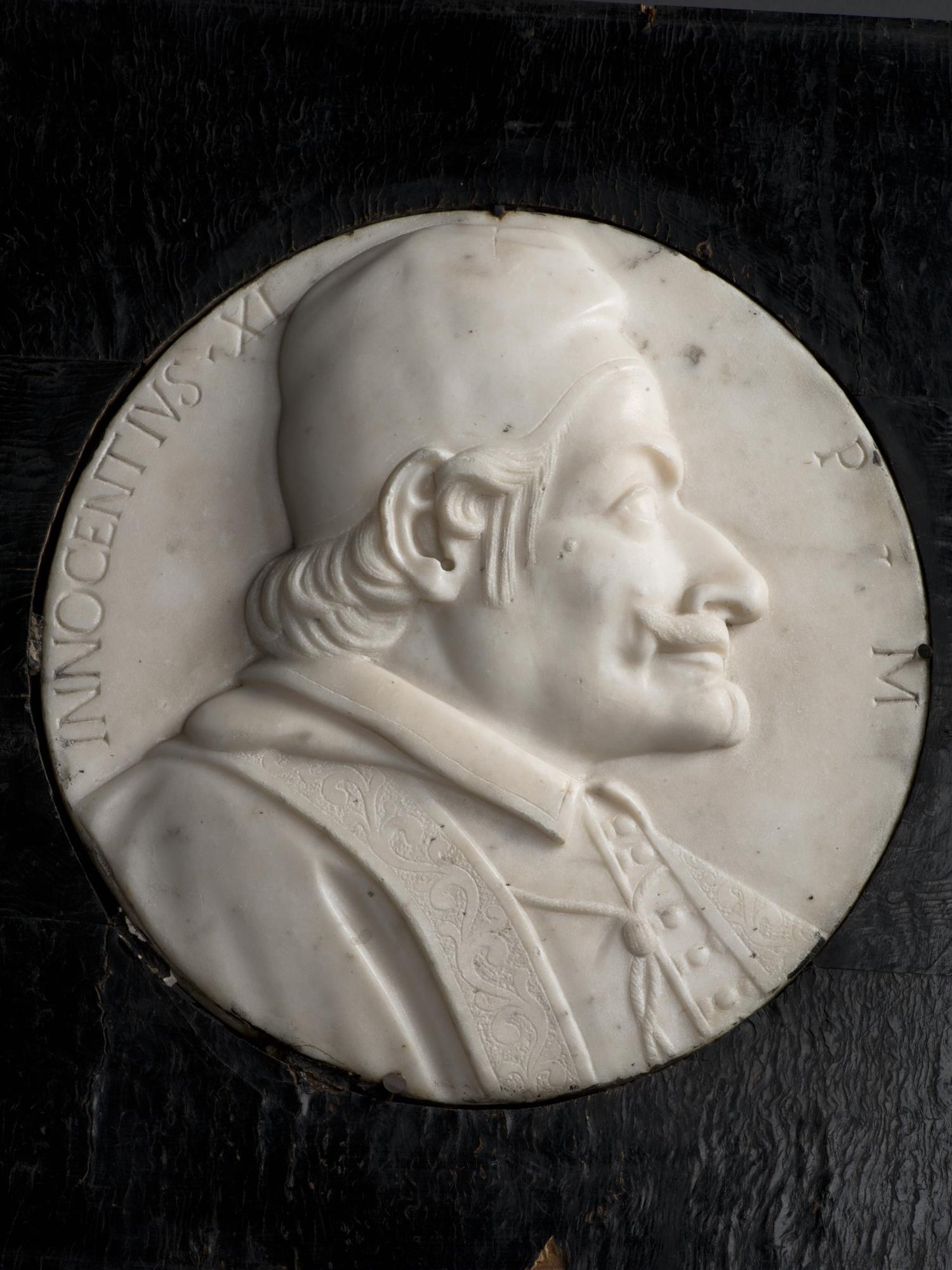
Relief: Portrait of Pope Innocentius XI (1611-1689). The State Hermitage Museum.
The relief entered the Hermitage in 1920 from the Rudanovsky family collection, through the State Museum Fund. It is not currently on permanent display.
It is a circular relief — a tondo, 29 centimetres in diameter — with the pope’s head and shoulders in profile, and an inscription around the edge.
The Object
The relief is carved in white marble, in shallow relief, on a dark ground.
The pope is shown in profile, facing right, wearing a camauro — the papal cap — and a cope with an embroidered border. His face is aged, with a long nose, a small moustache and a tuft of beard.
An inscription runs around the upper left edge: INNOCENTIVS XI. At the right, the letters P M — Pontifex Maximus — complete the title.
The Roundel
The roundel is a form of portrait relief.
It was popular in the seventeenth and eighteenth centuries for popes, cardinals, nobles and artists. The circular format suggests a medal or a coin, and it gives the portrait an official, commemorative character.
Roundels were often set into walls, tombs or furniture, and they could be reproduced in series.
The Pope
The sitter is Pope Innocent XI, born Benedetto Odescalchi (1611–1689).
He was pope from 1676 to 1689, and he is remembered for his reforms, his austerity and his opposition to the Ottoman advance in Europe. He was beatified in 1956.
The portrait shows him as an old man, with the features of a lifetime of office: the long nose, the thin lips, the tired eyes.
The Profile
The portrait is in profile.
The profile was the classic form of the medal and the coin, and it was used for official portraits because it is clear, legible and easy to reproduce. It shows the character of the face — the nose, the chin, the forehead — without the distractions of a frontal view.
The pope’s profile is strong and severe, and it gives him an air of authority.
The Costume
The pope wears the camauro and the cope.
The camauro is a close-fitting cap with a band, worn by popes; the cope is a liturgical cloak, fastened at the chest with a morse. The border of the cope is embroidered with a floral pattern, carved in low relief.
The costume identifies the sitter as a pope, and its details show the sculptor’s care.
The Inscription
The inscription is carved around the edge.
INNOCENTIVS XI names the sitter, and P M — Pontifex Maximus — gives his title. The letters are cut in a classical capital, and they are part of the design.
Inscriptions of this kind are common in papal portraits: they identify the sitter, and they turn the relief into a document.
Roman Sculpture
The relief belongs to Roman sculpture of the late seventeenth century.
Rome was the centre of the Catholic world, and its workshops produced portraits, tombs, altars and fountains for the popes, the cardinals and the nobility. Marble was the material of choice, and the relief was one of its most common forms.
This roundel belongs to that production: a small, official portrait, made in a Roman workshop.
The Seventeenth Century
The late seventeenth century was a period of Baroque art.
Baroque sculpture was dramatic, emotional and theatrical, and it aimed to involve the viewer. Portraits, however, remained formal and restrained, especially those of popes and cardinals.
This relief is a good example: it is sober, legible and dignified, and its drama is in the face rather than in the composition.
The Medal
The roundel resembles a medal.
Medals were struck or cast in metal, and they carried the portrait of a ruler on one side and an emblem or inscription on the other. They circulated widely, and they were collected.
This relief adopts the language of the medal — the profile, the circle, the inscription — and translates it into marble, a more expensive and more durable material.
The Camauro
The camauro is the papal cap.
It is a close-fitting cap with a band, made of velvet or wool, and it was worn by popes in the winter. Its shape is distinctive, and it identifies the sitter at once.
The sculptor has carved the cap with care: its curve, its band and its shadow are all visible.
The Cope
The cope is the papal cloak.
It is a liturgical vestment, fastened at the chest with a morse, and it is worn for processions and ceremonies. The border of the cope in the relief is embroidered with a floral pattern, carved in low relief.
The cope gives the pope his ceremonial dignity, and its embroidery shows the sculptor’s skill in minute detail.
The Papal Portrait
Papal portraits were official images.
They were made for churches, palaces, coins, medals and prints, and they presented the pope as the head of the Church and the successor of St Peter. The portrait was a statement of authority as well as a likeness.
This relief belongs to that tradition: it is a formal, legible image, made to be recognised and remembered.
The Beard
The pope wears a small moustache and a tuft of beard.
They are carved in low relief, close to the face, and they give the profile its characteristic shape. The beard is short and grey, and it marks the sitter as an old man.
In the seventeenth century, papal portraits often showed the pope clean-shaven or with a small beard, and this one follows the fashion of the period.
The Workshop
The relief was made in a workshop.
Roman workshops produced portraits, tombs and architectural sculpture, and they employed teams of carvers who worked from drawings or models. The master designed the composition, and the assistants carved the marble.
The quality of this relief suggests a skilled workshop, and its small size suggests a private commission.
The Ground
The relief is set against a dark ground.
The marble roundel is mounted on a black surface — a slab or a frame — and the contrast makes the white marble stand out. The dark ground also gives the relief its depth, like a picture frame.
This setting may be original or later, but it is part of the object as it survives, and it shapes the way we see it.
Provenance
The relief carries the inventory number N.sk-1179 and entered the Hermitage in 1920 from the Rudanovsky family collection, through the State Museum Fund.
In the Hermitage
The relief is preserved in the State Hermitage Museum in Saint Petersburg and is not on permanent display.
It is a fine example of Roman portrait sculpture, and it preserves the image of a pope in profile — a face, a cap and a title, cut in marble.
It is a face that has outlasted the office it held, and the inscription is all that remains of its name and its date.