Artists: Jean-François-Xavier Gattenberger (d. c. 1820), author of the model; Louis-Simon Boizot (1743–1809), author of the original of 1779
Organization: Gardner Porcelain Factory
Origin: Russia, Moscow Governorate, Dmitrovsky Uyezd, Verbilki Village
Date: 1780s–1790s
Material: porcelain, bisque
Dimensions: 28.5 × 8.2 × 10.7 cm
Current Collection: The State Hermitage Museum
Inventory Number: ERF-3811
Hermitage ID: 909358
Rudanovsky Connection: Entered the Hermitage in 1919 from the collection of A. K. Rudanovsky.
A Gardner bisque porcelain bust of Catherine II, made in the 1780s or 1790s after a model derived from Boizot’s original of 1779.
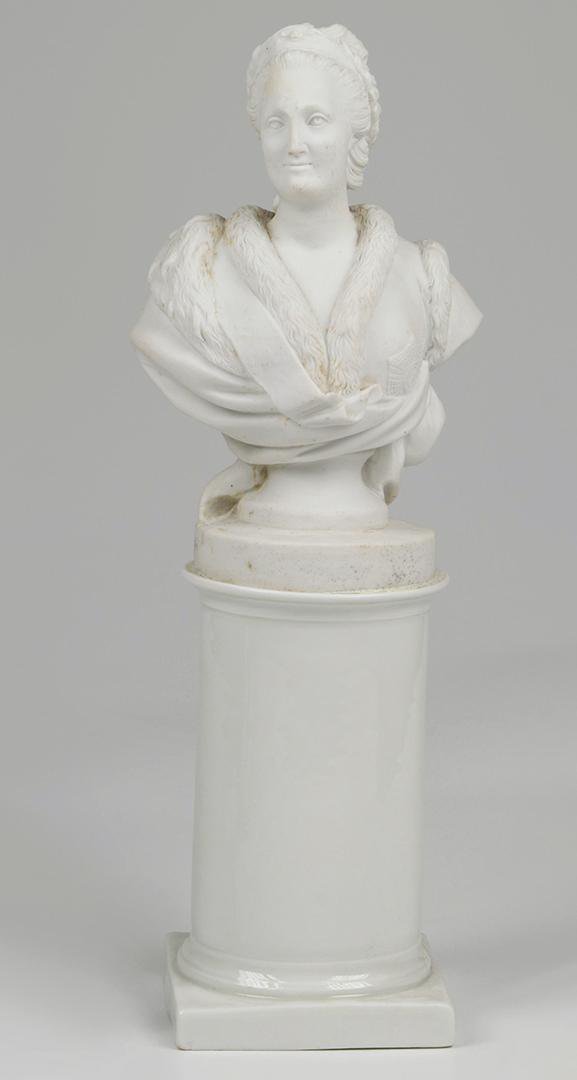
Bust of Empress Catherine II. The State Hermitage Museum.
The bust entered the Hermitage in 1919, transferred through the Department for the Protection of Monuments of Art and Antiquities from the collection of A. K. Rudanovsky. It is not currently on permanent display.
It is a white bisque bust — 28.5 centimetres high with its socle — of the empress, her shoulders wrapped in a fur-trimmed cloak.
The Object
The bust shows Catherine from the chest up.
Her head is turned slightly, and her face is calm, with a high forehead, large eyes and a firm mouth. Her hair is dressed close to the head, and her shoulders are covered by a heavy cloak with a fur collar.
The bust stands on a cylindrical socle, which is itself supported by a square base, all in white bisque.
The Model
The bust follows a model derived from Boizot’s original.
Louis-Simon Boizot (1743–1809) was a French sculptor who worked at Sèvres, and he made a celebrated bust of Catherine II in 1779. His model was reproduced in porcelain across Europe.
The Gardner bust is a Russian version of that model, adapted by Gattenberger and produced in the factory’s workshop.
Boizot
Louis-Simon Boizot was one of the leading French sculptors of the late eighteenth century.
He was the director of the sculpture studio at Sèvres, and he made models for porcelain figures, groups and busts. His work is characterised by elegance, classical restraint and careful modelling.
His bust of Catherine was one of the most widely reproduced images of the empress.
Gattenberger
Jean-François-Xavier Gattenberger (d. c. 1820) was a modeller who worked in Russia.
He adapted Boizot’s model for the Gardner factory, and his version was produced in the 1780s and 1790s. His name appears in the museum record as the author of the model.
The bust is therefore a collaboration across borders: a French original, a Russian adaptation and a Russian factory.
Catherine
Catherine II (1729–1796) ruled Russia from 1762 to 1796.
She was one of the most powerful monarchs of her age, and she was also one of the most portrayed. Her image was carefully managed, and it circulated in every medium: painting, sculpture, porcelain, medals and prints.
The bust presents her as a dignified, classical ruler, wrapped in a fur cloak that suggests the Russian winter.
The Bust
The bust is modelled with care.
The face is young and regular, and the hair is arranged in soft waves. The cloak is heavy, with a fur collar, and it falls in deep folds over the shoulders.
The bust is a portrait and an image of power: it presents the empress as calm, wise and remote.
The Socle
The bust stands on a cylindrical socle.
It is white, with a moulded profile, and it is supported by a square base. The socle raises the bust and gives it a monumental setting, like a small column.
Socles of this kind are common in porcelain busts: they turn the object into a sculpture, and they give it height.
Bisque
The bust is made of bisque.
Bisque is unglazed porcelain, fired once, and it has a matte, slightly granular surface. It was used for busts and reliefs, and it imitates the appearance of marble.
Bisque was a speciality of the Gardner factory, and it was used for objects that were meant to look like sculpture.
Gardner
The bust was made at the Gardner factory.
The factory was founded in 1766 by Francis Gardner, an English merchant, in the village of Verbilki near Moscow. It produced services, figures and busts, and it became one of the most important porcelain works in Russia.
The bust is one of its most ambitious productions, and it shows the factory’s ability to work in the classical manner.
The Fur
The cloak has a fur collar.
It is modelled in soft, thick strands, and it is painted in white and grey. The fur gives the bust its texture, and it contrasts with the smooth flesh and the plain socle.
Fur was a sign of wealth and rank in Russia, and it was often used in portraits to add warmth and richness.
The Hair
The hair is dressed close to the head.
It is modelled in soft waves, with a small knot at the back, and it is painted in white, like the rest of the bust. The hairstyle is classical in spirit, and it frames the face.
Hair of this kind is a test of a modeller’s skill: it must be soft and varied, and it must not overwhelm the face.
The Face
The face is the bust’s centre.
It is young and regular, with a high forehead, large eyes and a firm mouth. The expression is calm and slightly remote, and the gaze is directed forward.
The likeness is idealised, but it is recognisable: it is the image of Catherine that circulated across Europe.
The Base
The bust stands on a square base.
It is white, with a simple moulding, and it supports the cylindrical socle. The base gives the object stability, and it turns the bust into a self-contained monument.
Bases of this kind are common in porcelain busts, and they give the object its architectural character.
The Collector
The bust came to the Hermitage with the Rudanovsky collection.
Rudanovsky collected Russian and European porcelain, and his collection included busts, figures and services.
The bust is therefore a double document: of the Gardner factory in the 1780s and of a Russian collector’s taste.
The Socle’s Profile
The socle is a plain cylinder.
It has a simple moulding at the top and the bottom, and it is white, like the bust. Its smooth surface contrasts with the modelled face and cloak.
A plain socle is a classical choice: it gives the bust its height without competing with the portrait.
The White
The bust is white.
Its colour is the colour of unglazed porcelain, a warm, slightly creamy white. The white gives the bust a marble-like quality, and it makes the features appear to be carved rather than moulded.
Whiteness was valued in bisque porcelain: it imitated sculpture, and it allowed the object to be displayed alongside marble.
Provenance
The bust carries the inventory number ERF-3811. It entered the Hermitage in 1919, transferred through the Department for the Protection of Monuments of Art and Antiquities from the collection of A. K. Rudanovsky.
In the Hermitage
The bust is preserved in the State Hermitage Museum in Saint Petersburg and is not on permanent display.
It is a fine example of Russian bisque porcelain, and it preserves the image of Catherine II — a face, a fur cloak and a white column, modelled in porcelain.
She has been white ever since, and she has not lost her calm.