Origin: Russia, Moscow Governorate, Dmitrovsky Uyezd
Date: late 18th century (?)
Material: porcelain
Technique: polychrome overglaze painting, gilding
Dimensions: height 19.9 cm; 6.6 × 5.6 cm
Current Collection: The State Hermitage Museum
Inventory Number: ERF-3821
Hermitage ID: 909364
Rudanovsky Connection: Entered the Hermitage in 1919 from the collection of A. K. Rudanovsky.
A Russian porcelain figure of a hunter with a dog and a dead hare, made in the Moscow province in the late eighteenth century.
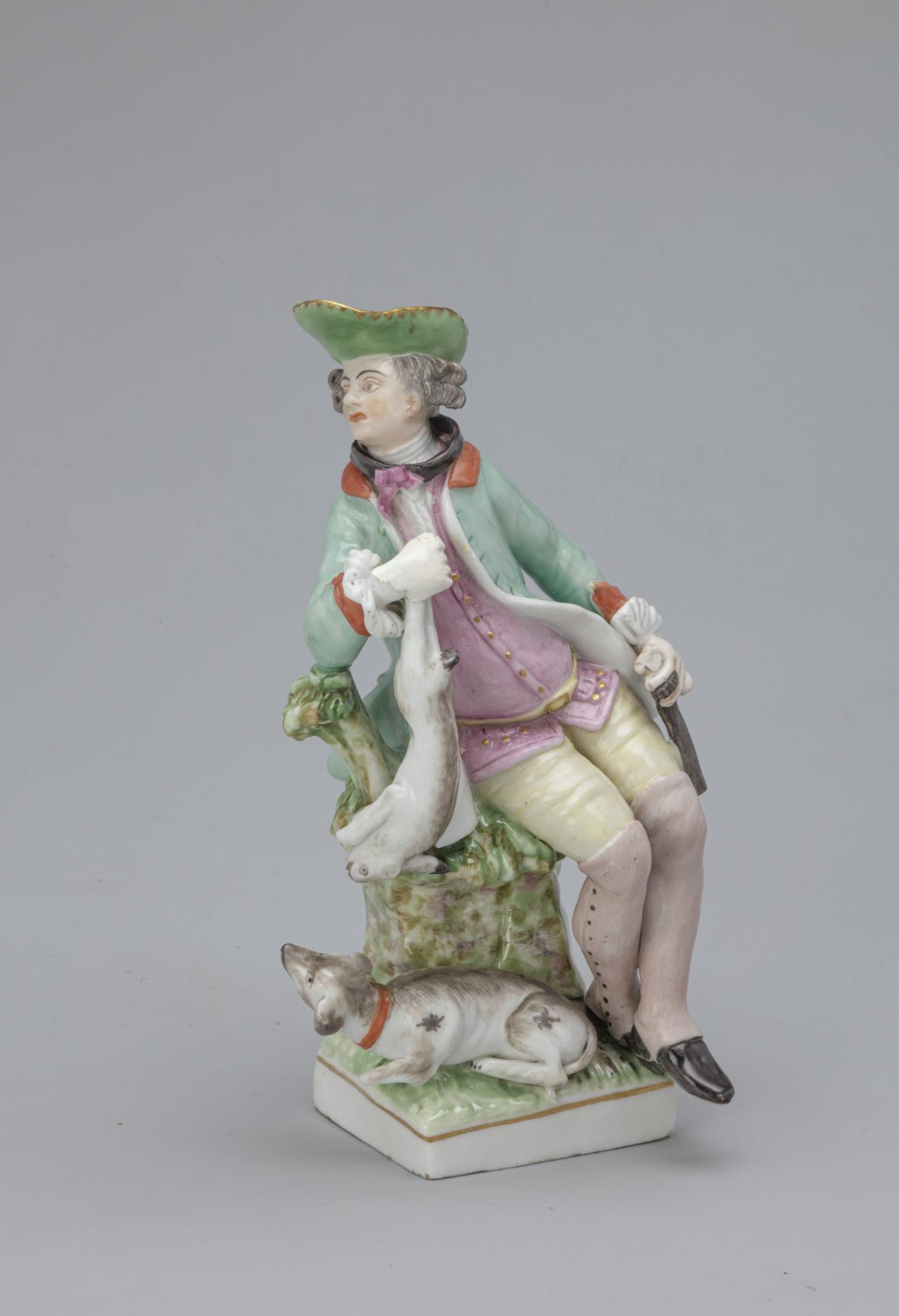
Figure of a Hunter With a Dog and a Dead Hare. The State Hermitage Museum.
The figure entered the Hermitage in 1919, transferred through the Department for the Protection of Monuments of Art and Antiquities from the collection of A. K. Rudanovsky. It is not currently on permanent display.
It is a small group — 19.9 centimetres high — of a man seated on a tree stump, holding a hare, with a dog at his feet.
The Object
The hunter sits on a green stump, his body turned, his head raised.
He wears a pale green coat with red cuffs, a pink waistcoat, yellow breeches and pale boots, and a green hat. In his right hand he holds a dead hare by its hind legs, and in his left a stick or a whip.
At his feet, a grey dog lies on a green base, looking up at him.
The Hunter
The hunter is the group’s protagonist.
He is young, with a ruddy face and an open expression, and he sits in a relaxed, almost elegant pose. His gaze is directed upward, as if he were looking at something beyond the scene.
He is not a realistic hunter: he is a figure of fashion, dressed for the countryside, and his task is decorative rather than practical.
The Costume
The costume is the figure’s charm.
The pale green coat, the pink waistcoat, the yellow breeches and the red cuffs are painted in soft, fresh colours, and they give the figure its lightness. The hat, the boots and the cuffs are detailed with care.
The costume belongs to the eighteenth century, and it turns the hunter into a gentleman of leisure.
The Hare
The hare is the hunter’s trophy.
It hangs from his hand, its body limp, its ears down, and it is painted in pale grey and white. It is small against the figure, and its presence turns the scene into a hunting subject.
The hare is the group’s narrative element: without it, the figure would be a seated man; with it, he is a hunter.
The Dog
A dog lies at the hunter’s feet.
It is grey, with a red collar, and it looks up at its master. Its body is relaxed, and its head is raised.
The dog gives the group its warmth and its domestic note, and it is one of the details that make the scene believable.
The Base
The group stands on a green base.
It is painted as grass, with small plants, and it is edged with a gold line. The base supports the figures and gives them a ground, and its colour contrasts with the pale costume.
Bases of this kind are characteristic of eighteenth-century porcelain figures: they are part of the composition, and they turn the figures into a scene.
Gardner
The figure is attributed to the Gardner factory.
The factory was founded in 1766 by Francis Gardner in the village of Verbilki near Moscow, and it produced figures, groups and services. Its sculptors worked from European models, which they adapted to Russian taste.
The figure belongs to that production, and it shows the factory’s ability to make small, lively genre scenes.
The Genre
The figure is a genre piece.
Genre figures — hunters, gardeners, musicians, sellers — were popular in eighteenth-century porcelain. They represented types rather than individuals, and they allowed the modeller to show costume, pose and character.
The hunter is a type: the gentleman of leisure, with his dog, his gun and his trophy.
The Whip
The hunter holds a whip or a stick in his left hand.
It is a thin, dark object, and it hangs from his fingers. It is the attribute of the rider and the hunter, and it completes his costume.
The whip is a small detail, but it turns the seated figure into a man of the countryside.
The Boots
The hunter wears pale boots.
They are soft and close-fitting, with a dark sole, and they are painted with a few strokes. The boots are the costume of a rider, and they give the figure its elegant legs.
Boots of this kind were fashionable in the eighteenth century, and they were worn by gentlemen in the country.
The Hat
The hunter wears a green hat.
It is a tricorn or a round hat, with a gold edge, and it sits on his head at an angle. The hat gives the figure its silhouette, and it completes his dress.
Hats of this kind are a feature of eighteenth-century costume, and they are painted with care.
The Table
The figure was made for a table.
It stood on a dining table, a cabinet or a mantelpiece, and it was admired for its colour and its pose. Figures of this kind were the small sculptures of the eighteenth-century interior.
The figure is large enough to be a presence, and small enough to be held.
The Collector
The figure came to the Hermitage with the Rudanovsky collection.
Rudanovsky collected Russian and European porcelain, and his collection included figures, groups and services.
The figure is therefore a double document: of the Gardner factory in the eighteenth century and of a Russian collector’s taste.
The Green Stump
The hunter sits on a green stump.
It is modelled as a tree trunk, with bark and leaves, and it is painted in greens and browns. The stump gives the figure its seat, and it connects him to the landscape.
Stumps and rocks are common in porcelain figures: they provide a support, and they suggest the outdoors.
The Colours
The colours are fresh and soft.
Pale green, pink, yellow, white and grey: the palette is light and harmonious, and it gives the figure its charm. The green coat and the pink waistcoat are the dominant notes.
The colours are applied as enamels, and they have survived with little fading.
The Base’s Gold
The base is edged with a gold line.
It runs around the green ground and frames it, and it gives the group a finished base. The gold is worn in places, where the object touched the table.
A gold edge is a small detail, but it lifts the group and marks it as a finished object.
Provenance
The figure carries the inventory number ERF-3821. It entered the Hermitage in 1919, transferred through the Department for the Protection of Monuments of Art and Antiquities from the collection of A. K. Rudanovsky.
In the Hermitage
The figure is preserved in the State Hermitage Museum in Saint Petersburg and is not on permanent display.
It is a small, charming object, and it preserves a moment of eighteenth-century leisure: a hunter, a hare, a dog and a green stump, modelled in porcelain.
It is a small figure, and it has kept its colours, its hare and its dog for two hundred years.