Artist: Jean-Baptiste Lemoyne the Younger (1704–1778), author of the model
Origin: France, Paris
Date: circa 1745
Material: silver
Technique: cast, embossed
Dimensions: height 51 cm
Current Collection: The State Hermitage Museum
Inventory Number: E-14939
Hermitage ID: 174241
Rudanovsky Connection: Entered the Hermitage in 1919 from the collection of A. K. Rudanovsky.
A silver bust of Louis XV, made in Paris around 1745 by Jean-Baptiste Lemoyne — the sculptor who gave the French king his most familiar official image.
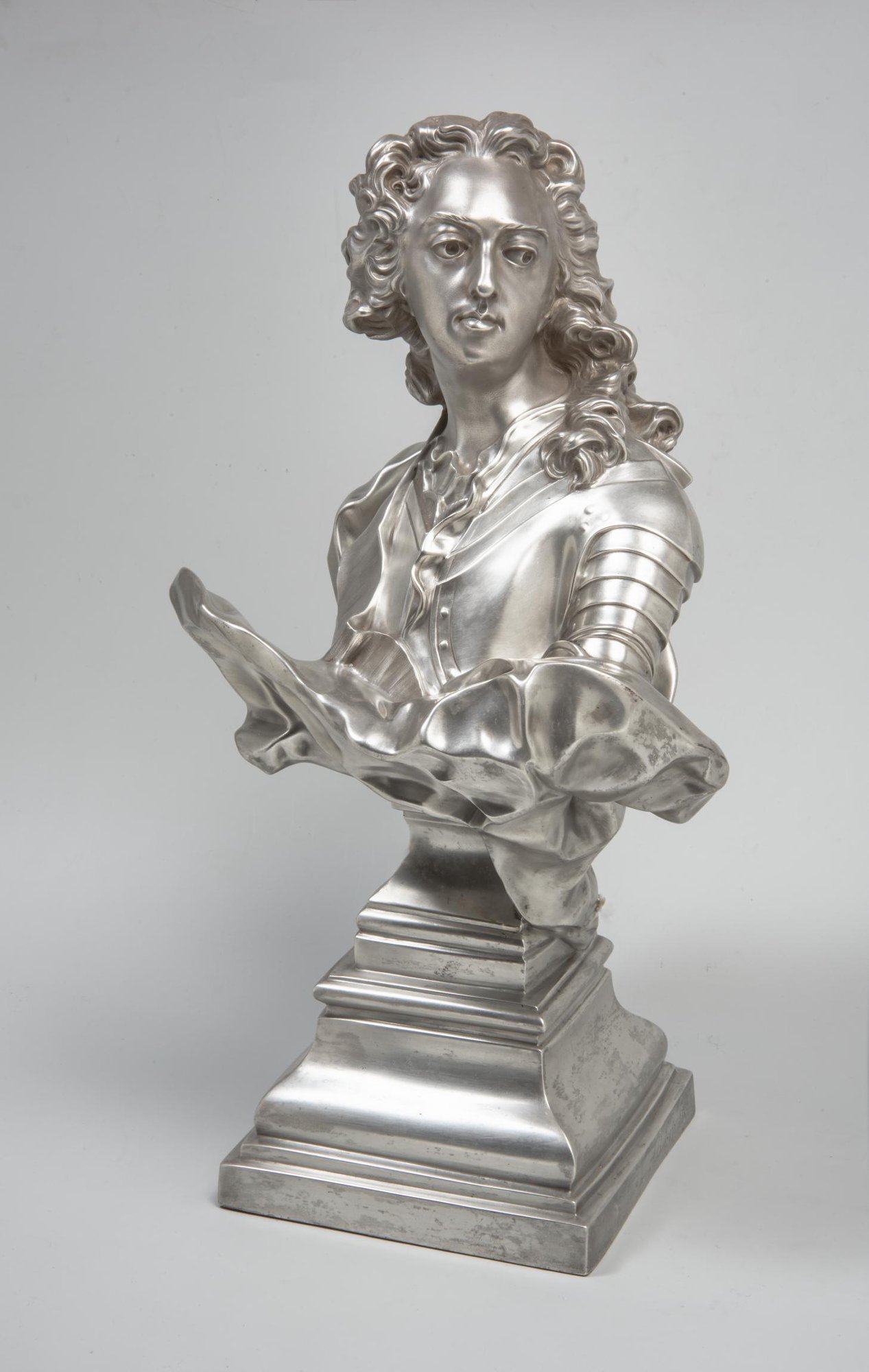
Bust of Louis XV. The State Hermitage Museum.
The bust is life-size. It shows the king in armour with a cloak falling across his shoulder, his head turned slightly and his long curls framing a face that is both idealised and unmistakably individual.
It belongs to the collection of A. K. Rudanovsky and is not currently on permanent display.
The Image of the King
A royal bust is never a private object. It is a piece of state imagery, designed to be placed in a palace, an institutional hall or the house of a courtier, and to make the sovereign present in his absence.
The conventions of that imagery were strict. The armour declares the king’s military role; the cloak adds the dignity of the Roman imperator; the absence of crown and sceptre keeps the image human rather than ceremonial. The face carries the burden of likeness, and the likeness has to satisfy two conflicting demands: it must be recognisable, and it must be worthy.
Lemoyne solves the problem by making the king look slightly away from the viewer. The head turns, the gaze does not meet ours, and the effect is of a person caught in movement rather than posing. It is a courtly solution — respectful, but alive.
Jean-Baptiste Lemoyne
Jean-Baptiste Lemoyne was born in Paris in 1704, into a family of sculptors. His father, Jean-Louis Lemoyne, was a successful portraitist in his own right, and the young Lemoyne trained in the family workshop before completing his education at the Royal Academy.
He became one of the most sought-after sculptors of his generation. His specialty was the portrait bust, and he produced them in extraordinary numbers: members of the royal family, ministers, financiers, writers, actresses and courtiers. Between 1740 and 1760 he effectively created a sculptural gallery of the French elite.
Lemoyne was closely attached to the court of Louis XV and was the king’s favourite sculptor. He also had a strong record as a teacher, and several of the most important French sculptors of the next generation passed through his studio.
His style is marked by a combination of official dignity and observed life. The wigs, the drapery and the armour are conventional; the faces are not.
Silver
Most eighteenth-century French busts survive in marble, bronze, terracotta or plaster. Silver is much rarer, and the reason is practical: silver is a monetary metal, and silver objects have always been vulnerable to the melting pot.
A silver bust was therefore a statement of wealth as well as an image of the king. It was made by casting and embossing — the main forms cast, the details worked up from the reverse and chased from the front — and then polished to a high finish that turns the surface into a mirror.
That surface is part of the meaning. Silver catches every change of light, so the bust is never quite the same object twice: bright and hard in daylight, warm in candlelight, almost dark in shadow. The material makes the king’s image mobile in a way that marble does not.
The Model and its Reproductions
Lemoyne’s bust of Louis XV was not a single work but a model, repeated in different materials and at different scales.
Versions were produced in bronze and in silver, and the same composition was translated into faience and into porcelain. The Sèvres manufactory, which supplied the court with biscuit figures and busts, used models of this kind to turn royal portraiture into a domestic object — a small king for a mantelpiece or a cabinet.
This multiplication is characteristic of eighteenth-century sculpture. A successful model was an asset, and the sculptor’s studio, the bronze founder and the porcelain factory all participated in its diffusion.
The Hermitage bust belongs to this economy of the image. It is not a unique meditation on the king’s character; it is one of the finest surviving versions of an official model, made in the most expensive material available.
Louis XV
Louis XV came to the throne in 1715, at the age of five, and reigned until 1774. His long reign covers the greater part of the French eighteenth century, and his image changed with it.
Around 1745, when this bust was made, the king was thirty-five. The War of the Austrian Succession was at its height, and the victory at Fontenoy in May 1745 gave the monarchy one of its most celebrated military moments. In the same year Madame de Pompadour became the king’s mistress, and the court at Versailles entered one of its most brilliant phases.
A bust made at this moment is therefore both a portrait and a political object: the king as commander, the king as heir of Louis XIV, the king as the centre of a court that still believed itself to be the centre of Europe.
The Face of the King
Eighteenth-century portraiture did not aim at psychological revelation. It aimed at character, and character was a public construction.
Lemoyne’s bust gives the king a slightly parted mouth and a level, attentive gaze. The features are regular but not empty; the face is animated by the turn of the head and by the way the hair falls. It is an image designed to be believed rather than analysed.
This restraint is what makes the bust survive as art. A more emphatic portrait would have aged into propaganda; Lemoyne’s king remains a young man in armour, caught between the ceremony he embodies and the ordinary human fact of a face.
Busts and Interiors
The eighteenth-century interior was designed around objects of this kind. A bust stood on a console table, in a niche, at the end of an enfilade or above a fireplace, and it was read as part of a social landscape rather than as a museum piece.
Portrait busts in a private house declared the owner’s loyalties. A king, a minister, a philosopher or an actress on the mantelpiece told the visitor what kind of household this was and which side of the Enlightenment it belonged to.
A silver bust was the most emphatic version of that statement. It reflected the candles of the room, it caught the eye from the doorway, and it announced that the owner could afford to turn a monetary metal into a portrait.
Seen in such a setting, Lemoyne’s Louis XV is not only a royal image but a piece of interior theatre — a king placed among the furniture to remind the company who ruled.
Provenance
The surviving Hermitage record states that the bust was originally in the collection of A. K. Rudanovsky. Unlike many works from the collection, it does not carry a date of transfer, and the circumstances of its acquisition by Rudanovsky are not documented in the catalogue entry.
The inventory number E-14939 belongs to the museum’s sculpture sequence.
In the Hermitage
The bust is preserved in the State Hermitage Museum in Saint Petersburg and is not on permanent display.
Within the Rudanovsky collection it represents the French eighteenth century at its most official — the court art that the collector’s generation admired and that the museum system later inherited. Seen beside the paintings and the decorative arts of the same collection, it explains something about the whole: this was a collection formed by people who wanted to live with the image of the French monarchy, not merely to study it.
A silver king, slightly larger than life, looking past the viewer into the middle distance: the object is a portrait, a status symbol and a piece of political theatre at the same time.