Origin: France
Date: 1850s
Material: ivory, silk, lace
Technique: carving, painting
Dimensions: length 29.5 cm
Current Collection: The State Hermitage Museum
Inventory Number: E-13604
Hermitage ID: 170702
Rudanovsky Connection: Entered the Hermitage in 1919 from the collection of A. K. Rudanovsky.
A folding fan from the 1850s, its pale blue silk leaf painted with bouquets of roses and pansies and overlaid with fine lace, mounted on carved ivory sticks.
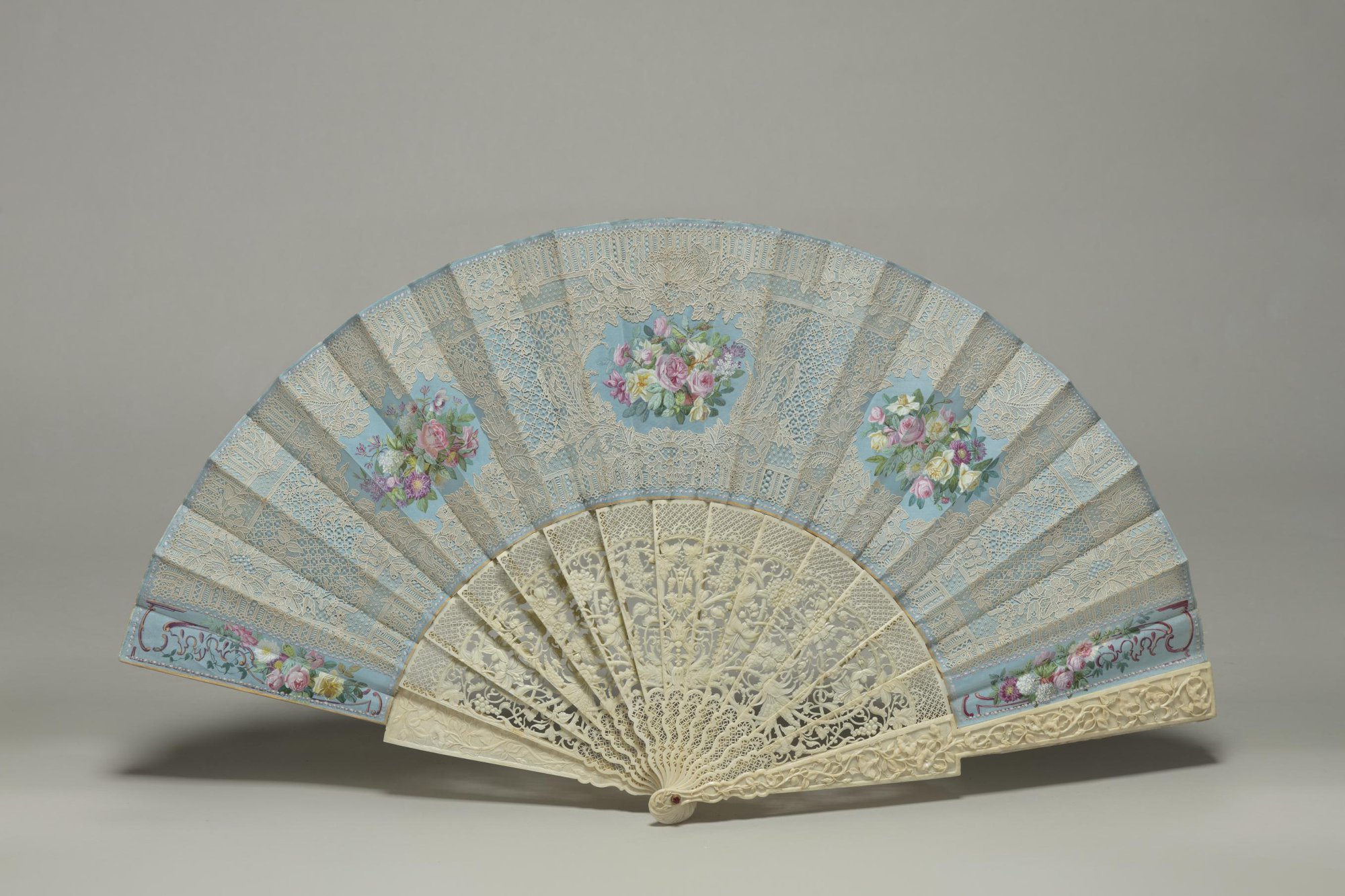
Folding Fan with Flower Composition. The State Hermitage Museum.
The fan comes from the collection of A. K. Rudanovsky and is not currently on permanent display.
At first glance it is a small, light, almost weightless thing. In the hand, however, it reveals a dense construction: two dozen carved ivory sticks, a pleated leaf, a lace overlay and painted decoration, all assembled with a precision that made the fan one of the most demanding luxury crafts of the nineteenth century.
The Object
The leaf is made of pale blue silk, pleated so that it opens into a wide arc and closes into a narrow bundle. Over the silk lies a fine white lace, arranged in a lattice of scrolls and floral motifs that softens the colour beneath and gives the surface its characteristic shimmer.
Three painted bouquets are set into reserved panels: roses, pansies and small blue flowers, painted in gouache with a light, almost porcelain finish. The lower edge carries a painted garland and a single rose, and the guard sticks are decorated with a painted floral border.
The sticks themselves are ivory, carved in openwork with scrolls and pierced ornament, and the guards are carved more deeply, with a floral design that continues the painted decoration of the leaf. A small metal rivet holds the whole assembly at the base.
The Fan in Europe
The folding fan is not a European invention. It came from East Asia — from Japan and China, where the pleated fan had been developed centuries earlier — and reached Europe in the sixteenth century through Portuguese and Spanish trade.
By the seventeenth century it had become a standard accessory of European court life, and by the eighteenth it was an indispensable part of fashionable dress. The great age of the painted fan was the Rococo: leaves painted with pastoral scenes, mythological subjects and gallant parties, mounted on mother-of-pearl or ivory.
The nineteenth century did not invent the fan, but it changed its character. Romantic historicism revived older forms; the fan became both a fashion object and a collector’s item; and the craft split between expensive handwork for the wealthy and cheaper printed fans for a broader market.
Ivory, Silk and Lace
Each material in this fan had its own industry behind it.
Ivory was imported from Africa and Asia, sawn into thin sticks and carved by specialists. The carving of a fan’s sticks is a miniature art in itself: the ribs must be strong enough to support the leaf, thin enough to close into a compact bundle, and decorated on a surface only a few millimetres wide.
The leaf was made of silk, sometimes of paper or parchment, and painted before mounting. Fan painters worked with gouache, which sits on the surface of the silk and keeps its brightness, and they had to plan the composition around the folds: an image painted flat becomes a broken sequence of panels when the fan is closed.
Lace added a further layer. In the 1850s the lace industry was at its height, and lace appliquéd onto a silk leaf gave the fan a texture that no painting could imitate — a soft, granular surface that catches the light differently from the smooth silk.
The Language of Flowers
The bouquets are not random. In the nineteenth century flowers carried meanings, and a fan painted with roses, pansies and forget-me-nots was a small message as much as a decoration.
The rose could signify love, beauty or silence — the last meaning inherited from the antique convention of the rose offered sub rosa, under the seal of confidence. The pansy, from the French pensée, carried the idea of thought: pense à moi, think of me. The forget-me-not needs no explanation.
Whether the painter intended a specific message, or simply assembled a pleasing group of fashionable flowers, cannot be determined. But the vocabulary was widely understood, and fans were among the objects through which that vocabulary circulated — painted, embroidered, printed and exchanged.
Paris and the Fan Trade
Paris was the centre of the European fan trade in the nineteenth century.
The industry was organised in small workshops, each with its own speciality: the tabletier prepared the sticks, the éventailliste mounted the leaf, the painter decorated it, the lacemaker supplied the border. A single fan could pass through a dozen hands.
The 1850s were the years of the Second Empire, of crinoline, of the great balls and of a court that set the tone for European fashion. Fans were accessories of the evening dress, but they were also gifts, souvenirs and objects of display. A fan in a fitted case, with a painted leaf and carved ivory sticks, was a possession meant to be shown.
A Woman’s Accessory
The social life of the fan was as important as its manufacture.
A closed fan held in the hand, an open fan moved slowly before the face, a fan snapped shut: these were gestures with meaning in a ballroom. The fan gave a woman something to do with her hands and a way to look at someone without being seen to look.
It also had a practical function. In rooms lit by candles and heated by bodies, a fan was a small machine for moving air, and the pleasure of coolness was part of the pleasure of the object.
By the end of the nineteenth century the fan’s social importance had begun to decline, but its place in the imagination of the period remained. The fan is one of the objects through which the nineteenth century is still pictured: a woman in a wide dress, a fan half-open in her hand.
Fans and Collecting
The nineteenth century discovered the fan as a historical object. Private collections of fans were formed in Paris and London; illustrated books on the history of the fan appeared; and the fan became one of the things a cultivated household might display in a cabinet rather than use.
This double life — useful object and collected object — is visible in the way fans were kept. A fan could be folded into its case and carried to a ball, or laid open under glass in a collector’s cabinet. The same object served both purposes, and the difference lay only in the hand that held it.
For a collection such as Rudanovsky’s, the fan was a natural acquisition: small, beautiful, technically complex, and connected to the great decorative traditions of France.
Provenance
The fan comes from the collection of A. K. Rudanovsky and carries the inventory number E-13604.
Its presence in that collection is characteristic of Rudanovsky’s range. The collection is usually discussed in terms of paintings, sculpture and Chinese or European porcelain, but it also included the small luxury objects through which a nineteenth-century house was furnished — the fans, boxes, miniatures and textiles that made an interior complete.
In the Hermitage
The fan is preserved in the State Hermitage Museum in Saint Petersburg and is not on permanent display.
It survives in remarkably good condition: the silk retains its colour, the lace its relief, the ivory its pale warmth. In a museum of paintings and sculpture, such an object is a reminder that the decorative arts of the nineteenth century were not a lesser form of art but a different one — an art of materials, of small scale and of use.
Seen closed, the fan is a slim, carved object that fits in the hand. Opened, it becomes a painted surface almost half a metre wide. That transformation — from tool to picture — is the whole point of the form.