Origin: Italy
Date: early 19th century
Material: agate-onyx
Technique: carving
Dimensions: 30 × 24 mm
Current Collection: The State Hermitage Museum
Inventory Number: K-6397
Hermitage ID: 150743
Rudanovsky Connection: Entered the Hermitage in 1928 from the collection of A. K. Rudanovsky.
A cameo of a woman’s head in profile, carved in white onyx against a pale ground — an ideal head in the neoclassical manner, made in Italy in the early nineteenth century.
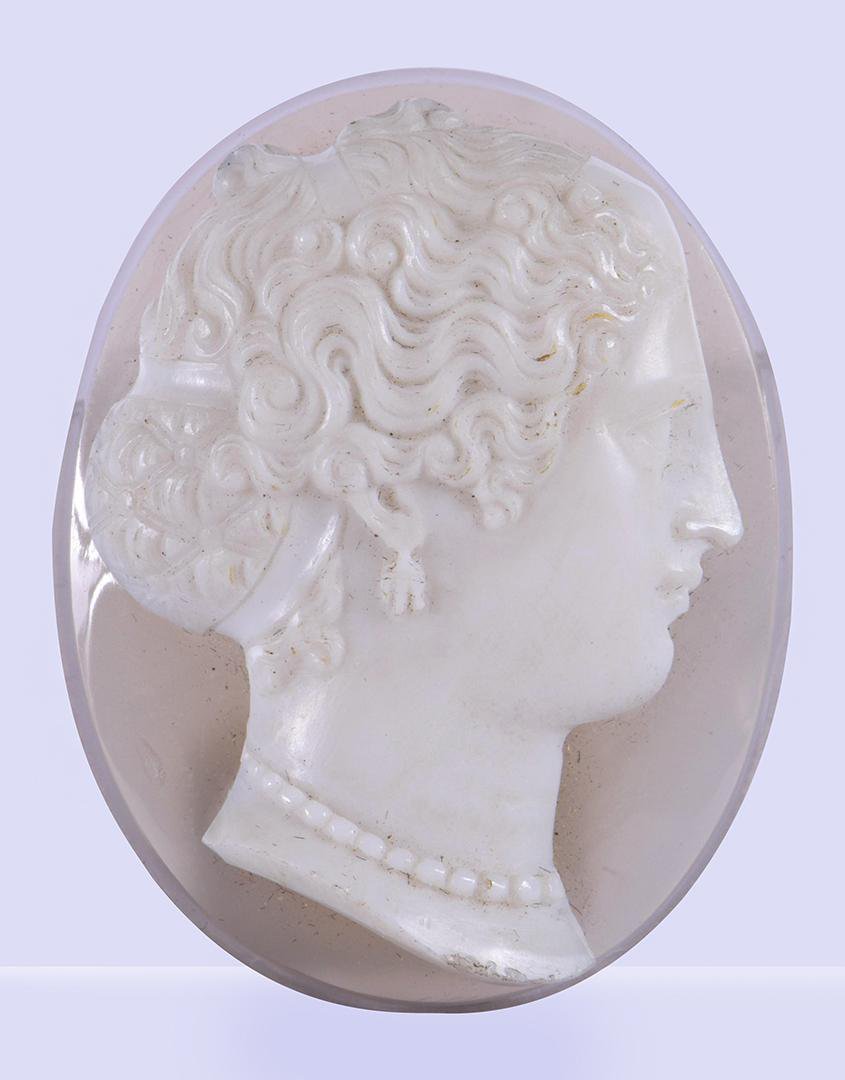
Cameo: Female Head in Profile Facing Right. The State Hermitage Museum.
The cameo entered the Hermitage in 1928 from the collection of A. K. Rudanovsky. It is not currently on permanent display.
It is small — three centimetres high — and it shows a young woman in profile, facing right, with an elaborate arrangement of curls and a string of beads around her neck.
The Object
The stone is an oval of agate-onyx with two layers: a white upper layer, used for the head, and a pale grey lower layer, which forms the background.
The head is carved in low relief. The face is shown in strict profile: forehead, nose, lips and chin in a single continuous line. The hair is worked in deep, curling locks, gathered at the back into a knot or a bun. An earring hangs from the ear, and a necklace of round beads follows the line of the neck.
The surface is polished, and the edges of the oval are smooth.
A Female Head
The subject is an ideal head rather than a portrait.
The features are regular and generic: a straight nose, a small mouth, a smooth cheek. There is no attempt at individual likeness, no asymmetry, no particular expression. The woman could be a muse, a goddess or a type of beauty.
This is characteristic of neoclassical cameo carving. The goal was not to record a person but to embody an idea of beauty derived from ancient sculpture and from the paintings of Raphael.
The Hair
The hair is the most elaborate part of the carving.
It is arranged in a classical coiffure: waves and curls around the face, a braid or a band across the crown, and a knot at the back. Each curl is modelled with a few strokes, and the whole mass is carved more deeply than the face, so that it catches the light and frames the pale profile.
Hair was a test of skill for a gem carver. It required a steady hand, a fine wheel and an understanding of how light moves across a curved surface.
The Jewellery
The earring and the necklace are small details that place the head in a social world.
The earring is a drop or a hoop, carved in relief; the necklace is a string of round beads, each one a tiny sphere. Such jewellery was common in classical and neoclassical portraits, and it served to indicate wealth, femininity and refinement.
At this scale, the beads are barely a millimetre across. Their presence shows the carver’s patience and the quality of the stone.
Onyx and Layers
The cameo depends on the layered structure of onyx.
The stone forms in successive bands, each with its own colour, and the carver cuts through the upper band to expose the lower one. The white layer becomes the head; the grey layer becomes the ground.
Working with layers is a matter of judgement. The carver must estimate the thickness of the white layer before cutting, and must leave enough material for the deepest parts of the relief. A mistake cannot be repaired.
Neoclassical Taste
The cameo belongs to the neoclassical revival of the late eighteenth and early nineteenth centuries.
After the excavations of Pompeii and Herculaneum, European taste turned toward classical antiquity: simple lines, white marble, profile portraits. Cameos, with their white figures on coloured grounds, were the perfect vehicle for that taste.
Ideal heads, mythological figures and classical profiles were produced in enormous numbers, and they were worn as jewellery, set into rings and brooches, and collected in cabinets.
Italy around 1800
Italy was the centre of this production.
Rome, Naples and Florence had workshops of gem engravers who served the stream of travellers on the Grand Tour and the growing market for classical souvenirs. Some carvers were Italian, some were foreign artists who had settled in Rome.
The cameo is recorded as made in Italy in the early nineteenth century, which places it in that world of workshops, dealers and collectors.
Cameos for Travellers
For a traveller, a cameo was the perfect souvenir.
It was small, light, unbreakable and expensive enough to be a gift. It could be worn as a brooch or a ring, or kept in a cabinet as a small piece of antiquity — or of the antiquity that the eighteenth century had reinvented.
Many cameos in European collections were bought in Italy by travellers and brought home as reminders of the Grand Tour.
The Profile
The profile is the oldest form of portraiture.
It appears on coins, medals and seals from antiquity onward, and it carries an association with authority and permanence. In a cameo, the profile is also a practical choice: it allows the carver to fit a head into an oval and to describe the face with a single outline.
The woman’s profile here is calm and slightly abstract, like a face on a coin — which is exactly what the neoclassical cameo was designed to be.
The Ideal Head
The ideal head is a genre of its own.
In neoclassical art, the ideal head was a face assembled from the best features of many models, purified of individual peculiarity. It was meant to represent a type — beauty, virtue, youth — rather than a person.
Winckelmann’s writings on Greek art encouraged this approach, and cameo carvers produced ideal heads in great numbers. They were popular because they could be worn by anyone and flattered everyone.
Wearing a Cameo
Cameos were made to be worn.
A gem of this size could be set in a brooch, a ring, a pendant or a diadem. It could be pinned to a dress, worn at the throat or given as a token of affection.
The back of the cameo often carries the marks of its setting: small scratches, traces of glue or metal, a hole drilled for a pin. This one is photographed unset, but it was probably mounted at some point in its life.
The Ground
The pale grey ground is not a neutral background.
It provides the contrast that makes the white head legible, and it also determines the mood of the object: cool, restrained and classical. A darker ground would have made the head more dramatic; a warmer one, more intimate.
The carver chose the stone for its layers, and the layers determined the ground. In cameo carving, the material and the image are inseparable.
Provenance
The cameo carries the inventory number K-6397. It entered the Hermitage in 1928 from the collection of A. K. Rudanovsky.
In the Hermitage
The cameo is preserved in the State Hermitage Museum in Saint Petersburg and is not on permanent display.
It is one of a group of gems from the Rudanovsky collection, and it represents the taste of the early nineteenth century: classical, elegant and small enough to be held between two fingers.