Origin: Italy
Date: second half of the 18th century
Material: agate-onyx
Technique: carving
Dimensions: 36 × 24 mm
Current Collection: The State Hermitage Museum
Inventory Number: K-6398
Hermitage ID: 150744
Rudanovsky Connection: Entered the Hermitage in 1928 from the collection of A. K. Rudanovsky.
A cameo portrait of Michelangelo, carved in white onyx on a brown ground — the bearded face of the artist as the eighteenth century imagined him.
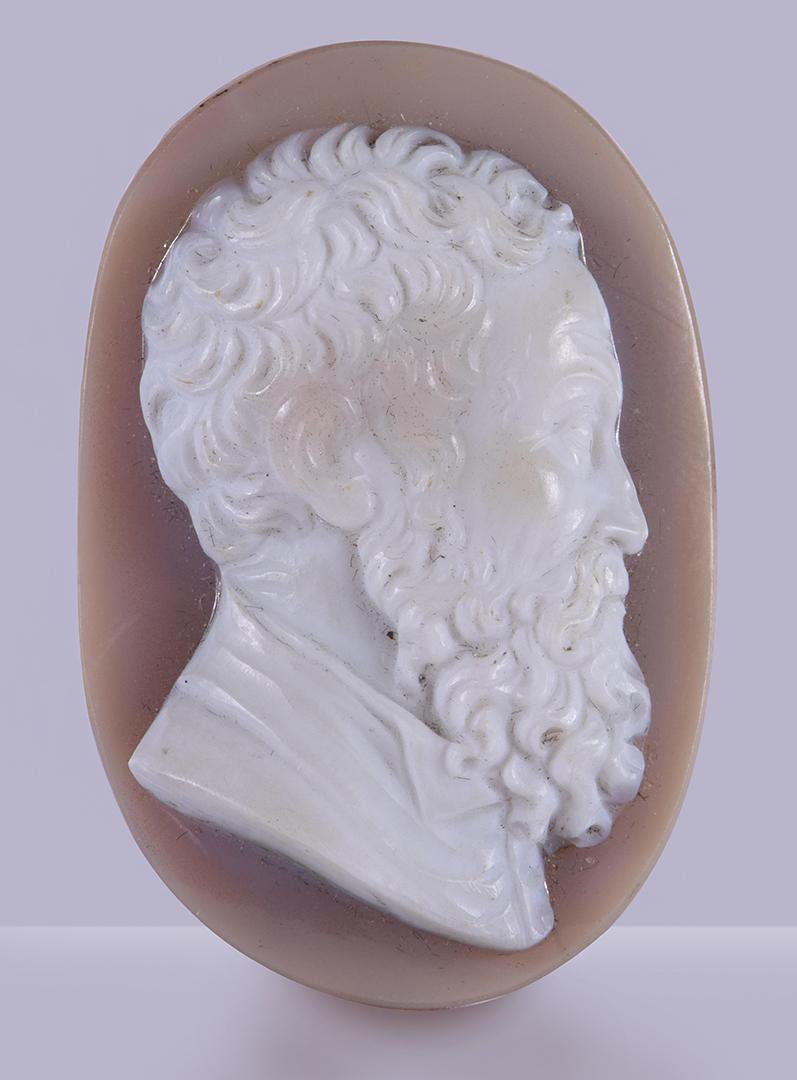
Cameo: Michelangelo. The State Hermitage Museum.
The cameo entered the Hermitage in 1928 from the collection of A. K. Rudanovsky. It is not currently on permanent display.
It shows a man in profile, facing right: a broad forehead, a strong nose, a full beard and a mass of curly hair. He wears a cloak or a mantle over the shoulders, and the whole head is carved in white stone against a warm brown ground.
The Object
The gem is an oval of agate-onyx, 36 by 24 millimetres, with a white upper layer and a brown lower layer.
The head is carved in relief, with the face, the hair and the beard all cut from the white layer. The background is the brown layer, polished smooth. The edges of the oval are rounded, and the surface is slightly worn.
The carving is confident but not minute: the hair and beard are described in broad curls, the features are simplified, and the cloak is indicated with a few folds.
Michelangelo
Michelangelo Buonarroti (1475–1564) was a sculptor, painter, architect and poet — the model of the universal artist of the Renaissance.
He carved the David and the Pietà, painted the ceiling of the Sistine Chapel, designed the dome of St Peter’s, and wrote sonnets that are still read. His fame was immense in his own lifetime and grew after his death.
His face is known from portraits by Daniele da Volterra, Giulio Bonasone and others, and from the tradition of the bearded, brooding artist that those portraits established.
The Bearded Head
The face on the cameo follows that tradition.
The broad forehead, the broken nose (Michelangelo’s nose was famously injured in a fight with Torrigiano), the full beard and the curly hair are all features of the standard image. The expression is serious and slightly withdrawn.
This is not a portrait from life. It is a portrait of a legend — the image that the eighteenth century had inherited and continued to reproduce.
The Cult of Michelangelo
The eighteenth century admired Michelangelo for his terribilità — the power, the grandeur and the slightly frightening intensity of his work.
Neoclassical theorists sometimes criticised him for departing from the rules, but collectors and artists revered him. His drawings were studied, his sculptures were copied, and his face was reproduced in prints, marbles and gems.
A cameo of Michelangelo was therefore an object of homage: a small image of the greatest sculptor, carved in stone, to be kept among the treasures of a collector.
The Carving
The cameo is carved in the traditional way, with a wheel and abrasive.
The white layer is cut back to the brown ground around the head, and the head itself is modelled with a series of shallow cuts. The hair and beard are the deepest parts of the relief, and they catch the light most strongly.
The work is not as fine as the best Roman cameos of the same period, but it is confident and effective. The face reads clearly at a glance, which is the first requirement of a gem.
Artists’ Portraits
Portraits of artists were a distinct genre in the eighteenth century.
Collectors wanted images of the masters they admired, and artists wanted to be associated with their predecessors. Prints, medals, busts and gems circulated these images across Europe.
A cameo of Michelangelo belongs to that culture of admiration. It is a small, portable monument to a great artist, made for a collector who wanted to hold the idea of genius in his hand.
The Stone
The agate-onyx gives the portrait its colour.
The white layer is opaque and slightly creamy; the brown layer is warm and translucent at the edges. The contrast between the two is what makes the head stand out, and it is the reason the carver chose this stone.
Onyx of this kind was imported from the East and from Germany, and it was expensive. A cameo was therefore both a work of art and a piece of material value.
The Cloak
The cloak over the shoulders is a small but telling detail.
It indicates the artist’s status: not a craftsman in an apron, but a dignified figure in a mantle. The cloak also provides a visual base for the head, anchoring it to the oval and filling the lower part of the composition.
In portraits of artists, clothing often carries the message of social standing, and this cloak is part of that message.
The Broken Nose
Michelangelo’s face was marked by a broken nose.
According to Vasari, the young Michelangelo was struck in the face by the sculptor Pietro Torrigiano during an argument, and the blow left his nose permanently flattened. The injury became part of his legend: a mark of the violence and passion of the man.
In portraits, the broken nose is usually softened or corrected. On this cameo, the nose is strong and straight, which suggests that the carver followed an idealised model rather than a documentary one.
Prints as Sources
Cameo portraits of artists were often based on prints.
Engravings of Michelangelo’s face, after portraits and busts, circulated widely in the eighteenth century. A carver could work from a print without ever seeing the original painting or sculpture, and the cameo would reproduce the print’s version of the face.
This is how images travelled in the pre-photographic age: from painting to print, from print to gem, from gem to collection. Each step simplified the image and fixed it more firmly in the popular imagination.
The Collector’s Cabinet
Gems were kept in cabinets.
A collector’s cabinet of gems was a piece of furniture with shallow drawers, lined with velvet or paper, in which the stones were arranged in trays. Each gem had its place, and the cabinet could be opened to show the collection to visitors.
In such a cabinet, a cameo of Michelangelo would sit beside portraits of other artists, ancient heads and mythological figures. The cabinet was a small museum, arranged by the collector for his own pleasure and for the admiration of his guests.
The Beard
The beard is the most conspicuous feature of the head.
In Renaissance portraits, a beard signified maturity, gravity and often learning. For Michelangelo, the beard became part of his image: the old artist, the prophet, the man who had seen and made so much.
Carving a beard in cameo is a test of technique. The curls must be suggested rather than described, with a few strokes each, and the mass must read as a whole. On this cameo, the beard is carved in broad, rhythmic curls that catch the light and frame the face.
Scale
At 36 millimetres, the cameo is at the upper end of the scale for a portrait gem.
The size allows more detail than a smaller stone, but it also makes the carving more demanding: every part of the head must be modelled, and the surface must be polished without blurring the features. The carver has used the space well, filling the oval with the head and leaving just enough ground to make it read.
Provenance
The cameo carries the inventory number K-6398. It entered the Hermitage in 1928 from the collection of A. K. Rudanovsky.
In the Hermitage
The cameo is preserved in the State Hermitage Museum in Saint Petersburg and is not on permanent display.
It is one of three artist portraits in the Rudanovsky group of gems — with Raphael and Michelangelo — and together they show how the nineteenth-century collector thought about art: as a lineage of great individuals, whose faces could be carved in stone and kept close.