Origin: Russia (?)
Date: 19th century
Material: jasper
Technique: carving
Dimensions: 26 × 18 mm
Current Collection: The State Hermitage Museum
Inventory Number: K-6396
Hermitage ID: 150742
Rudanovsky Connection: Entered the Hermitage in 1928 from the collection of A. K. Rudanovsky.
A small oval of brown jasper carved with a male head in profile — a cameo from the Rudanovsky collection, no larger than a thumbnail.
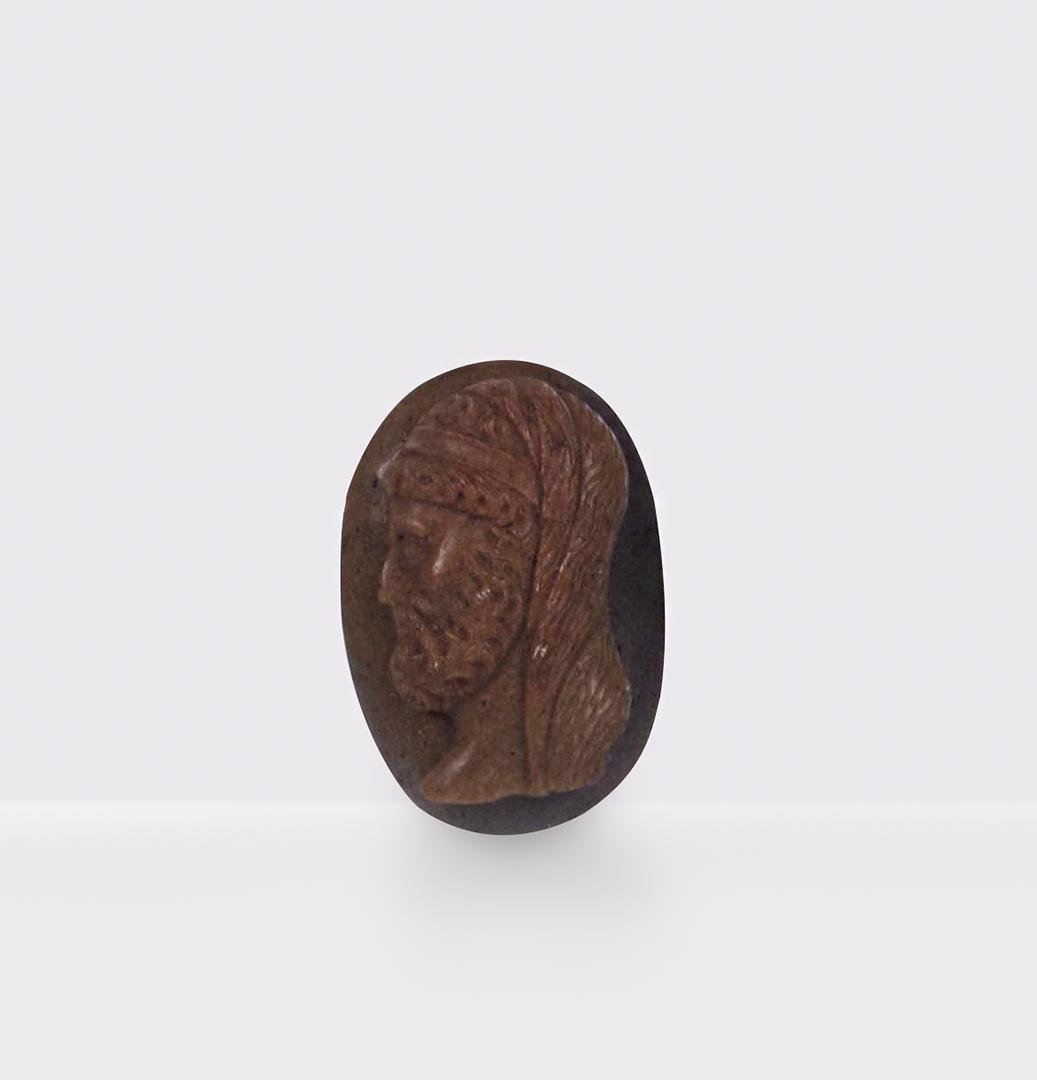
Cameo: Male Head. The State Hermitage Museum.
The cameo entered the Hermitage in 1928 from the collection of A. K. Rudanovsky. It is not currently on permanent display.
At 26 by 18 millimetres it is smaller than a postage stamp, and it belongs to a category of object that is easy to overlook in a museum of paintings: the carved gem, a world compressed into a stone.
The Object
The gem is an oval cabochon of brown jasper, polished on the surface and carved with a head in relief.
The head is turned to the left, in profile or three-quarter view, and is framed by a cloth or headdress that covers the hair and falls behind the ear and down the neck. The features are large and simplified: a straight nose, a full mouth, a broad cheek. The carving is low and soft, without sharp edges.
The stone is a warm reddish-brown, mottled with darker patches, and the carved surfaces catch the light differently from the polished ground. The contrast between the raised head and the dark background is what makes the image legible at such a small scale.
Jasper
Jasper is an opaque variety of chalcedony, a form of quartz coloured by impurities.
It occurs in many colours — red, brown, yellow, green, grey — and it takes a high polish. In Russia, jasper was quarried in the Urals and the Altai, and it became one of the characteristic stones of Russian lapidary work in the eighteenth and nineteenth centuries.
The jasper used here is brown-red, with darker veins and patches. It is not a precious stone in the sense of diamond or ruby; it is a hardstone, valued for its colour, its density and its ability to take a fine carve.
Cameo and Intaglio
Carved gems come in two basic kinds.
A cameo is carved in relief: the image stands out from the background, usually in a stone with layers of different colours, so that the figure is one colour and the ground another.
An intaglio is carved into the stone: the image is incised, and it is designed to be pressed into wax or clay to produce a seal.
The Hermitage record calls this object a cameo, and the head does appear to be carved in relief against a darker ground. The distinction matters less than the skill: both techniques require the carver to work at a scale of millimetres, with a wheel, a drill and a magnifying lens.
The Head
The head is difficult to identify, and the museum does not attempt to name it.
It could be an antique philosopher, a Turk, a biblical figure or a generic «oriental» type — the kind of subject that was popular in cameo carving in the eighteenth and nineteenth centuries. The headdress suggests the East, but the features are classical in their simplicity.
This ambiguity is characteristic of the genre. Cameos often depict types rather than individuals: a philosopher, a warrior, a muse, a saint. The pleasure of the object lies in the carving, not in the identity of the sitter.
Glyptics in Russia
Carved gems were among the most prestigious of the decorative arts in imperial Russia.
Catherine the Great assembled one of the largest collections of engraved gems in Europe, and the Hermitage became a centre for their study. Russian lapidary workshops, especially those of Ekaterinburg and Peterhof, produced cameos and intaglios in local hardstones, and foreign carvers were invited to work at court.
By the nineteenth century, cameo carving had become both a court art and a collector’s market. Gems were bought, exchanged, mounted in rings and brooches, and kept in cabinets as small sculptures.
The Rudanovsky Gems
The Rudanovsky collection included a group of carved gems, of which this is one.
Collecting gems was a distinct pursuit from collecting paintings. It required a different knowledge — of stones, of carving, of classical iconography — and a different kind of display: cabinets, drawers, trays lined with velvet.
The presence of gems in the Rudanovsky collection is a sign of its breadth. This was not a collection of one kind of object but a nineteenth-century interior in miniature, in which paintings, furniture, porcelain and gems coexisted.
Scale and Attention
The cameo demands a particular kind of attention.
At arm’s length it is a small brown oval; held close, it becomes a face. The transition is sudden, and it is the essence of the glyptic experience: an image that reveals itself only when the viewer comes close enough to give it time.
This is why gems were kept in cabinets rather than hung on walls. They were meant to be taken out, held, turned in the light and examined — objects of intimacy rather than display.
The Carver’s Tools
Carving a gem is a slow, abrasive process.
The carver works with a lathe or a bow drill, using wheels of copper, tin and wood charged with emery or diamond dust. The stone is ground away, not cut; the image emerges gradually, and every stage is irreversible.
At 26 millimetres, the head is smaller than a fingernail, and the details — the line of the nose, the fold of the cloth — are carved with tools finer than a needle. The work requires patience, a steady hand and a good light.
Why Heads?
The head is the most common subject of cameos, and for good reasons.
A head fits an oval; it can be read at a glance; it carries the suggestion of a person without requiring a body. In the glyptic tradition, heads were used for emperors, philosophers, poets, gods and anonymous types.
The head on this jasper belongs to that tradition. It is not a portrait but a type — a face carved to be recognised as a face, and to be admired for the skill of its making.
Unset
The gem is photographed without a mount, and that is worth noting.
Most cameos survive as part of a jewel: set in a ring, a brooch, a pendant or a snuff-box lid. The mount protects the stone, frames it and turns it into an object of use.
This one is bare. It may have lost its setting, or it may never have had one — a collector’s piece, kept in a cabinet and handled rather than worn. The absence of a mount is a small piece of evidence about how the gem was used and valued.
Provenance
The cameo carries the inventory number K-6396. It entered the Hermitage in 1928 from the collection of A. K. Rudanovsky.
In the Hermitage
The cameo is preserved in the State Hermitage Museum in Saint Petersburg and is not on permanent display.
It is one of the smallest objects in the collection and one of the most concentrated: a head, a stone and a history, held in the palm of a hand. It is a small thing, but it is complete.