Origin: Russia
Date: mid-18th century
Material: silver, glass
Technique: carving, repoussé, polishing
Dimensions: 6.9 × 4.7 cm
Current Collection: The State Hermitage Museum
Inventory Number: E-10092
Hermitage ID: 146102
Rudanovsky Connection: Entered the Hermitage in 1919 from the collection of A. K. Rudanovsky.
A pair of shoe buckles set with clear paste stones in silver, made in Russia in the middle of the eighteenth century and still bright enough to catch a candle.
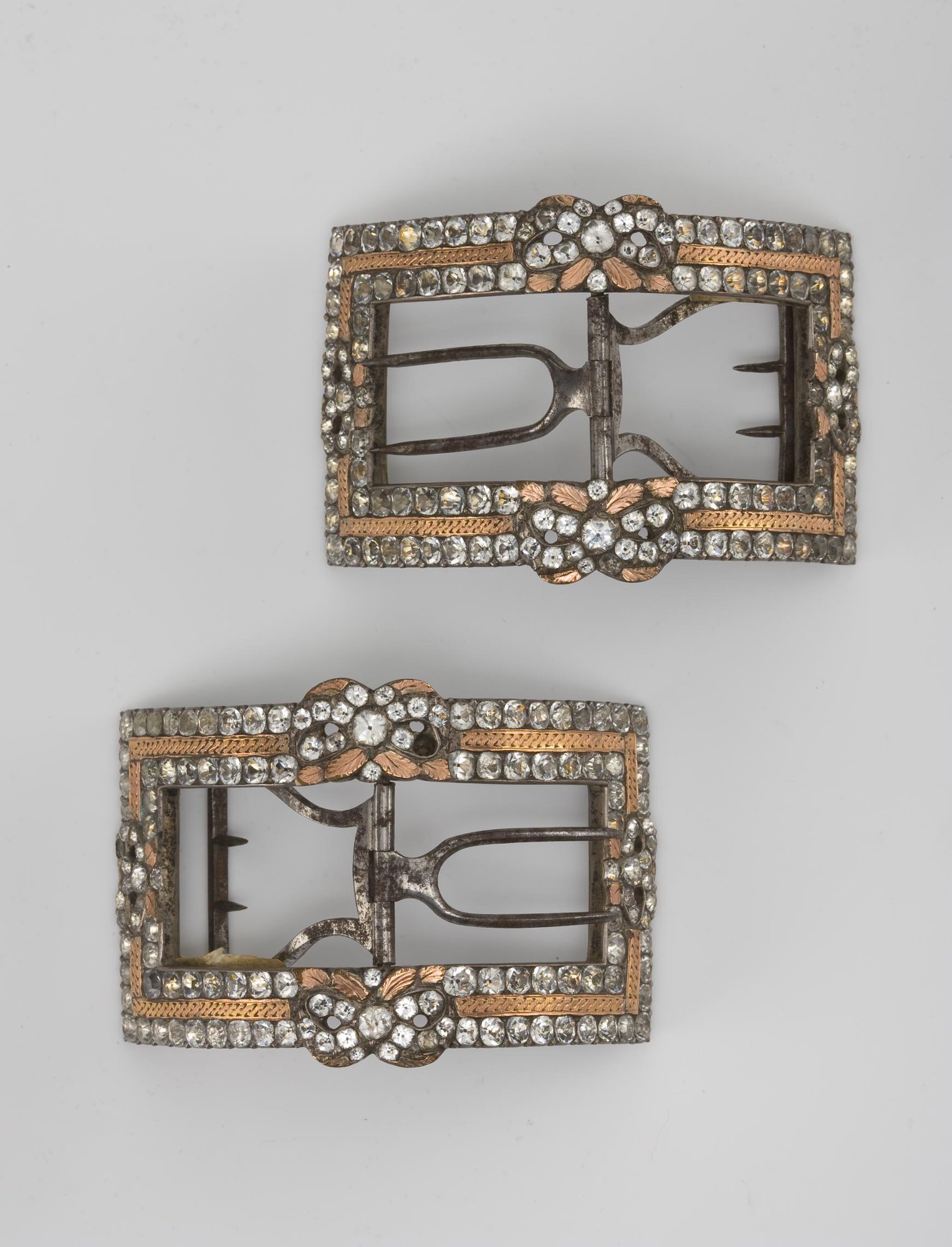
Pair of Shoe Buckles. The State Hermitage Museum.
The buckles entered the Hermitage in 1919 from the collection of A. K. Rudanovsky. They are on display in the New Hermitage, in room 126.
They are small objects — about the size of a matchbox — and they belong to the most ordinary and most revealing category of eighteenth-century luxury: the accessories of dress.
The Object
Each buckle is a rectangle with rounded corners, built as a frame around an open centre.
The frame is set with rows of clear stones, closely packed, with larger stones clustered at the top and bottom in flower-like groups. Between the stones run bands of engraved gold-coloured metal, and the edges are finished with a fine moulding.
The back of each buckle carries an iron chape: a hinged metal fitting with two prongs, designed to pass through the buttonhole of the shoe and hold the buckle in place.
Buckles and Fashion
In the eighteenth century, shoe buckles were not a detail. They were one of the most visible items of a man’s dress.
Breeches ended at the knee, stockings covered the leg, and the shoe was finished with a buckle that caught the light. A pair of buckles could be silver, gilt, paste or real diamonds; the choice announced the wearer’s wealth and taste as clearly as a watch or a ring.
Buckles replaced the ribbons and rosettes of the previous century and became, by the middle of the eighteenth century, an essential part of polite dress for both men and women.
Paste
The stones in these buckles are glass, not diamonds.
Paste — lead glass with a high refractive index — was developed in the eighteenth century to imitate precious stones. Cut and polished, it sparkles almost like a diamond, and it allowed jewellers to produce brilliant accessories at a fraction of the cost.
Paste was not a cheap substitute in the modern sense. It was a legitimate material, worn at court and in society, and it was made by skilled craftsmen who cut and set it with the same care as real stones. The distinction between paste and diamond was one of value, not of appearance.
Silver and the Chape
The frame of the buckle is silver, worked with carving and repoussé and finished with polishing.
The chape — the hinged fitting on the back — is iron, and it is the mechanical heart of the object. It must hold the buckle firmly on the shoe, open and close smoothly, and survive the pressure of walking.
The contrast between the glittering front and the utilitarian back is characteristic of eighteenth-century dress accessories. The part that was seen was jewelled; the part that worked was iron.
Russia and the Court
The buckles are recorded as made in Russia, in the middle of the eighteenth century.
Russian court dress of the period followed European fashion closely, and St Petersburg had its own jewellers, silversmiths and paste-makers. The imperial court, the nobility and the wealthy merchantry all wore buckles, and the quality of Russian work was high.
The style of these buckles — the rectangular frame, the dense setting, the floral clusters — belongs to the international rococo of the 1740s and 1750s, which was practised from Paris to St Petersburg.
A Pair
The buckles are a pair, and they were made as a pair.
The two are almost identical: the same size, the same setting, the same clusters of stones. The small differences between them are the result of handwork — a stone set at a slightly different angle, a moulding cut a little deeper.
Pairs matter in dress accessories. A single buckle is useless; two matching buckles make a pair of shoes fit for society. The pair survives together, which is not always the case with such objects.
Wear and Survival
The buckles show signs of use: the silver is worn, the stones are slightly dulled, and the iron chapes are rusted.
That they survive at all is a small accident of history. Shoe buckles went out of fashion in the early nineteenth century, when shoelaces and simpler fastenings replaced them. Most were melted down or discarded.
These survived because they were kept — perhaps as a souvenir of a costume, perhaps as part of a collection of small decorative objects.
The Stones
The paste stones were cut by a lapidary, not by a jeweller.
Each stone is faceted so that it catches the light and throws it back in a sparkle. The cutting was done on a wheel with abrasives, and the stones were then polished and set close together, so that the surface of the buckle reads as a continuous field of light.
Some paste stones were backed with foil to increase their brilliance — a technique borrowed from real jewellery. Whether these stones are foiled cannot be seen from the photograph, but the brightness of the surface suggests a deliberate effort to imitate diamond.
Small Collections
Buckles belong to a category of object that collectors often ignore: the small accessory.
They are not paintings, not sculpture, not porcelain; they are the hardware of dress. And yet they are among the most personal objects of the eighteenth century, worn on the body, chosen with care and kept as mementoes.
Rudanovsky’s collection included such objects alongside its paintings and porcelain. Their presence suggests a collector interested in the texture of daily life, not only in masterpieces, and their survival is a small miracle of care.
The Buttonhole
A buckle is a mechanism, and its mechanism depends on the shoe.
Eighteenth-century shoes were made with a strap across the instep, pierced with a buttonhole. The chape of the buckle passed through the hole, and the prongs engaged with the strap to hold the buckle in place.
The system was simple and effective, and it allowed buckles to be changed: a plain pair for day, a brilliant pair for evening. The buckle was therefore both a fastening and an ornament — a piece of engineering that had to look like a jewel.
The shoe, in turn, was made to be seen: buckles sat on the instep, where the eye falls, and the whole arrangement of breeches, stockings and shoe was designed to lead the gaze downward to the glitter at the foot.
Provenance
The buckles carry the inventory number E-10092 and entered the Hermitage in 1919 from the collection of A. K. Rudanovsky.
In the Hermitage
The buckles are on display in the New Hermitage, in room 126, among the applied arts of the eighteenth century.
They are a small exhibit, easily passed by, but they do something that a painting cannot: they put the visitor in contact with the everyday appearance of the eighteenth century — the shine of paste at a ball, the weight of silver on a shoe, the small mechanical click of a chape closing.