Origin: Italy
Date: late 18th – first third of the 19th century
Material: agate-onyx
Dimensions: 33 × 26 mm
Current Collection: The State Hermitage Museum
Inventory Number: K-6399
Hermitage ID: 150745
Rudanovsky Connection: Entered the Hermitage in 1928 from the collection of A. K. Rudanovsky.
A cameo portrait of Raphael carved in layered onyx — a Renaissance image made three centuries later, in the age that worshipped the Renaissance.
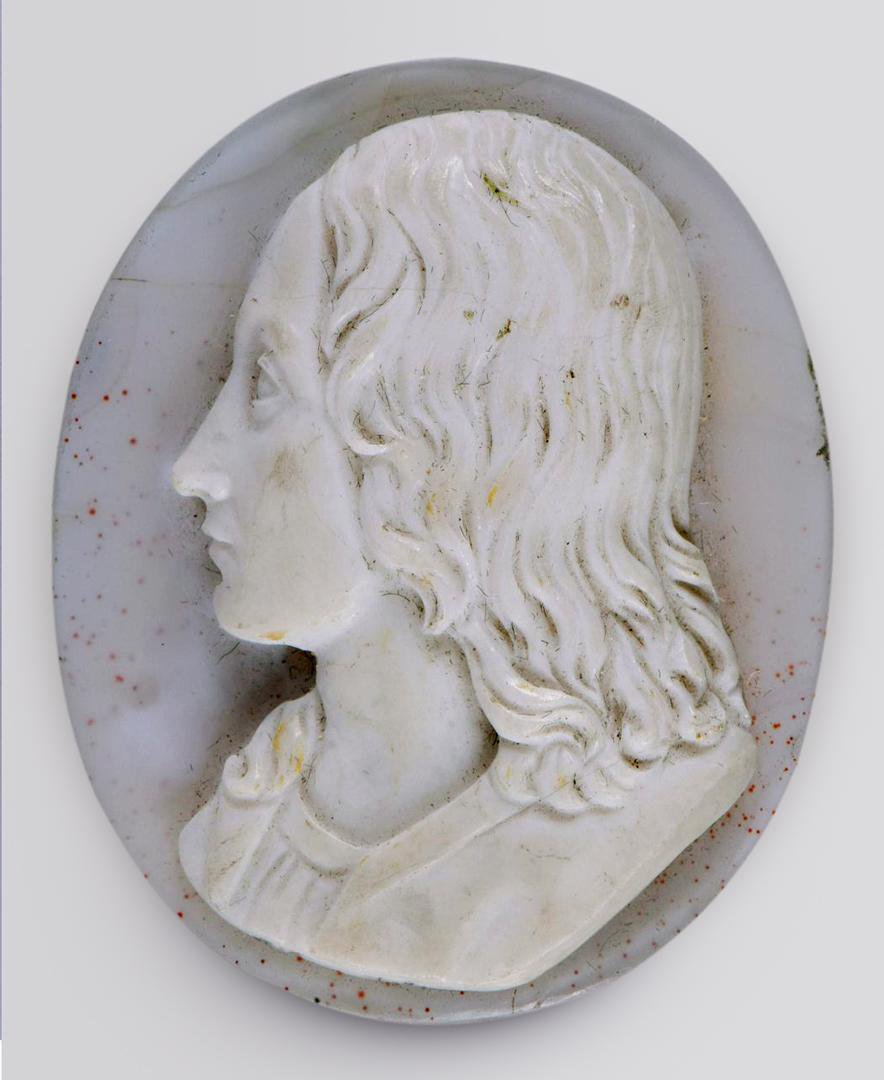
Cameo: Portrait of Raphael. The State Hermitage Museum.
The cameo entered the Hermitage in 1928 from the collection of A. K. Rudanovsky. It is not currently on permanent display.
It is a small oval, 33 by 26 millimetres, carved in white on a grey-blue ground. The head is shown in profile, facing left, with long curling hair, a straight nose and a soft mouth — the face of a young man, idealised and slightly melancholy.
The Object
The stone is an agate-onyx with two visible layers: a pale, almost white upper layer, used for the head, and a darker grey-blue lower layer, which forms the ground.
The carving is low and delicate. The hair is described in long, wavy lines; the eye is a shallow almond; the lips are barely modelled. The neck and shoulder emerge from the ground with a soft transition, and the whole head seems to float on the surface of the stone.
The cameo is oval and unset in the photograph, which makes the carving easier to see. The surface is worn smooth in places, a sign that the stone was handled often by its successive owners.
Raphael
Raphael Sanzio (1483–1520) was one of the three great artists of the Italian Renaissance, with Leonardo and Michelangelo.
He was born in Urbino, trained in Perugia and Florence, and worked in Rome for the popes. His paintings — the Stanze, the Sistine Madonna, the Transfiguration — became the standard of classical harmony for centuries.
His face is known from several portraits and from the legend that grew around him: the beautiful young painter, the courtly artist, the favourite of popes and princes.
The Cult of Raphael
The late eighteenth and early nineteenth centuries were the great age of the cult of Raphael.
Winckelmann and the neoclassical theorists held him up as the model of ideal beauty; Goethe wrote about him; collectors competed for his drawings; and engravers reproduced his works across Europe.
A cameo portrait of Raphael was therefore not simply a likeness. It was an emblem of artistic perfection — a small object that allowed its owner to carry the idea of the greatest painter in his pocket.
Onyx and Layered Stone
Cameo carving depends on layered stone.
Onyx, a variety of chalcedony, forms in layers of different colours: white over grey, brown over cream, black over white. The carver cuts through the upper layer to expose the lower one, using the contrast to create the image.
The technique requires planning. The carver must decide, before cutting, which layer will be the face and which the ground, and must judge the thickness of the layers with care. A mistake cannot be corrected; the stone is ground away, not added to.
The Cameo Portrait
The cameo portrait is a genre with its own conventions.
The head is shown in profile, the neck and shoulder are abbreviated, and the background is left plain. The face is idealised: the features are regular, the expression is calm, and the likeness is general rather than particular.
This is not a failure of observation but a convention of the genre. A cameo is a small object, meant to be read at a glance and admired for its carving; a detailed likeness would be lost at this scale.
Italy and the Trade in Gems
Italy was the centre of cameo carving in the eighteenth and nineteenth centuries.
Rome had a colony of gem engravers who worked for travellers on the Grand Tour, producing cameos of antique subjects, famous faces and contemporary portraits. Naples, Florence and Milan had their own workshops.
The trade was international. Gems were bought by collectors, mounted in jewellery and exported across Europe. A cameo of Raphael, carved in Italy, could end up in a Russian collection — as this one did.
The Face
The face on the cameo is not a portrait from life.
It is a reconstruction, based on earlier portraits and on the idea of Raphael that the nineteenth century had formed: the young, beautiful, slightly melancholic artist. The long hair, the straight nose and the soft mouth are features of that idea rather than of the historical man.
This is what makes the cameo interesting. It is a portrait of a reputation as much as of a person — a small stone carrying the image that Europe wanted Raphael to have, and projecting it into a century that had never seen him.
Portraits of Artists
The portrait of the artist is a genre with its own history.
From the Renaissance onward, painters and sculptors were celebrated as individuals, and their faces became part of their fame. Vasari’s Lives gave artists biographies; prints circulated their portraits; collectors wanted their images alongside their works.
By the eighteenth century, the artist had become a cultural hero, and a portrait of Raphael was a way of owning a piece of that heroism. The cameo is a small, portable version of the same impulse that filled galleries with artists’ self-portraits.
The Hermitage Gems
The Hermitage collection of engraved gems is one of the largest and finest in the world.
Its core was formed by Catherine the Great, who bought collections wholesale in the 1760s and 1770s and turned the Winter Palace into a cabinet of gems. The collection grew through the nineteenth century and after the Revolution, absorbing private collections such as Rudanovsky’s.
Within that collection, this cameo is one object among many thousands. Its interest is not its uniqueness but its typicality: it shows what a cultivated collector of the early nineteenth century might own and value, and what a later museum would inherit.
The Stone
Agate-onyx is a hard stone, and carving it required patience and skill.
The layers of the stone are formed by successive deposits in volcanic cavities, and their colours depend on the minerals present. A carver could not choose the layers; he had to work with what the stone offered, adapting the design to the thickness and the colour of the surface.
This is why cameos often look slightly improvised. The head is not carved to a fixed plan but adjusted to the stone, and the quality of the result depends as much on the material as on the hand.
Provenance
The cameo carries the inventory number K-6399. It entered the Hermitage in 1928 from the collection of A. K. Rudanovsky.
The cameo was included in the Hermitage exhibition The Line of Raphael. 1520–2020 (2022), which traced the artist’s influence across five centuries.
In the Hermitage
The cameo is preserved in the State Hermitage Museum in Saint Petersburg and is not on permanent display.
It belongs to the collection of engraved gems, one of the great strengths of the Hermitage. Within that collection, it is a modest object — a single portrait among thousands — but it carries a surprising amount of cultural history in its two layers of stone.