Artist: after Nathaniel Marchant (1739–1816)
Origin: England
Date: late 18th century
Material: paste, gold
Dimensions: 3.4 × 2.5 cm
Current Collection: The State Hermitage Museum
Inventory Number: I-11731
Hermitage ID: 43508
Rudanovsky Connection: Entered the Hermitage in 1928 from the collection of A. K. Rudanovsky.
A green glass paste in a gold mount, impressed with a scene of Achilles mourning Patroclus — an imitation of an intaglio by Nathaniel Marchant.
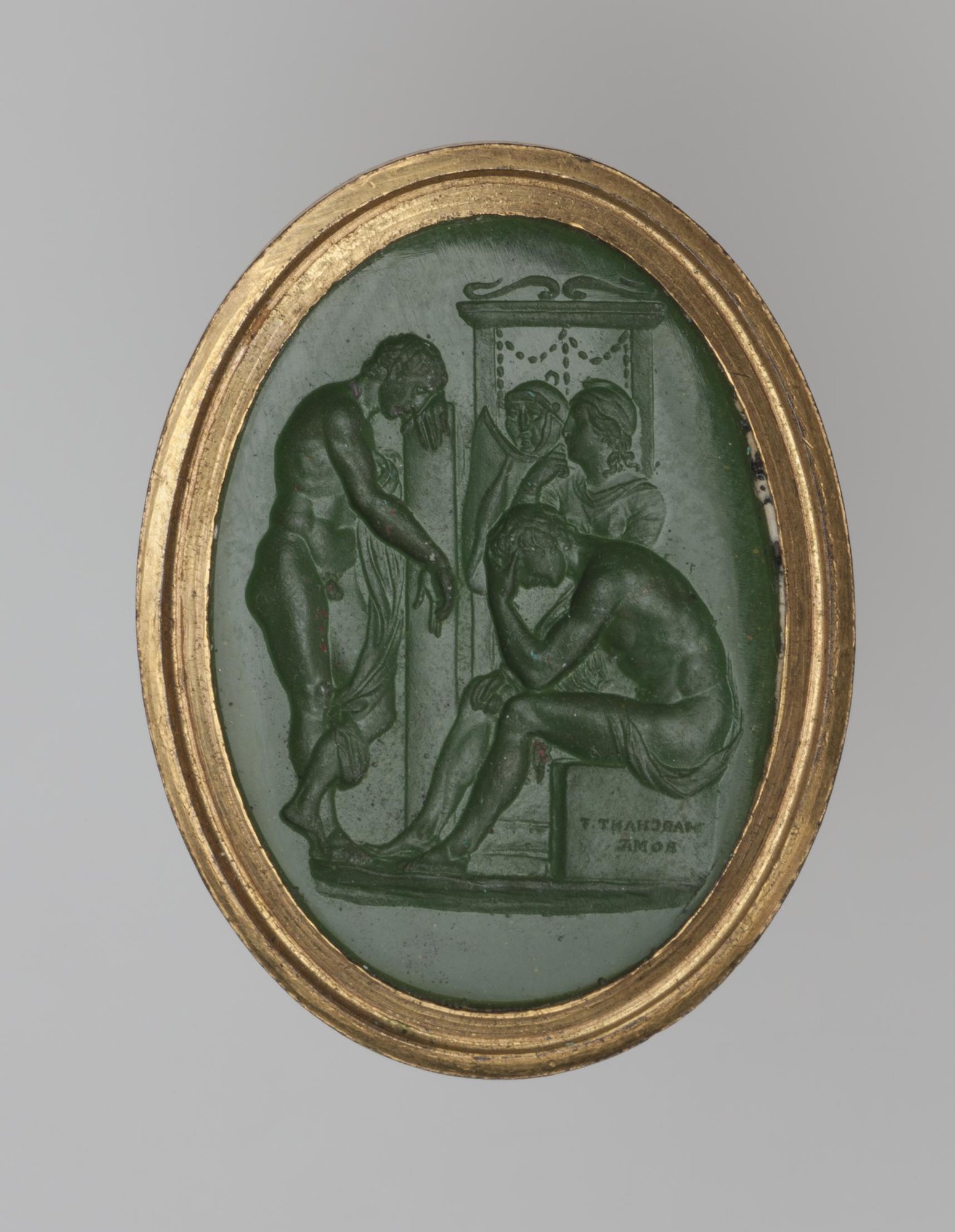
Imitation of Intaglio: Achilles Lamenting the Death of Patroclus. The State Hermitage Museum.
The object entered the Hermitage in 1928 from the collection of A. K. Rudanovsky. It is not currently on permanent display.
It is a small oval — 34 by 25 millimetres — of translucent green glass, set in a plain gold frame, with a scene pressed into its surface in intaglio. The glass is worn smooth at the edges, and the gold of the mount is thin.
The Object
The paste is a deep, slightly greyish green, polished to a soft shine and marked by fine scratches.
The scene is incised into the surface, so that it reads as a shallow relief in reverse: a standing nude man leaning on a staff, a seated man with his head bowed in grief, a display of armour on a stand, and a veiled woman behind.
The gold mount is simple: a plain oval band with a small loop at the top, made to hang or to be set into a frame. It is later than the paste, or at least simpler than the object it contains.
The Subject
The subject is drawn from the Iliad.
Achilles mourns Patroclus, his closest companion, killed in battle. The scene of the mourning hero — seated, head bowed, surrounded by the armour of the dead — is one of the most familiar images of classical grief.
The composition on the paste follows a known type: the hero seated in despair, the armour displayed, companions around him. It is the kind of subject that was popular in engraved gems because it combined a famous story with a strong, legible group.
Marchant
Nathaniel Marchant (1739–1816) was one of the most celebrated English gem engravers of the eighteenth century.
He trained in London, worked in Rome for several years, and returned to England, where he became engraver to the king. His intaglios and cameos were admired for their classical correctness and their refined cutting, and they were collected by connoisseurs across Europe.
Marchant’s subjects were often drawn from ancient gems and from classical literature. His work helped to shape the neoclassical taste of the period.
Paste and Reproduction
The object is not an original intaglio. It is a paste — a glass impression taken from an intaglio, or made in imitation of one.
Pastes were an important part of the gem trade. They allowed collectors to own a copy of a famous gem without paying for the original, and they allowed engravers to circulate their work. James Tassie in Scotland built a whole business on paste impressions of gems, and his catalogues were used by collectors across Europe.
A paste is therefore not a forgery. It is a reproduction, openly made and openly sold, and it preserves the image of an intaglio that may itself be lost.
The Gold Mount
The mount turns the paste into a wearable object.
A paste alone is a piece of glass; in a gold frame it becomes a jewel — a pendant, a brooch or a component of a larger piece. The simple oval band of this mount suggests a later setting, perhaps made when the paste entered a collection.
Mounts are often the least studied part of a gem, but they are essential to its history. They show how the object was worn, displayed or stored, and they can be dated by their style, which in this case is plain and sober.
Antique Gems and the Grand Tour
The taste for engraved gems was one of the defining passions of the eighteenth century.
Travellers on the Grand Tour bought gems in Rome and Naples; collectors assembled cabinets of them; and books of engravings reproduced the most famous pieces. Gems were admired for their antiquity, their craftsmanship and their portability.
A paste like this one belongs to that culture. It is a small, affordable, portable image of a classical subject — exactly what a collector of modest means might buy to feel part of the world of antiquities.
Green Glass
The green colour of the paste is worth noticing.
Ancient intaglios were often cut in green stones — emerald, plasma, prase — and the colour became associated with the classical gem. A paste in green glass was therefore a deliberate imitation, not only of a carving but of a material.
The colour also affects the way the image reads. The incised lines catch the light and appear lighter than the surrounding surface, so the scene seems to float in the green.
Intaglio and Impression
An intaglio is designed to be pressed, not simply looked at.
The image is cut into the stone in reverse, so that when the gem is pressed into wax or clay it leaves a raised impression — the correct way round. In antiquity, intaglios were seals; in the eighteenth century, they were collected for their impressions as much as for their surfaces.
A paste takes the impression directly. It is, in effect, a permanent record of what the intaglio would leave in wax — a way of preserving and circulating the image without the stone.
Copies and Originals
The distinction between a copy and an original is modern as much as ancient.
In the eighteenth century, copies were not shameful. Plaster casts, paste impressions and engravings were the normal means by which works of art circulated, and a collector might own a cabinet of casts and pastes alongside a few originals.
This object is a copy, and it is proud of it: the record describes it as an imitation. Its value lies in the image it preserves, and in the evidence it gives of how classical subjects travelled through Europe in the age of neoclassicism — and that is a kind of value in itself.
Grief in Miniature
The scene is a study in grief.
Achilles sits with his head bowed, his body heavy, his hands slack. The standing figure leans on a staff, watching him. The armour on its stand is a reminder of the dead friend and of the war that killed him.
In a gem, such a scene must be compressed into a few square centimetres, and the carver relies on silhouette and gesture rather than on detail. The result is a small, legible image of a large emotion — which is exactly what the classical tradition excelled at.
Provenance
The paste carries the inventory number I-11731. It entered the Hermitage in 1928 from the collection of A. K. Rudanovsky.
In the Hermitage
The object is preserved in the State Hermitage Museum in Saint Petersburg and is not on permanent display.
It is a copy of a copy — a glass impression after an intaglio, which was itself an interpretation of an ancient subject. And yet it is a complete work: a green oval, a gold frame and a scene of grief, small enough to hold between two fingers.