
Artist: Pierre-Philippe Thomire (1751–1843)
Organization: Workshop of Pierre-Philippe Thomire
Origin: France, Paris
Date: 1820s
Material: bronze
Technique: gilding
Dimensions: height 98 cm
Current Collection: The State Hermitage Museum
Inventory Number: Epr-927
Hermitage ID: 48976
Rudanovsky Connection: Entered the Hermitage in 1919 from the collection of A. K. Rudanovsky.
A gilt bronze candelabrum of the 1820s from the workshop of Pierre-Philippe Thomire, with a figure of the goddess of Victory.
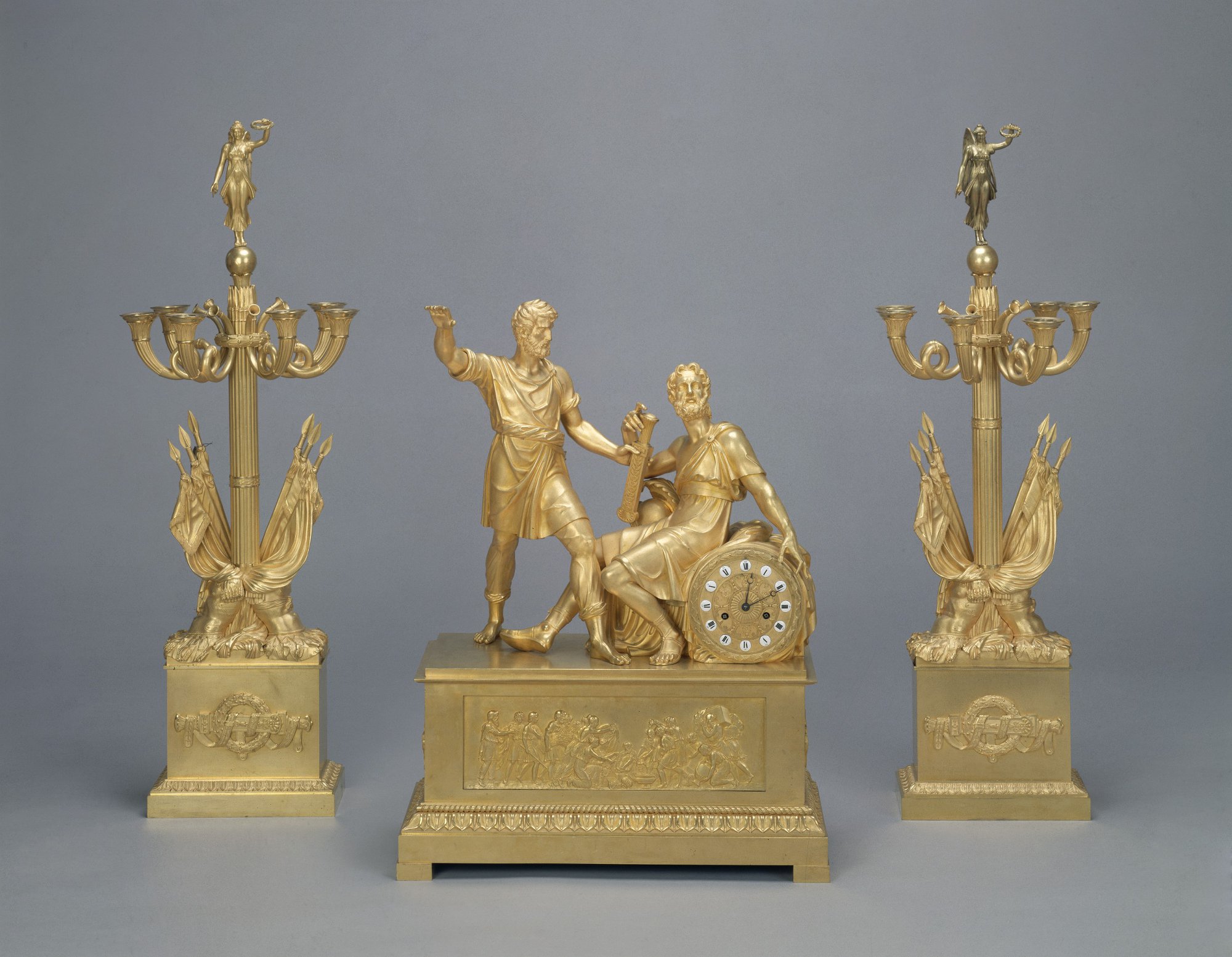
Candelabrum for 6 Candles with the Figure of the Goddess of Victory (Epr-927). The State Hermitage Museum.
The candelabrum entered the Hermitage in 1919 from the collection of A. K. Rudanovsky. It is on display in the General Staff Building, in room 318.
It is a tall gilt bronze object — 98 centimetres high — with six candle arms, military trophies at the base and a figure of Victory on top.
The Object
The candelabrum stands on a square plinth.
From the plinth rises a cluster of flags and standards, bound with cords and topped with eagles. Above them, a fluted column carries six candle arms, arranged in a circle.
On the top of the column, a small figure of Victory stands on a sphere, holding a wreath and a palm.
The Victory
The Victory is the candelabrum’s crowning figure.
She is a winged woman in a long robe, and she stands on a sphere, her arms raised. In one hand she holds a wreath, and in the other a palm branch.
Victory is a classical figure, and she turns the candelabrum into a monument: light, triumph and military glory, in a single object.
The Arms
The base is a cluster of military trophies.
Flags and standards are bound together with cords, and their staffs end in eagles. The flags hang in heavy folds, and their gilt surfaces catch the light.
Trophies of this kind are a feature of Empire and Restoration decoration: they celebrate military victory, and they give the object its patriotic character.
The Column
The column is fluted, and it rises from the trophies to the candle arms.
It is slender and tall, and it gives the candelabrum its height. Its surface is gilt, and it catches the light.
Columns of this kind are a classical element, and they connect the candelabrum to the architecture of antiquity.
The Plinth
The plinth is square and plain.
It is decorated with a wreath and a garland, and it is banded with mouldings. The plinth gives the object stability, and it turns it into a monument.
Plinths of this kind are a feature of Empire candelabra, and they give the object its formal character.
Thomire
Pierre-Philippe Thomire (1751–1843) was one of the greatest bronziers of his age.
He worked in Paris, and he supplied the French court and the European nobility with clocks, candelabra, vases and mounts. His work is characterised by fine chasing, rich gilding and classical subjects.
His workshop was among the most important of the Empire and Restoration periods.
The Ensemble
The candelabrum is one of a pair.
The two were made as part of an ensemble with a mantel clock representing Minin and Pozharsky, the Russian heroes of 1612. The clock and the candelabra were displayed together, on a mantelpiece or a console.
The ensemble is therefore a unit: a clock, two candelabra and a single programme of light and glory.
The Candle Arms
The candelabrum has six candle arms.
They curve out from the column in a circle, and each ends in a socket for a candle. Their forms are scrolls, and they are chased and gilded.
Six arms were a standard number for a large candelabrum: it gave a strong light, and it made a symmetrical ring of flames.
The Sphere
The Victory stands on a sphere.
It is a small gilt ball, and it represents the world. The goddess stands on it, as if she had conquered it.
The sphere is a classical symbol, and it gives the figure her meaning: victory over the world.
The Cords
The flags are bound with cords.
The cords are modelled as ropes, and they tie the standards together. They give the cluster its structure, and they suggest the discipline of an army.
Details of this kind are a feature of Thomire’s work: the bronze is chased to imitate rope, cloth and wood.
The Gilding
The candelabrum is gilded.
The gold covers the whole surface, and it is matte rather than bright. It was applied by fire gilding, a technique that fuses gold to bronze.
The gilding gives the object its richness, and it makes the bronze look like gold.
The Room
The candelabrum was made for a grand room.
It stood on a mantelpiece or a console, beside a clock and a mirror, and it lit the room with candles. Its height and its gold made it a centrepiece.
The room is gone, but the candelabrum still carries its scale.
The Collector
The candelabrum came to the Hermitage with the Rudanovsky collection.
Rudanovsky collected European applied art, and his collection included bronzes, clocks and candelabra as well as porcelain.
The candelabrum is therefore a double document: of Thomire’s workshop and of a Russian collector’s taste.
The Base
The base is the object’s weight.
The square plinth, the cluster of flags and the eagles are all heavy, and they hold the column and the candle arms steady. Without them, the candelabrum would be unstable.
The base is also the object’s image: it is a monument of trophies, and it carries the military meaning of the whole.
The Chasing
The bronze is chased.
The craftsman worked the surface with tools to model the cloth, the feathers, the cords and the leaves. Chasing is what turns a cast bronze into a sculpture.
The chasing here is fine and detailed, and it is one of the signs of Thomire’s workshop.
The Height
At 98 centimetres, the candelabrum is tall.
It was made to stand beside a clock on a mantelpiece, and its height matches the clock’s. The two objects form a vertical composition.
A candelabrum of this size is an architectural object: it needs a room of a certain height, and it was made for one.
The Clock’s Pair
The candelabrum’s pair stands on the other side of the clock.
The two are identical, and they were made to flank the clock on a mantelpiece. Together, they form a symmetrical composition of three objects.
A pair of candelabra and a clock was a standard arrangement in the nineteenth century, and it turned a mantelpiece into a small stage of time and light.
Provenance
The candelabrum carries the inventory number Epr-927. It entered the Hermitage in 1919 from the collection of A. K. Rudanovsky.
In the Hermitage
The candelabrum is on display in the General Staff Building, in room 318.
It is a magnificent object, and it preserves the art of French bronze: a Victory, six candles, a cluster of flags and a tall gilt column, made in Paris two centuries ago.
It is a machine for light, and it is also a monument: flags, eagles, a Victory and six flames, arranged in gold.
It has been lit by candles, by gas and by electricity, and it has never lost its Victory. Not once, in two hundred years, has it dropped a wreath. And it is still, in its way, victorious.