Artist: Pierre-Philippe Thomire (1751–1843)
Organization: Workshop of Pierre-Philippe Thomire
Origin: France, Paris
Date: 1820s
Material: bronze
Technique: gilding
Dimensions: height 98 cm
Current Collection: The State Hermitage Museum
Inventory Number: Epr-928
Hermitage ID: 48979
Rudanovsky Connection: Entered the Hermitage in 1919 from the collection of A. K. Rudanovsky.
The second of a pair of gilt bronze candelabra of the 1820s from the workshop of Pierre-Philippe Thomire, with a figure of the goddess of Victory.
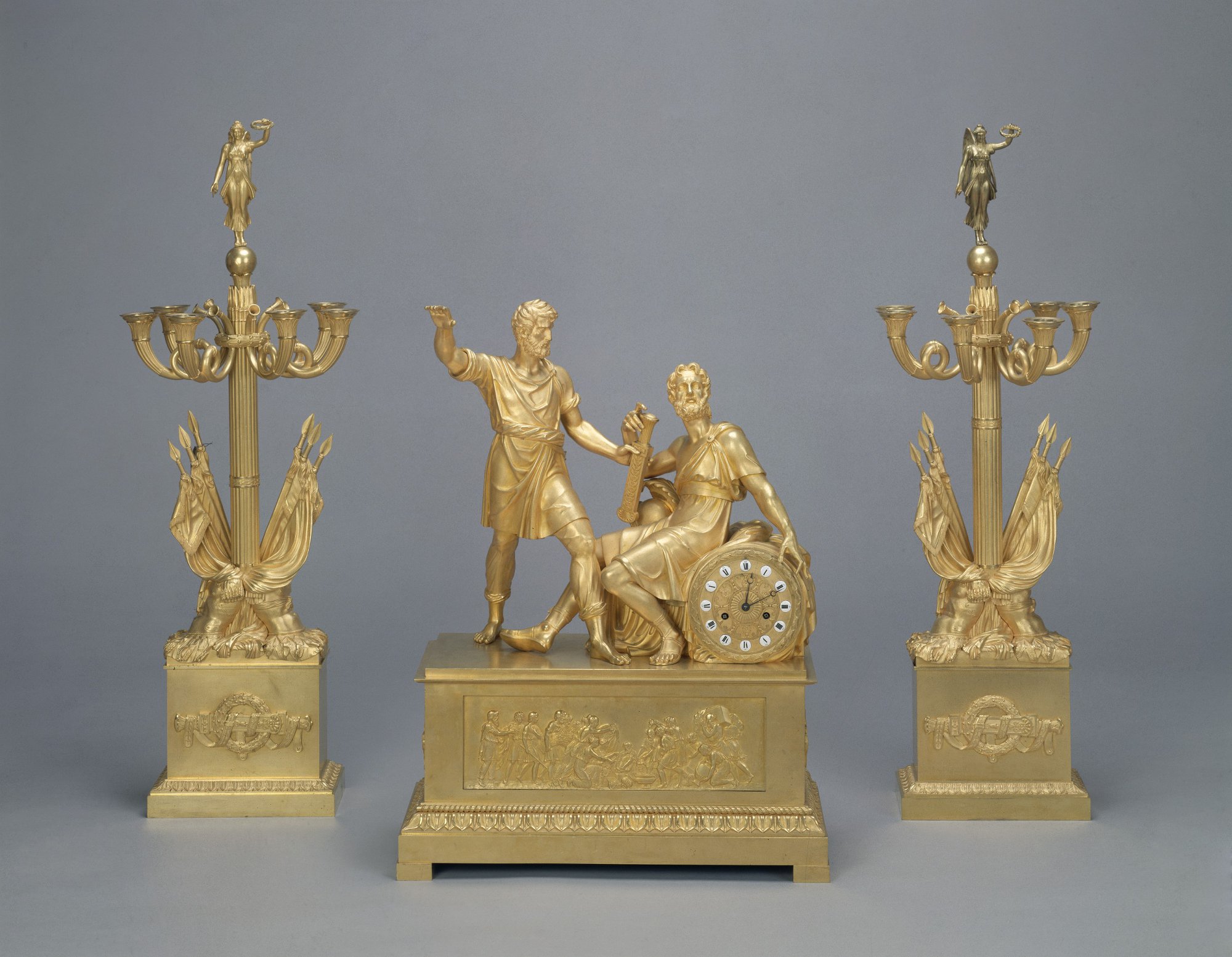
Candelabrum for 6 Candles with the Figure of the Goddess of Victory (Epr-928). The State Hermitage Museum.
The candelabrum was formerly in the collection of A. K. Rudanovsky. It is on display in the General Staff Building, in room 318.
It is the pair of another candelabrum in the collection, and together they flank a mantel clock representing Minin and Pozharsky.
The Object
The candelabrum stands on a square plinth.
From the plinth rises a cluster of flags and standards, topped with eagles; above them, a fluted column carries six candle arms; on the top, a small Victory stands on a sphere, holding a wreath and a palm.
It is identical in form to its pair, and the two were made together.
The Pair
The candelabrum is one of a pair.
Pairs of candelabra were a standard element of grand interiors: they flanked a clock, a mirror or a console, and they provided symmetry and light. Their forms and decorations mirror each other.
A pair is more than two objects: it is a composition, and it was designed as such.
The Clock
The pair flanks a mantel clock.
The clock represents Minin and Pozharsky, the Russian heroes who led the national militia against the Polish intervention in 1612. One figure stands, the other sits, and the dial is set into the base.
The clock and the candelabra form an ensemble, and they were displayed together on a mantelpiece.
Minin and Pozharsky
Kuzma Minin and Dmitry Pozharsky were the leaders of the Russian militia of 1612.
They raised an army in Nizhny Novgorod, marched on Moscow and helped to end the Polish occupation. They became symbols of Russian patriotism, and their monument stands in Red Square.
The clock, made in Paris, was a French image of Russian heroism, and it was probably made for the Russian market.
The Symmetry
The pair is symmetrical.
The two candelabra are identical, and they are placed at equal distances from the clock. Their flags, columns and Victories mirror each other, and the ensemble forms a triangle.
Symmetry of this kind is a feature of Empire and Restoration interiors: it creates order, balance and dignity.
The Candlelight
The candelabra were made for candlelight.
Each held six candles, and together they gave twelve points of light around the clock. Their gilt bronze reflected the flames, and their Victory figures shone in the dark.
In a museum, the candelabra are lit by electricity, but they were made for fire.
Thomire
Pierre-Philippe Thomire (1751–1843) was one of the greatest bronziers of his age.
He worked in Paris, and he supplied the French court and the European nobility with clocks, candelabra, vases and mounts. His work is characterised by fine chasing, rich gilding and classical subjects.
The candelabra are a good example of his workshop’s production.
The 1820s
The candelabra are dated to the 1820s.
It was the period of the Restoration in France, when the Bourbon monarchy had returned and the decorative arts flourished. The Empire style continued, with its classical forms and military trophies.
The candelabra belong to that moment, and they show the taste of the period.
The Flags
The flags hang in heavy folds.
They are modelled in bronze, and they imitate cloth: their edges curl, their surfaces are chased, and their colours are the colour of gold.
Flags of this kind are a feature of military trophies: they represent the standards captured from an enemy, and they give the object its patriotic charge.
The Eagles
The staffs end in eagles.
They are small, gilt eagles, with spread wings, and they are modelled in the round. They top the standards, and they give the cluster its heraldic character.
Eagles are the emblem of empire, and their presence turns the candelabrum into a symbol of power.
The Dial
The clock’s dial is set into the base.
It is a small circular face, with Roman or Arabic numerals and two hands, and it is surrounded by gilt ornament. The dial is the clock’s function, and it anchors the ensemble.
The clock and the candelabra belong together: the dial tells the time, and the candles light it.
The Room
The ensemble was made for a grand room.
It stood on a mantelpiece, between mirrors and under a chandelier, and it was part of the decoration of a palace or a mansion. Its gold and its flags made it a statement.
The room is gone, but the ensemble still carries its scale and its programme.
The Collector
The candelabrum came to the Hermitage with the Rudanovsky collection.
Rudanovsky collected European applied art, and his collection included bronzes, clocks and candelabra as well as porcelain.
The candelabrum is therefore a double document: of Thomire’s workshop and of a Russian collector’s taste.
The Base
The base is the object’s weight.
The square plinth, the cluster of flags and the eagles are all heavy, and they hold the column and the candle arms steady. Without them, the candelabrum would be unstable.
The base is also the object’s image: it is a monument of trophies, and it carries the military meaning of the whole.
The Chasing
The bronze is chased.
The craftsman worked the surface with tools to model the cloth, the feathers, the cords and the leaves. Chasing is what turns a cast bronze into a sculpture.
The chasing here is fine and detailed, and it is one of the signs of Thomire’s workshop.
The Pair’s History
The two candelabra were separated in the record: one entered the Hermitage with an inventory number, the other as part of a family collection.
They are now displayed together, with their clock, and the ensemble has been restored to its original arrangement.
The Bronze
The candelabrum is made of bronze.
Bronze is an alloy of copper and tin, and it was used for clocks, candelabra and mounts because it is strong, takes fine detail and can be gilded. The casting of a complex form like this one required a skilled foundry.
The bronze is gilded by fire, a technique that fuses gold to the metal and gives it a rich, durable surface.
Provenance
The candelabrum carries the inventory number Epr-928. It was formerly in the collection of A. K. Rudanovsky.
In the Hermitage
The candelabrum is on display in the General Staff Building, in room 318.
It is a magnificent object, and it is also half of a composition: a Victory, six candles, a cluster of flags and a clock of Russian heroes, arranged for a mantelpiece two centuries ago.
It is half of a composition, and it has been waiting for its clock and its pair for two hundred years.
It is a small monument to symmetry, and it is still symmetrical. And it is still waiting, patiently, on its side of the clock. The clock, after all, has kept the time for both of them.